What Are the Hip Extensors?
The hip extensors are a group of muscles that move the thigh backward relative to the pelvis. They are heavily involved whenever you stand up from a chair, climb stairs, run, jump, or straighten your body after bending forward. These muscles also help control the pelvis and contribute to stability during everyday movement and athletic activity.
Hip extension occurs when the angle between the front of your thigh and torso increases. For example, when your leg moves behind you during walking, the hip is extending. The same action occurs when you drive your hips forward while rising from a squat or completing a hip-hinge movement such as a deadlift.
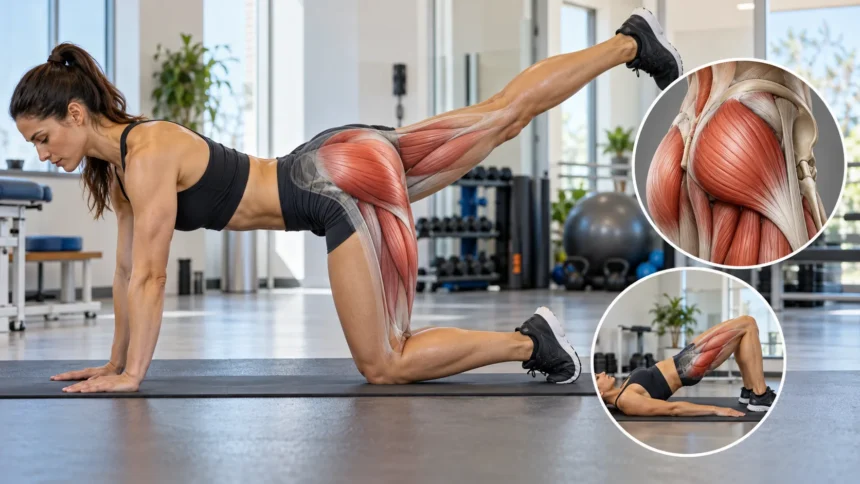
The main hip extensors include the gluteus maximus and the hamstring muscles, with additional assistance from other surrounding muscles depending on the position of the hip and knee. These muscles work together rather than functioning completely independently. Understanding their roles can make strength training, mobility work, and movement technique easier to understand.
Gluteus Maximus and Hip Extension
The gluteus maximus is the largest muscle in the buttock and one of the strongest hip extensors in the body. It originates from parts of the pelvis and sacral region and attaches to the upper femur and connective tissue along the thigh. Its size and position allow it to generate significant force during powerful hip-extension movements.
The gluteus maximus becomes particularly active when moving from a flexed hip position toward standing. Actions such as rising from a deep squat, sprinting, climbing a steep hill, or lifting something from the floor require substantial gluteal contribution. It also assists with outward rotation of the hip and contributes to overall pelvic stability.
Although the gluteus maximus is powerful, it does not need to contract maximally during every step you take. Lower-intensity activities involve coordinated work between several muscles. The gluteus generally contributes more as the physical demand increases, which is why exercises involving resistance, speed, or deeper hip flexion can challenge it effectively.
Hamstrings as Hip Extensor Muscles
The hamstrings are located along the back of the thigh and include the semitendinosus, semimembranosus, and biceps femoris. Most of these muscles cross both the hip and knee joints. Because of this arrangement, they can contribute to hip extension while also helping bend the knee during walking, running, and other movements.
When your leg moves backward behind your body, the hamstrings assist the gluteus maximus in extending the hip. They also help control the leg during running and deceleration. Their contribution can change depending on how much the knee is bent because crossing two joints means their muscle length changes with both hip and knee position.
The hamstrings are especially important during hip-hinge exercises such as Romanian deadlifts and good mornings. These movements lengthen the hamstrings while the hips move backward and then require them to help extend the hips again. Good technique and gradual loading are important because sudden increases in sprinting or resistance training can place considerable stress on these muscles.
Other Muscles That Assist Hip Extension
Although the gluteus maximus and hamstrings perform most of the hip-extension work, several other muscles can contribute. Portions of the adductor magnus, particularly its posterior fibers, can assist in extending the hip. This muscle is located along the inner thigh and contributes differently depending on the position and direction of movement.
Smaller hip and trunk muscles also support the movement indirectly by stabilizing the pelvis. Without adequate pelvic control, the powerful hip extensors may not transfer force as efficiently. Muscles around the abdomen, lower back, hips, and thighs therefore work together to create stable movement during walking, lifting, running, and changing direction.
This coordinated action explains why hip extension should not be viewed as the job of one isolated muscle. Strong movement patterns depend on several tissues contributing at the right time. Training that includes both hip extension and general lower-body strength can help build better coordination than focusing exclusively on one muscle group.
How Hip Extensors Work During Walking
During walking, the hip extensors help control the position of the trunk and pelvis as your foot contacts the ground. They contribute to stabilizing the body and preventing excessive forward movement at the hip. Their activity changes throughout the walking cycle rather than remaining constantly high from one step to the next.
As your body moves forward, the leg eventually travels behind the pelvis, creating hip extension. At this stage, the muscles must coordinate with the hip flexors, calf muscles, and other structures to maintain smooth movement. Normal walking therefore depends on a sequence of muscle actions rather than a single powerful hip-extension contraction.
Weakness, pain, or reduced confidence in one area may influence the way someone walks, but movement patterns are complex and individual. A person may shorten their stride, move more slowly, or rely differently on nearby muscles. Strengthening the hip extensors can support walking capacity, although exercise selection should reflect the person’s overall needs.
Why Hip Extensors Matter for Running and Sports
Running requires considerably more force than ordinary walking, which increases the demand placed on the hip extensors. The gluteus maximus and hamstrings help drive the body forward and contribute to controlling the leg during each stride. Faster running and sprinting generally require greater force production from these muscles.
Jumping, accelerating, climbing, and changing direction also rely heavily on powerful hip extension. Athletes use the hips to transfer force from the lower body into the ground and through the rest of the body. Strong hip extensors can therefore contribute to movements used in football, basketball, track, weightlifting, and many other sports.
Strength alone is not the only important factor. Timing, coordination, tendon capacity, technique, and overall conditioning also influence athletic performance. An effective training program usually develops several qualities together instead of assuming that simply making one muscle stronger will automatically improve every type of sporting movement.
Hip Extensors and Posture
The hip extensors contribute to control of the pelvis, which influences how the trunk and legs are positioned during standing and movement. However, posture is affected by many factors, including anatomy, habits, comfort, fatigue, and task demands. There is no single perfect pelvic position that everyone needs to maintain throughout the day.
When standing up from a bent position, the hip extensors help bring the pelvis and trunk back toward upright. They also work during tasks that require you to resist being pulled forward. This makes them important for everyday movements such as lifting groceries, picking objects up, gardening, and transitioning from sitting to standing.
Weakness may make some of these activities feel harder, but posture should not be judged solely by how strong the glutes are. Mobility, trunk strength, pain, and movement habits all matter. Strengthening the hip extensors can support functional movement without requiring you to constantly squeeze the glutes or hold your pelvis rigidly.
Best Exercises for Hip Extensor Strength
Glute bridges are one of the simplest exercises for learning hip extension. Lie on your back with your knees bent, press through your feet, and lift your hips until your body forms a comfortable line from shoulders to knees. Avoid excessively arching your lower back or pushing higher than you can control comfortably.
Hip hinges, Romanian deadlifts, and squats can provide greater resistance as strength improves. These exercises train the glutes and hamstrings while integrating them with other lower-body and trunk muscles. Start with manageable resistance and prioritize controlled movement before increasing weight, speed, or total training volume.
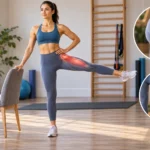
Single-leg exercises can add another challenge by requiring greater balance and hip control. Split squats, step-ups, and standing leg raises may be included in a broader lower-body routine depending on your goals. Using different movement patterns helps train the hips through varied positions rather than relying on one exercise exclusively.
Hip Extension During Squats and Deadlifts
Squats involve both hip and knee movement. As you lower yourself, the hips flex and the muscles around the hips control the descent. During the upward phase, the gluteus maximus and other hip extensors help drive the hips forward while the quadriceps simultaneously extend the knees.
Deadlifts place even greater emphasis on the hip-hinge pattern. The hips move backward while the spine remains controlled, and the hamstrings and glutes lengthen under load. During the lifting phase, these muscles generate force to extend the hips and return the body toward an upright position.
Neither exercise requires aggressively squeezing the glutes for several seconds at the top. Once the hips are fully extended, maintaining a stable standing position is generally enough. Overextending the lower back in an attempt to achieve more hip extension can shift unnecessary stress away from the intended muscles and reduce movement quality.
Signs of Weak or Undertrained Hip Extensors
Undertrained hip extensors may become noticeable when activities such as climbing stairs, rising from low chairs, running, or lifting feel more difficult than expected. Someone may also notice that they fatigue quickly during bridges, hinges, or squats. However, difficulty with these movements does not prove that one specific muscle is weak.
Strength should ideally be evaluated through movement and resistance testing rather than appearance or assumptions about posture. Pain, joint stiffness, fear of movement, or poor technique can also make a person appear weak during certain exercises. A broader assessment provides more useful information than simply deciding that the glutes are “inactive.”
If you suspect weakness, gradually increasing lower-body resistance training is usually more practical than trying to consciously activate the glutes all day. Muscles adapt when they are challenged consistently and given enough recovery. Progressive strengthening can improve capacity while also building confidence in movements that previously felt difficult.
Hip Extensor Tightness and Mobility
People sometimes describe the back of the hips or thighs as tight, particularly after long periods of sitting or demanding exercise. This sensation does not always mean the muscles are physically shortened. Fatigue, soreness, reduced movement variety, or sensitivity can all create a feeling of tightness without a true loss of muscle length.
Gentle stretching and mobility work may feel useful when the hips or hamstrings feel restricted. Hip flexion stretches for the hamstrings and comfortable lower-body movement can temporarily improve flexibility. Avoid forcing stretches through sharp pain, tingling, or nerve-like sensations, especially when discomfort travels down the leg.
Mobility and strengthening do not need to be treated as competing approaches. Many people benefit from using comfortable movement to maintain range while progressively strengthening the muscles through that range. Combining both methods can support useful flexibility without relying entirely on passive stretching to manage every sensation of tightness.
How to Strengthen Hip Extensors Safely
Begin with exercises you can perform with good control and without significant pain. Bodyweight bridges, sit-to-stands, and light hip hinges may be useful starting points for beginners. Once these movements become comfortable, resistance can be gradually increased using dumbbells, barbells, resistance bands, machines, or more challenging single-leg variations.
Progress training slowly enough that your muscles and tendons have time to adapt. Sudden increases in sprinting, deadlifting, hill running, or high-volume lower-body workouts can create excessive soreness or strain. Consistent increases in resistance, repetitions, or exercise difficulty are generally more effective than occasional sessions that leave you extremely fatigued.
Recovery also matters because muscle adaptation occurs between training sessions. Adequate sleep, nutrition, and appropriate spacing between hard workouts can support progress. Persistent sharp pain, major weakness, bruising, or symptoms that interfere with walking should not be treated as ordinary exercise soreness and may require professional evaluation.
Everyday Activities That Use the Hip Extensors
You use your hip extensors throughout daily life even when you are not exercising. Standing up from a chair, climbing stairs, walking uphill, picking something up, and stepping onto a curb all involve hip extension. The amount of muscle effort required depends on the load, movement speed, and position of the body.
Activities that require more force place greater demand on these muscles. Carrying a heavy object upstairs or rising from a very low seat may challenge the glutes and hamstrings more than ordinary walking. This is one reason resistance training can make daily tasks feel easier by increasing the amount of force your muscles can comfortably produce.
Maintaining general physical activity also gives the hip extensors regular opportunities to work. Walking, recreational sports, hiking, and strength training can all contribute to lower-body capacity. You do not need complicated exercises to keep these muscles active, but progressive resistance is useful when the specific goal is increasing strength.
Conclusion
The hip extensors are a powerful group of muscles responsible for moving the thigh backward and helping the body return from a flexed hip position. The gluteus maximus and hamstrings perform much of this work, while the adductor magnus and surrounding stabilizers provide additional assistance during different movements.
These muscles are involved in everything from walking and standing up to sprinting, jumping, squatting, and lifting. Their function depends on coordination with the trunk, knees, and other hip muscles rather than isolated strength alone. Training multiple movement patterns can therefore provide a more balanced approach to hip function.
Exercises such as bridges, squats, deadlifts, step-ups, and hip hinges can help develop hip-extensor strength when progressed appropriately. Focus on controlled technique and gradual increases in difficulty instead of chasing fatigue. Strong, well-conditioned hip extensors can support everyday mobility, athletic movement, and overall lower-body capacity.
FAQs
What are the main hip extensor muscles?
The main hip extensors are the gluteus maximus and hamstrings. The posterior portion of the adductor magnus can also assist hip extension depending on the position of the hip and movement being performed.
What movement do the hip extensors perform?
Hip extensors move the thigh backward relative to the pelvis and help straighten the body from a flexed hip position. They are active during standing, stair climbing, running, jumping, squatting, and lifting.
What is the best exercise for hip extensors?
There is no single best exercise for everyone. Bridges, hip thrusts, squats, Romanian deadlifts, step-ups, and other hip-hinge movements can all effectively train the hip extensors when performed with appropriate resistance.
Can weak hip extensors affect walking?
Reduced hip-extensor strength can make some walking and stair-climbing tasks more demanding. However, walking patterns are influenced by many factors, so noticeable difficulty should not automatically be blamed on weak glutes alone.
How often should you train the hip extensors?
Training frequency depends on exercise intensity, experience, and recovery. Many strength programs train major lower-body muscles multiple times per week while allowing enough recovery between demanding sessions to maintain good performance.