Standing leg raises are a simple lower-body exercise that can strengthen the hips, thighs, and supporting muscles while also challenging balance. Because they require little or no equipment, they can be performed at home, in the gym, or during short movement breaks. Several variations allow you to target different muscle groups depending on the direction in which you raise the leg.
Although standing leg raises look straightforward, technique matters. Leaning excessively, swinging the leg, or lifting higher than you can comfortably control may reduce the effectiveness of the exercise. Learning proper form, choosing the right variation, and progressing gradually can help you build strength while keeping the movement comfortable and controlled.
What Are Standing Leg Raises?
Standing leg raises involve lifting one leg while the other remains planted on the floor. Depending on whether you move the leg forward, backward, or sideways, the exercise can emphasize the hip flexors, glutes, outer hip muscles, or other lower-body stabilizers. The standing leg also works continuously to maintain balance and support your body.
Unlike lying leg raises, the standing version places greater demand on coordination and single-leg stability. Your ankle, knee, hip, and core must work together to keep the body upright while the moving leg travels through its range. This makes the exercise useful for strengthening muscles while also practicing balance during a functional standing position.
Standing leg raises can be performed using body weight or with added resistance from ankle weights, cables, or resistance bands. Beginners can hold a wall, countertop, or sturdy chair for support. As balance and strength improve, you can gradually reduce assistance or introduce additional resistance without changing the basic movement pattern.
Muscles Worked During Standing Leg Raises
The muscles targeted depend heavily on the direction of the leg raise. Raising the leg forward primarily activates the hip flexors and quadriceps, while lifting it backward places greater emphasis on the gluteus maximus and muscles around the back of the hip. Sideways raises mainly challenge the gluteus medius and other hip abductor muscles.
The standing leg also performs important work during every repetition. Muscles around the hip, thigh, ankle, and foot help maintain alignment and prevent unnecessary wobbling. Your gluteus medius is particularly important because it helps keep the pelvis stable when your weight is supported on only one leg.
Core muscles contribute as well by controlling the trunk during movement. If the torso leans dramatically to compensate for a weak or tired hip, the target muscles may do less work. Keeping your body relatively tall encourages better control and turns standing leg raises into a useful exercise for both lower-body strength and stability.
How to Do Standing Leg Raises Correctly
Begin by standing beside a stable chair, wall, or countertop. Place your feet about hip-width apart and maintain a comfortable upright posture with your shoulders relaxed. Lightly hold the support surface rather than gripping it tightly, and shift your weight onto one leg while keeping a small bend in the standing knee.
Slowly lift the opposite leg in the desired direction without using momentum. Move only as far as you can while keeping your pelvis and torso controlled. Pause briefly at the top, then lower the leg slowly until your foot nearly reaches the floor before beginning the next repetition.
Complete eight to fifteen repetitions before switching sides, depending on your strength and experience. One to three sets can be appropriate for many beginners, although the exact amount should match your overall training routine. Smooth, controlled repetitions are more important than trying to lift the leg extremely high.
Standing Side Leg Raises
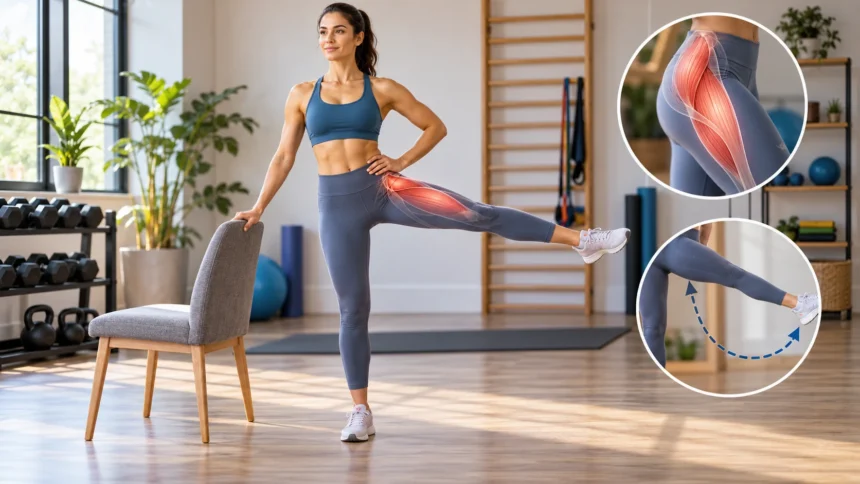
Side leg raises primarily strengthen the hip abductors, including the gluteus medius. Stand tall while holding a support surface, then shift your weight onto one leg. Keep the toes of the moving leg facing mostly forward as you slowly raise that leg out to the side.
Avoid leaning your torso in the opposite direction to create extra height. A smaller movement performed with good control usually challenges the outer hip more effectively than a high swing combined with body movement. Keep the standing knee soft and lower the raised leg slowly instead of letting it drop.
This variation can be particularly useful for developing hip stability needed during walking, stair climbing, and single-leg activities. Stronger lateral hip muscles may also improve control of the pelvis and knee. Resistance bands can eventually be added around the thighs or ankles once bodyweight repetitions become easy.
Standing Front Leg Raises
Front leg raises emphasize the hip flexors while also involving the quadriceps and core. Begin in the same supported standing position and slowly lift one straight or slightly bent leg in front of your body. Keep your spine comfortable and avoid leaning backward to create additional range.
The leg does not need to reach waist height for the exercise to be effective. Lift only until you can maintain steady posture without swinging or arching your lower back. Pause for a moment, then lower the leg gradually while maintaining control through the entire repetition.
People who spend many hours sitting may notice that their hip flexors fatigue quickly during this variation. Start with a modest number of repetitions rather than forcing a large range. Strength develops gradually, and better control is more useful than trying to achieve the highest possible leg position.
Standing Back Leg Raises
Standing back leg raises target the gluteus maximus and other muscles around the back of the hip. Hold a sturdy support, maintain an upright torso, and slowly move one leg behind you. Keep the knee straight or slightly bent while focusing on creating the movement from the hip.
A common mistake is arching the lower back instead of extending the hip. If your torso tips forward or your back begins to compensate, reduce how far you move the leg. The glutes can still work effectively through a relatively small range when the movement remains controlled.
You may feel the muscles in the buttocks working during the exercise, but you should not experience sharp lower-back pain. Gradually increase repetitions or add resistance as your strength improves. Standing back leg raises can pair well with bridges, squats, and other glute-strengthening exercises in a balanced routine.
Benefits of Standing Leg Raises
Standing leg raises can strengthen several muscles involved in everyday lower-body movement. Hip flexors help move the leg forward, glutes support hip extension, and outer hip muscles help stabilize the pelvis. Training these muscles can support activities such as walking, climbing stairs, changing direction, and getting in or out of a vehicle.
Another benefit is improved balance. Standing on one leg requires continuous adjustments from the muscles around the ankle, knee, hip, and core. Using light hand support allows beginners to practice this skill safely while still gaining the benefits of single-leg loading and controlled movement.
The exercise is also convenient and easy to modify. It requires minimal space and can be performed with no equipment, making it practical for home workouts or movement breaks. More advanced exercisers can add resistance bands, ankle weights, or cables to increase the challenge without completely changing the exercise.
Common Mistakes to Avoid
Swinging the leg is one of the most common mistakes during standing leg raises. Momentum may allow you to move higher, but it reduces muscle control and can make the exercise less effective. Slowing both the lifting and lowering phases creates more consistent muscular effort and helps you notice when your form starts to change.
Leaning the torso excessively is another common problem. People often shift their body in the opposite direction to compensate when the hip muscles become tired. Holding a support surface lightly and using a smaller movement range can help you maintain better alignment without sacrificing the exercise’s intended purpose.
Another mistake is progressing resistance too quickly. Heavy ankle weights or tight bands can cause you to shorten the movement, lose balance, or rely on momentum. Build strength with bodyweight repetitions first, then add resistance gradually once you can complete your chosen range with steady technique.
How to Make Standing Leg Raises Easier or Harder
Beginners can make standing leg raises easier by using both hands on a countertop or sturdy chair. A smaller movement range can also reduce the strength and balance demands. Start with fewer repetitions and allow enough rest between sets if the standing hip or ankle becomes fatigued.
As the exercise becomes easier, reduce how much support you use. Progress from two hands to one hand, then perhaps to fingertip support before attempting unsupported repetitions. This increases the balance challenge without requiring additional weight and allows the standing leg to work harder to stabilize your body.
For greater muscular difficulty, add a resistance band, ankle weight, or cable attachment. You can also slow the lowering phase or pause longer at the top of each repetition. Progress only one variable at a time so you can maintain control and determine how your body responds to the increased demand.
Safety Tips and When to Modify the Exercise
Standing leg raises should feel like controlled muscular work rather than sharp joint pain. If you experience significant hip, knee, ankle, or back discomfort, reduce the movement range or stop the exercise. Pain that becomes stronger with each repetition is a reason to reassess rather than continue simply to finish the set.
Balance problems can also affect exercise safety. Perform the movement near a stable support, especially if you are new to single-leg exercises or recovering from inactivity. If you develop unexplained sudden ankle pain, address the ankle symptoms separately before increasing single-leg loading or resistance.
People recovering from surgery, fractures, major ligament injuries, or other significant conditions should follow an individualized rehabilitation plan. A physical therapist or healthcare professional can help determine whether standing leg raises are appropriate and how much resistance to use. Modifying an exercise is often more useful than forcing a standard version that does not match your current ability.
How to Add Standing Leg Raises to Your Routine
Standing leg raises can be used as part of a warm-up, lower-body strength session, or short balance routine. You might perform one or two sets in each direction before more demanding exercises. This can activate the hips while giving you a chance to assess how your legs feel before progressing to heavier movements.
They can also be combined with squats, calf raises, bridges, step-ups, and walking to create a more complete lower-body program. Each exercise challenges the muscles differently, which helps build broader strength and movement capacity. Relying on only one leg-raise variation may leave other important movement patterns undertrained.
Most people do not need to perform standing leg raises every day to benefit from them. Two to four sessions per week may be enough depending on training intensity and recovery. Consistency, gradual progression, and good technique usually matter more than trying to complete a very high number of repetitions.
Conclusion
Standing leg raises are a practical exercise for strengthening the hips, thighs, glutes, and supporting muscles while also challenging balance. Moving the leg forward, backward, or sideways allows you to emphasize different muscle groups. The exercise can be adapted easily for beginners as well as people looking for greater resistance.
Proper technique involves standing tall, using support when needed, and moving the leg slowly without excessive swinging or leaning. A controlled range is more valuable than lifting the leg as high as possible. As strength improves, you can gradually increase repetitions, reduce hand support, or introduce additional resistance.
Pay attention to how your hips, knees, ankles, and back respond during the exercise. Mild muscular fatigue is expected, but sharp or worsening pain should not be ignored. When performed consistently and appropriately, standing leg raises can become a useful part of a balanced lower-body strength and mobility routine.
FAQs
What muscles do standing leg raises work?
Standing leg raises can target the hip flexors, quadriceps, glutes, and outer hip muscles depending on the direction of movement. The standing leg and core also work to maintain balance and stability.
How many standing leg raises should I do?
Beginners can usually start with eight to fifteen repetitions per side for one to three sets. Adjust the amount based on your strength, exercise experience, and ability to maintain controlled form.
Are standing leg raises good for balance?
Yes. Supporting your body on one leg challenges the ankle, hip, and core muscles involved in balance. Beginners can hold a stable surface and gradually reduce support as their confidence improves.
Can standing leg raises help strengthen the hips?
Yes. Different standing leg raise variations strengthen several muscles around the hips, including the hip flexors, gluteus maximus, and gluteus medius. Using multiple directions provides more balanced hip strengthening.
Should I use ankle weights for standing leg raises?
Ankle weights can increase difficulty once bodyweight repetitions become easy and controlled. Begin with light resistance and avoid weights that cause swinging, leaning, joint pain, or loss of balance.