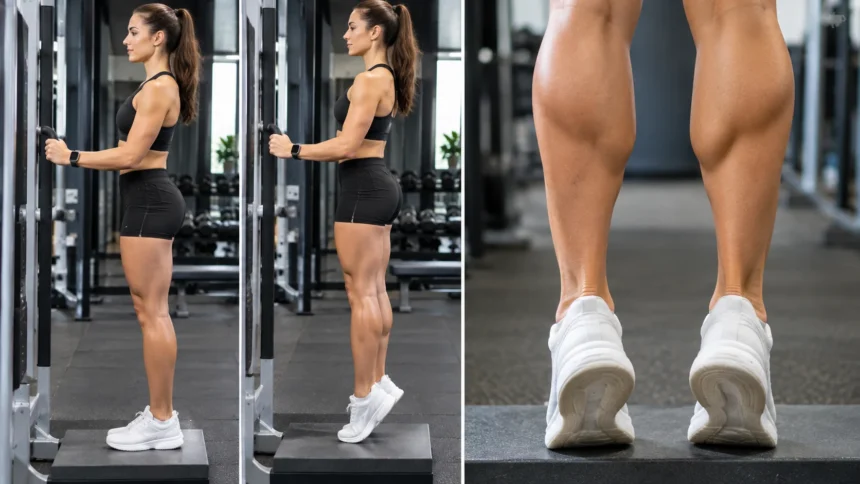
Calf raises are simple lower-body exercises that help strengthen the muscles at the back of your lower legs. They involve lifting your heels while keeping the front of your feet supported on the ground. This movement improves calf muscle strength, supports ankle stability, and makes everyday activities such as walking and climbing stairs easier.
One of the biggest advantages of a calf raise is its flexibility. You can perform this exercise at home, at the gym, or in a rehabilitation setting with appropriate guidance. It requires little equipment, making it accessible to beginners and people who want to improve their lower-body strength.
However, proper calf raise form is important for getting the most from the movement. Poor technique, excessive resistance, or rushing through repetitions can reduce effectiveness and cause discomfort. This guide explains how to perform calf raises correctly, their main benefits, common mistakes, variations, and practical tips for building stronger calf muscles.
What Is a Calf Raise Exercise?
A calf raise is a strength-training exercise that targets the muscles responsible for lifting your heels off the ground. The movement involves pushing through the front of your feet while raising your heels in a controlled manner. It primarily works the calf muscles and helps develop strength around the ankle joint.
Calf raises are commonly included in lower-body workouts, sports conditioning programs, and physical therapy routines. They can be performed while standing, sitting, or using gym equipment. Each variation changes how the calf muscles are challenged and can support different training goals.
The exercise is suitable for many fitness levels because its difficulty can be adjusted. Beginners may start with supported bodyweight calf raises, while experienced individuals can gradually add resistance. The most important factor is maintaining controlled movement and choosing a variation that matches your current ability.
What Muscles Do Calf Raises Work?
Calf raises primarily target two important lower-leg muscles: the gastrocnemius and the soleus. These muscles work together to produce plantar flexion, the movement that points your foot downward. They play an essential role in walking, running, jumping, and maintaining stability during everyday movement.
The gastrocnemius is the larger, more visible calf muscle that crosses both the knee and ankle joints. It contributes strongly to movements involving ankle extension, especially when the knee remains relatively straight. Standing calf raises place considerable emphasis on this muscle while also working other supporting muscles.
The soleus lies underneath the gastrocnemius and contributes to ankle movement and postural control. Because it does not cross the knee joint, it remains especially important during bent-knee calf exercises. Seated calf raises are commonly used to emphasize the soleus while strengthening the overall calf muscle group.
How to Do a Standing Calf Raise Correctly
Begin by standing upright with your feet approximately hip-width apart on a stable, flat surface. Keep your knees comfortably straight without locking them and distribute your weight evenly across both feet. If necessary, place one hand against a wall or sturdy support to maintain balance throughout the exercise.
Slowly lift your heels by pushing through the balls of your feet until you reach a comfortable height. Keep your body upright and avoid rolling your ankles inward or outward. Pause briefly near the top of the movement while maintaining control and allowing your calf muscles to do the work.
Lower your heels gradually until they return to the floor. Avoid dropping suddenly or using momentum to begin the next repetition. Repeat the movement for a manageable number of repetitions, focusing on smooth technique rather than speed or reaching a specific performance target.
Benefits of Calf Raises for Lower-Body Strength
One of the main benefits of calf raises is improving strength in the muscles that support ankle movement. Strong calf muscles contribute to everyday activities such as standing, walking, and climbing stairs. Regular strengthening can help these muscles handle physical demands more comfortably and efficiently.
Calf raises also improve the ability of the lower legs to produce force during movement. This can support activities involving pushing off the ground, including certain sports and recreational exercises. However, improvements depend on consistent practice, appropriate resistance, and the overall training program.
Another advantage is that calf raises are easy to include in a balanced exercise routine. They can complement walking, mobility work, and other lower-body strengthening movements. Because the exercise is adaptable, it allows individuals to gradually build strength without requiring complicated equipment or advanced training techniques.
How Calf Raises Support Ankle Stability
The calf muscles help control movement around the ankle joint during standing and walking. When these muscles are strong enough for everyday demands, they contribute to stable and coordinated movement. Calf raises provide a practical way to strengthen an important part of the ankle’s supporting muscle system.
During the exercise, the ankle moves through plantar flexion while the surrounding muscles help control foot position. Performing the movement slowly encourages awareness of balance and alignment. Supported versions allow beginners to develop confidence without placing unnecessary demands on balance.
Although calf raises can contribute to ankle strength, stability also depends on other muscles, ligaments, and sensory systems. A complete program may include balance exercises and movements in different directions. People recovering from ankle injuries should follow professional guidance before increasing exercise difficulty.
Calf Raises for Walking, Running, and Sports
The calf muscles play an important role in walking because they help push the body forward during each step. They also contribute to controlling ankle movement as the foot interacts with the ground. Strengthening these muscles can support the physical demands of regular walking and other daily activities.
Running places repeated demands on the calf muscles and Achilles tendon. Calf strengthening exercises may improve the lower leg’s ability to tolerate these demands when introduced gradually. However, running performance and injury risk depend on many factors, including training habits, recovery, footwear, and individual physical characteristics.
Athletes in activities involving jumping, quick direction changes, and repeated acceleration often include calf exercises in their training. Standing and seated variations can strengthen different parts of the calf muscle group. These movements are most useful when combined with appropriate conditioning, movement practice, and sufficient recovery.
How to Perform Seated Calf Raises
Seated calf raises provide another effective way to strengthen the muscles of the lower leg. Begin by sitting upright in a sturdy chair with your knees bent and feet flat on the floor. Keep your feet approximately hip-width apart and maintain a relaxed but supported sitting position.
Slowly raise your heels while keeping the balls of your feet in contact with the ground. Lift only as high as feels comfortable, making sure the movement comes from your ankles. Pause briefly at the top before lowering your heels in a smooth and controlled manner.
Seated calf raises place greater relative emphasis on the soleus muscle because the knees remain bent. Beginners can perform them without added resistance to learn the movement. Once comfortable, resistance may be introduced gradually through suitable equipment under appropriate instruction.
Standing vs. Seated Calf Raises
Standing and seated calf raises both strengthen the calf muscles, but knee position changes how the muscles contribute. Standing variations are commonly used to train the gastrocnemius alongside the soleus. Seated variations reduce the gastrocnemius’s mechanical contribution and place greater relative emphasis on the soleus.
Standing calf raises also require balance and coordination, particularly when performed without support. Seated versions provide a more stable position and may be easier for individuals who find standing exercises challenging. Both options can be useful depending on personal goals and exercise experience.
Including both variations can provide a broader approach to calf muscle strengthening. However, performing every possible variation is not necessary for progress. Choosing exercises that feel comfortable and gradually increasing the challenge is generally more important than creating an unnecessarily complicated routine.
Single-Leg Calf Raises for Improved Control
Single-leg calf raises increase the challenge by requiring one leg to support the movement. This variation places greater demand on the working calf and requires additional balance. It is usually more appropriate after you can perform regular standing calf raises with good control.
Begin near a sturdy wall or railing and place one hand on the support. Shift your weight onto one foot while lifting the other slightly away from the floor. Slowly raise and lower the supporting heel without allowing the ankle to collapse inward or outward.
If maintaining balance becomes difficult, return to a two-legged version or use more support. The exercise should challenge your calf muscles without forcing unstable movements. Progressing gradually helps improve strength and coordination while allowing time to adapt to the increased workload.
Common Calf Raise Mistakes to Avoid
Rushing through repetitions is one of the most common mistakes during calf raises. Fast bouncing movements can rely on momentum and reduce control over the exercise. Moving slowly helps you maintain consistent technique and better manage the effort placed on your lower-leg muscles.
Another mistake is allowing the ankles to roll excessively inward or outward. This changes how force is distributed through the feet and may create unnecessary discomfort. Keeping your feet stable and lifting through a comfortable path helps maintain alignment during each repetition.
Using too much resistance before mastering the movement can also interfere with proper form. Heavy loading may encourage shortened repetitions, poor balance, or compensating movements elsewhere in the body. Start with a manageable challenge and increase difficulty only when you can perform the exercise comfortably and consistently.
How Many Calf Raises Should You Do?
The appropriate number of calf raises depends on your experience, fitness goals, and current physical ability. Beginners may find that one or two comfortable sets are enough to practice the movement. The goal is to complete controlled repetitions without excessive fatigue or discomfort.
Rather than focusing on a fixed number, pay attention to movement quality and how your muscles respond. If you can perform repetitions smoothly while maintaining stable foot alignment, the difficulty may be appropriate. If your technique becomes inconsistent, reduce the number of repetitions or take a break.
Calf muscles also need recovery time between challenging strengthening sessions. Training frequency should reflect the intensity of your workouts and how well you recover. A gradual, consistent approach is generally more useful than suddenly performing large numbers of repetitions every day.
How to Make Calf Raises More Challenging
Once basic calf raises feel comfortable, you can gradually increase the difficulty. Options include performing slower repetitions, adding a brief pause at the top, or progressing toward supported single-leg raises. These changes increase the muscular challenge without necessarily requiring additional equipment.
Resistance can also be increased using appropriate gym machines or other suitable exercise equipment. However, heavier loads should not come at the expense of comfortable movement and proper alignment. The ability to control both the lifting and lowering phases is more important than the amount of resistance used.
Progressive overload means gradually increasing training demands as your muscles become stronger. Changes can involve resistance, repetitions, sets, or exercise variations. Making one adjustment at a time allows you to monitor your response and avoid increasing several training demands too quickly.
Should You Do Calf Raises Every Day?
Whether daily calf raises are appropriate depends on the intensity of the exercise and your recovery needs. Light movements may be manageable for some people, while challenging resistance sessions require more recovery. Muscles adapt through a combination of appropriate exercise and sufficient rest.
Performing calf raises every day is not necessary to develop stronger calves. Consistency over time matters more than exercising the same muscles without breaks. A balanced routine allows you to train different muscle groups while giving recently challenged areas time to recover.
Pay attention to persistent soreness, unusual fatigue, or reduced movement quality. These signs may indicate that the workload needs adjustment. If you are uncertain about appropriate training frequency, a qualified fitness professional or physical therapist can help develop a suitable plan.
Calf Raises for Beginners at Home
Calf raises are convenient home exercises because they require very little space. A flat, non-slip floor and a sturdy support are often enough to begin. This makes the exercise practical for people who prefer simple strengthening movements without purchasing specialized gym equipment.
Start with both feet on the floor and your hand resting lightly on a stable surface. Raise your heels slowly, pause briefly, and lower them with control. Focus on learning the movement and maintaining balance before thinking about adding resistance or trying more difficult variations.
Home workouts can include calf raises alongside other comfortable lower-body exercises. Sit-to-stand movements, gentle walking, and suitable mobility activities may complement calf strengthening. The best routine is one that matches your abilities, provides appropriate challenges, and can be followed consistently.
Calf Raises and the Achilles Tendon
The Achilles tendon connects the calf muscles to the heel bone and plays an important role in ankle movement. When the calf muscles contract during a heel raise, force is transmitted through this tendon. This relationship explains why calf exercises are often included in lower-leg strengthening programs.
Gradual calf strengthening can help improve the ability of the muscle-tendon system to tolerate appropriate loads. However, exercise selection and intensity matter, especially when someone has Achilles tendon discomfort. Different tendon conditions and stages of recovery may require different approaches.
People experiencing ongoing Achilles pain should avoid assuming that more repetitions will solve the problem. Sudden increases in exercise intensity may worsen symptoms. A healthcare professional can help determine whether calf raises are appropriate and recommend modifications based on individual circumstances.
How to Include Calf Raises in a Workout
Calf raises can be included in a lower-body strength session or a broader full-body workout. They often fit well alongside exercises targeting the thighs, hips, and other supporting muscles. Their placement depends on your training goals and whether calf strength is a particular priority.
Some people prefer performing calf raises after larger lower-body movements, while others include them earlier when their calves are less fatigued. Either approach can work when the overall training demands are manageable. Maintaining controlled technique matters more than following one rigid exercise order.
A well-rounded program should address different movement patterns instead of focusing only on the calves. Strength training, comfortable mobility work, and suitable aerobic activity can support overall physical function. Calf raises contribute to this broader approach by strengthening muscles that are important for everyday movement.
Calf Raise Safety Tips for Better Results
Begin calf raise exercises with movements that match your current strength and balance. Use a sturdy support when necessary, especially if standing on your toes feels unstable. Exercising on a flat, non-slip surface can also make the movement easier to control.
Avoid forcing your heels into an uncomfortable range of motion. You should feel your calf muscles working, but sharp pain or unusual discomfort is a reason to stop. People with recent injuries, significant balance difficulties, or relevant medical conditions may need individualized exercise advice.
Consistency and gradual progression are important for safe strengthening. Focus on controlled repetitions, appropriate recovery, and realistic training expectations rather than trying to advance quickly. A comfortable, well-planned approach helps make calf raises a sustainable part of regular physical activity.
Conclusion
Calf raises are straightforward strengthening exercises that target the muscles of the lower legs. They support ankle movement, contribute to balance and mobility, and help prepare the calves for everyday physical demands. Their simplicity makes them useful in many home and gym exercise routines.
Proper form involves raising and lowering the heels with control while maintaining stable foot alignment. Standing, seated, and single-leg variations provide different ways to challenge the calf muscles. Choosing an appropriate version and gradually increasing the workload can help improve strength without unnecessary strain.
The best results come from consistent practice, comfortable movement, and adequate recovery. Calf raises work well as part of a balanced fitness routine that includes other strengthening and movement activities. With a gradual approach, they can support lower-body function and long-term physical activity.
Frequently Asked Questions
What are calf raises good for?
Calf raises strengthen the gastrocnemius and soleus muscles, which support ankle movement and everyday activities. They can also contribute to lower-leg strength, balance control, and physical preparation for walking, running, and other movements.
How do you perform calf raises correctly?
Stand on a stable surface, keep your feet comfortably apart, and slowly lift your heels. Pause briefly before lowering them with control, maintaining steady ankle alignment throughout the movement.
Are standing or seated calf raises better?
Neither variation is universally better. Standing calf raises emphasize the gastrocnemius alongside the soleus, while seated calf raises place greater relative emphasis on the soleus because the knees remain bent.
Can beginners do calf raises at home?
Yes, beginners can perform supported bodyweight calf raises at home using a flat floor and sturdy support. Starting with controlled movements helps develop confidence and strength before progressing to more challenging variations.
How often should you perform calf raises?
Training frequency depends on your fitness level, exercise intensity, and recovery needs. Challenging calf workouts generally benefit from recovery between sessions, while lighter exercises may be appropriate more frequently for some individuals.