Quadriceps tendon pain is discomfort felt just above the kneecap where the large muscles at the front of the thigh connect to the patella. It can develop gradually from repetitive activity or appear suddenly after an awkward movement, jump, or heavy load. The pain may affect walking, climbing stairs, squatting, running, or getting up from a chair.
The quadriceps tendon plays an important role in straightening the knee and controlling movement during daily activities. When the tendon becomes irritated, overloaded, or injured, even simple movements can become uncomfortable. Symptoms can range from mild stiffness after exercise to significant pain, swelling, and weakness around the front of the knee.
Understanding what causes quadriceps tendon pain can help you respond appropriately and avoid making the problem worse. Many mild cases improve with activity modification, gradual strengthening, and proper recovery. However, sudden severe pain, major weakness, or inability to straighten the knee may indicate a more serious injury that needs prompt medical evaluation.
What Is the Quadriceps Tendon?
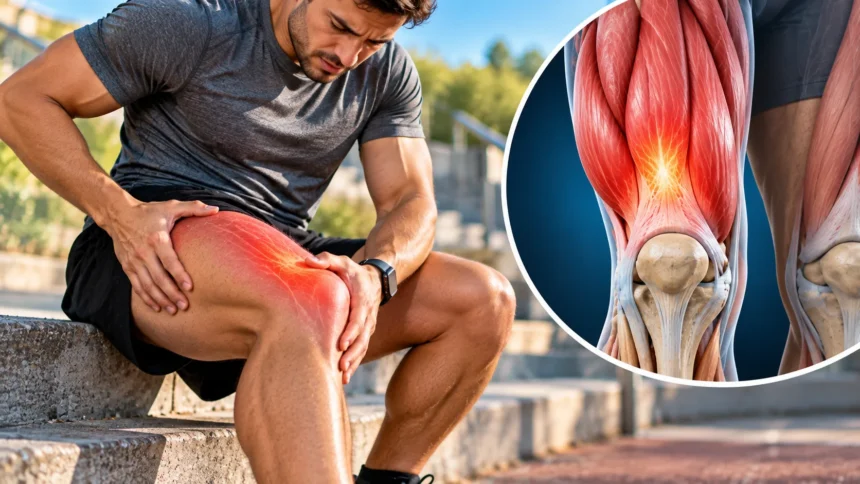
The quadriceps tendon is a strong band of connective tissue located directly above the kneecap. It connects the quadriceps muscles at the front of the thigh to the patella. These muscles include the rectus femoris, vastus lateralis, vastus medialis, and vastus intermedius, which work together to straighten and stabilize the knee.
When the quadriceps contract, force travels through the quadriceps tendon into the kneecap and then through the patellar tendon toward the shinbone. This system allows you to extend the knee during walking, running, jumping, kicking, and standing. The tendon therefore experiences substantial loading during both athletic activity and everyday movement.
Healthy tendons are strong and capable of adapting to repeated physical stress. Problems can develop when activity increases faster than the tendon can recover or when the tendon experiences a sudden excessive force. Repetitive overload can contribute to tendon irritation, while more severe forces may cause partial or complete tearing.
What Does Quadriceps Tendon Pain Feel Like?
Quadriceps tendon pain is usually felt just above the kneecap at the lower end of the thigh. The area may feel tender when pressed, particularly around the point where the tendon attaches to the patella. Some people notice discomfort only during exercise, while others develop soreness during normal daily activities.
Pain may become more noticeable when climbing stairs, squatting, running, jumping, or standing from a low chair. These movements increase the demand placed on the quadriceps tendon because the muscles must produce greater force. Stiffness can also occur after sitting for a long time or when beginning activity after rest.
Symptoms vary according to the severity and cause of the problem. Mild tendon irritation may produce a dull ache or temporary stiffness, whereas a significant injury may cause sudden sharp pain, swelling, bruising, or weakness. A popping sensation followed by difficulty straightening the knee can be a warning sign of tendon rupture.
Common Causes of Quadriceps Tendon Pain
Repeated loading is one of the most common reasons the quadriceps tendon becomes painful. Running, jumping, cycling, weight training, and sports involving frequent acceleration or direction changes can repeatedly stress the tendon. Problems may appear when training volume increases faster than the tissue has time to adapt.
Sudden increases in exercise intensity are particularly important. Adding heavy squats, hill running, more jumping, or significantly longer workouts can expose the tendon to unfamiliar forces. Even experienced athletes can develop symptoms after changing their training routine or returning quickly after a long period of inactivity.
Direct trauma can also cause quadriceps tendon pain. A fall, collision, or forceful knee movement may strain or tear the tendon. Age-related tendon changes, certain medical conditions, and previous injuries may also affect tendon strength, making some people more vulnerable to problems during demanding physical activity.
Quadriceps Tendinitis and Tendinopathy
Quadriceps tendinitis refers to irritation involving the quadriceps tendon, often associated with repeated activity or a recent increase in physical loading. The term is frequently used when symptoms are relatively recent. Pain is usually located above the kneecap and becomes more noticeable during activities that require strong knee extension.
When tendon pain becomes persistent, the term quadriceps tendinopathy may be more appropriate. Tendinopathy generally describes longer-term changes involving tendon structure and function rather than simple short-lived inflammation. Symptoms may improve with rest but return whenever the tendon is exposed to the same demanding activity.
Long-term tendon problems generally require more than simply avoiding exercise indefinitely. Controlled strengthening and gradual reloading can help the tendon adapt to physical demands again. The exact program depends on pain severity, strength, activity level, and whether other knee or lower-limb problems are contributing.
How Lower-Limb Mechanics Can Affect the Tendon
The knee does not work independently from the hips, ankles, and feet. Movement patterns throughout the lower limb influence how force travels through the quadriceps and knee during walking, running, and jumping. Weakness, reduced mobility, or changes in foot loading can sometimes increase stress around the knee.
For example, discomfort lower in the leg can cause someone to walk differently without realizing it. Persistent arch pain may influence how the foot contacts the ground and how weight moves through the ankle, knee, and hip. These compensations do not automatically cause quadriceps tendon pain, but they may contribute to altered movement patterns.
Hip and glute strength can also influence knee control during squatting, running, and landing. A rehabilitation program may therefore assess the entire lower limb rather than concentrating only on the painful tendon. Addressing movement quality alongside tendon loading can create a more balanced approach to recovery.
How to Relieve Mild Quadriceps Tendon Pain
Temporarily reducing activities that strongly aggravate the tendon can help settle symptoms. This does not necessarily mean stopping all movement, especially when walking and light activity remain comfortable. Instead, reduce activities such as deep squats, repeated jumping, sprinting, or heavy leg training if they consistently increase pain.
Cold therapy may provide temporary comfort when the area feels irritated after activity. Apply a wrapped cold pack rather than placing ice directly against the skin, and keep application periods moderate. Some people prefer gentle heat for stiffness, particularly when symptoms are more chronic and there is no significant swelling.
Recovery also depends on sleep, nutrition, and sensible training volume. Avoid repeatedly testing the painful tendon with high-intensity exercise to see whether it has improved. Give symptoms time to settle while maintaining comfortable activity, then gradually rebuild strength and tolerance rather than returning immediately to previous workloads.
Exercises for Quadriceps Tendon Pain
Strengthening is often an important part of recovery when quadriceps tendon pain is related to overuse or tendinopathy. Early exercises may involve gentle quadriceps contractions or controlled knee-extension movements that place manageable tension through the tendon. The goal is to stimulate adaptation without repeatedly provoking significant pain.
Wall sits, controlled sit-to-stands, or partial squats may be introduced when they feel comfortable. These exercises strengthen the quadriceps while allowing the amount of knee bend and load to be adjusted. Movement should remain slow and controlled, and the range can gradually increase as strength and tolerance improve.
Later rehabilitation may include heavier squats, step-ups, lunges, or resistance exercises if appropriate. Athletes may eventually progress to running, jumping, and sport-specific movements. Progression should depend on how the tendon responds rather than following a fixed timeline, particularly when symptoms have been present for several weeks or months.
Stretching and Mobility for Quadriceps Tendon Pain
Gentle quadriceps stretching may feel helpful when the front of the thigh is tight. Bend the knee gradually and bring the heel toward the buttock until a mild stretch is felt through the thigh. Avoid pulling aggressively or forcing the knee into a position that increases pain above the kneecap.
Hip flexor and calf mobility may also be considered because these areas participate in lower-limb movement. However, stretching should not become the main treatment for a tendon that needs improved strength and load tolerance. Mobility exercises are generally more useful when they complement an appropriate strengthening program.
Avoid deep stretching directly into significant tendon pain. A stronger stretching sensation does not necessarily improve recovery and may irritate an already sensitive area. Comfortable movement, gradual loading, and appropriate recovery usually matter more than trying to achieve maximum flexibility around the knee.
Common Mistakes That Can Delay Recovery
One common mistake is returning to high-impact activity as soon as pain begins to improve. Tendon symptoms can settle before strength and load tolerance have fully recovered. Immediately returning to intense running, jumping, or heavy leg training may cause the pain to return and create a repeated cycle of irritation.
Another mistake is complete rest for an extended period without rebuilding strength. Rest can reduce pain temporarily, but prolonged inactivity may lower the tendon’s ability to handle normal physical demands. A gradual strengthening program can help bridge the gap between symptom relief and a safe return to regular activity.
People may also ignore pain until it becomes severe. Mild discomfort that consistently occurs during the same activity can be an early sign that training volume or technique needs adjustment. Responding sooner may allow you to modify activity and begin strengthening before symptoms become more persistent.
How Long Does Quadriceps Tendon Pain Take to Heal?
Recovery time depends on whether the problem is a mild overload, established tendinopathy, muscle-tendon strain, partial tear, or another knee condition. Mild irritation may improve within several days or weeks after modifying aggravating activity. More persistent tendon problems often require a longer period of structured rehabilitation.
Chronic tendinopathy can take several weeks or months to improve because tendon adaptation happens gradually. Progress may not be completely linear, and occasional increases in discomfort can occur as exercises become more challenging. Looking at overall trends in strength and activity tolerance is often more useful than judging recovery from one day.
Tendon tears generally require longer recovery and may need specialist management. Partial tears sometimes respond to immobilization and rehabilitation, while complete ruptures often require surgical repair. Following professional guidance is especially important when the tendon has been significantly damaged because premature loading can interfere with healing.
How to Prevent Quadriceps Tendon Pain
Gradual training progression is one of the best ways to reduce excessive tendon stress. Avoid suddenly increasing running distance, jumping volume, resistance, or training frequency. When introducing a new exercise program, give your muscles and tendons enough time to adapt before significantly increasing difficulty.
Strengthening the quadriceps, hamstrings, glutes, calves, and other lower-body muscles can help distribute forces more effectively. A balanced training program should include strength, mobility, and adequate recovery rather than repeatedly loading one movement pattern. Proper technique also matters during squats, lunges, running, and jumping activities.
Rest and recovery should be treated as part of training rather than as an interruption to progress. Persistent soreness around the tendon is a sign to review workload instead of simply pushing harder. Maintaining consistent exercise throughout the year can also be easier on tendons than repeatedly stopping and restarting intense training.
When Quadriceps Tendon Pain Is Serious
Seek medical evaluation if quadriceps tendon pain is severe, follows a significant injury, or does not improve with reasonable activity modification. Increasing swelling, extensive bruising, or substantial weakness may indicate more than ordinary tendon irritation. Difficulty bearing weight or using the knee normally also deserves professional assessment.
A complete quadriceps tendon rupture often causes sudden pain above the kneecap, followed by weakness and difficulty straightening the knee. Some people notice a popping or tearing sensation at the moment of injury. A visible or palpable gap above the kneecap may also develop, although this is not always easy to recognize.
Prompt medical attention is particularly important if you cannot actively straighten the knee, the leg repeatedly gives way, or swelling develops rapidly after an injury. These symptoms should not be managed through home stretching or exercise alone. Imaging and specialist evaluation may be required to determine the extent of tendon damage.
Returning to Exercise After Quadriceps Tendon Pain
Returning to activity should happen gradually rather than based only on whether pain has disappeared. Begin with movements that place manageable stress through the quadriceps tendon and monitor how the knee responds during and after exercise. Mild temporary discomfort may sometimes occur, but significant or increasing pain suggests that the workload is too high.
Strength should progressively approach the level needed for your normal activities. Someone returning to everyday walking may need less tendon capacity than a runner, football player, or athlete who performs repeated jumping. Rehabilitation should therefore match the physical demands you eventually want the knee to handle.
Increase one major training variable at a time when possible. For example, increase running duration before adding faster speeds, or increase squat resistance before dramatically increasing total repetitions. Gradual progression makes it easier to identify what your tendon tolerates and reduces the chance of sudden overload.
Conclusion
Quadriceps tendon pain usually develops when the tendon above the kneecap becomes overloaded, irritated, or injured. Repetitive running, jumping, heavy strength training, sudden increases in activity, and direct trauma are common contributors. Symptoms often become noticeable during movements that require strong knee extension, such as climbing stairs or standing from a chair.
Mild cases may improve with temporary activity modification, comfortable movement, and gradual strengthening. Long-term recovery often depends on rebuilding the tendon’s ability to tolerate load rather than relying only on rest or stretching. Lower-limb strength, movement mechanics, and sensible training progression can also influence recovery.
Sudden severe pain, rapid swelling, significant bruising, or inability to straighten the knee can indicate a more serious tendon injury. These symptoms deserve prompt medical evaluation. Recognizing warning signs while addressing milder symptoms early can help protect knee function and support a safer return to normal activity.
Frequently Asked Questions
What causes quadriceps tendon pain above the knee?
Common causes include repetitive exercise, sudden increases in training, jumping, running, heavy squats, direct injuries, and age-related tendon changes. Persistent pain may represent quadriceps tendinopathy rather than temporary post-exercise soreness.
Is walking good for quadriceps tendon pain?
Comfortable walking is often acceptable when it does not significantly increase symptoms. Reduce distance or intensity if pain worsens during or after walking, and seek guidance if normal walking becomes difficult.
Should I stretch a painful quadriceps tendon?
Gentle quadriceps stretching may help surrounding muscle tightness, but aggressive stretching can irritate a sensitive tendon. Keep stretches comfortable and combine mobility work with gradual strengthening rather than relying on stretching alone.
How long does quadriceps tendon pain take to recover?
Mild irritation may improve within days or weeks, while chronic tendinopathy can require several weeks or months of progressive rehabilitation. Significant partial or complete tendon tears generally have longer recovery periods.
When should I worry about quadriceps tendon pain?
Seek prompt medical care for severe pain, rapid swelling, significant bruising, a popping sensation, major weakness, or inability to straighten the knee. These symptoms can indicate a substantial tendon tear or rupture.