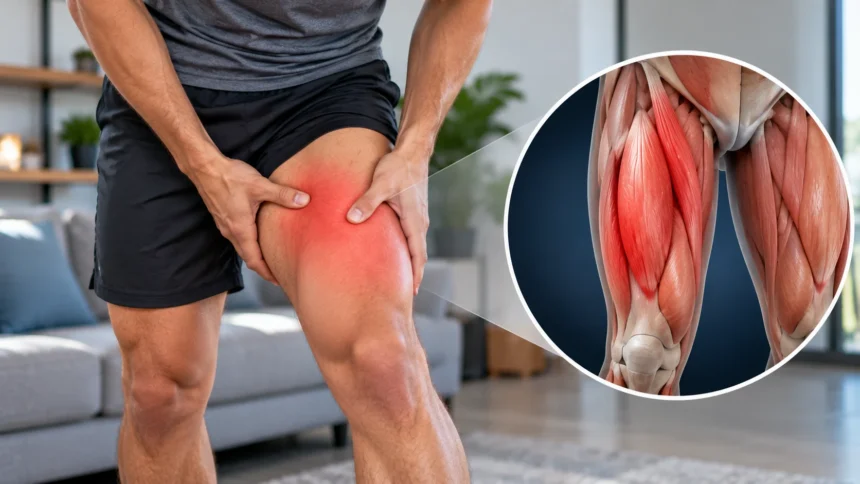
Pain in a thigh muscle can range from mild soreness after exercise to sharper discomfort that interferes with walking, climbing stairs, or everyday movement. The thigh contains several large muscle groups, including the quadriceps, hamstrings, and adductors, so the location and type of pain can provide useful clues about what may be happening.
In many cases, thigh muscle pain is related to overuse, a minor strain, delayed-onset muscle soreness, or a sudden increase in physical activity. However, pain can sometimes come from nearby joints, nerves, circulation problems, or the lower back rather than the thigh muscles themselves. This is why persistent or unexplained discomfort deserves closer attention.
The way the pain started, what movements make it worse, and whether you notice swelling, weakness, numbness, or bruising can help narrow down the possibilities. Understanding common causes can help you decide when simple self-care may be reasonable and when professional medical evaluation is more appropriate.
Where Thigh Muscle Pain Can Occur
Pain in the front of the thigh often involves the quadriceps, which are responsible for straightening the knee and assisting with many activities such as walking, squatting, and climbing stairs. These muscles can become sore after unfamiliar exercise, repetitive activity, or sudden forceful movement. Front-thigh discomfort can also occasionally be related to the hip or nearby nerves.
Pain at the back of the thigh is commonly associated with the hamstrings. These muscles help bend the knee and extend the hip, making them important during running, jumping, and bending movements. Hamstring strains are especially common when a person accelerates quickly or performs explosive activity without being adequately prepared.
Inner-thigh discomfort may involve the adductor muscles, which bring the legs toward the body’s midline and help stabilize the pelvis. Adductor strains can occur during kicking, side-to-side movement, sudden direction changes, or overstretching. Outer-thigh pain, meanwhile, may involve different soft tissues or referred discomfort rather than the major muscle groups alone.
Muscle Strain as a Cause of Thigh Pain
A muscle strain occurs when muscle fibers are stretched beyond their current capacity or exposed to more force than they can tolerate. The injury may happen suddenly during sprinting, jumping, slipping, lifting, or changing direction. Some strains are mild, while more significant injuries can cause immediate pain, weakness, swelling, or bruising.
Mild strains may feel like tenderness, tightness, or soreness that becomes more noticeable during certain movements. More severe strains can make walking difficult and may produce visible bruising over the thigh. The pain is often localized to a specific muscle rather than spread evenly across the entire leg.
Initial management usually focuses on reducing activities that clearly aggravate the area while maintaining comfortable movement when possible. Returning to demanding exercise too quickly can increase the chance of repeated irritation. Significant weakness, extensive bruising, or difficulty putting weight through the leg should be assessed by a healthcare professional.
Delayed-Onset Muscle Soreness
Delayed-onset muscle soreness, often called DOMS, is a common reason the thigh muscles hurt after exercise. It usually appears several hours after training and may become most noticeable one or two days later. New exercises, downhill running, squats, lunges, or increased training volume can make the quadriceps and hamstrings especially sore.
DOMS often creates a dull, aching, or tender sensation rather than sudden sharp pain. The muscles may feel stiff when you first move and improve slightly after gentle activity. This type of soreness usually affects the muscles that were worked during training and gradually settles as the body recovers.
Light movement, adequate sleep, sensible hydration, and gradually increasing training demands can support recovery. You do not necessarily need complete inactivity, but another intense workout for the same sore muscles may not be helpful. Pain that is severe, continues worsening, or lasts much longer than expected may have another cause.
Muscle Cramps and Thigh Discomfort
A thigh muscle cramp is a sudden, involuntary contraction that can feel intensely painful. Cramps may occur during exercise, after activity, or even while resting. The muscle can temporarily become hard or visibly tightened before gradually relaxing, leaving behind tenderness for several hours afterward.
Exercise-related cramps can have several contributing factors, including muscle fatigue, unfamiliar workloads, prolonged activity, and individual susceptibility. Fluid and electrolyte changes may play a role in some situations, particularly during extended exercise in hot conditions. However, not every cramp is caused simply by dehydration or a lack of one specific mineral.
Gentle movement and slowly lengthening the affected muscle may help when a cramp occurs. Frequent unexplained cramps, especially when accompanied by weakness, numbness, swelling, or medication changes, are worth discussing with a healthcare professional. Recurrent symptoms should not automatically be treated with supplements without identifying the underlying reason.
Overuse and Repetitive Activity
Thigh muscle pain can develop gradually when the same tissues are repeatedly stressed without enough time to recover. Runners, cyclists, hikers, athletes, and people with physically demanding jobs may develop soreness or irritation after increasing workload too quickly. Overuse pain often begins mildly and becomes more noticeable as activity continues.
Changes in training can be especially important. Adding more running distance, heavier squats, additional sports sessions, or steep hills may exceed what the thigh muscles are currently prepared to tolerate. Even an activity that is normally safe can become irritating when volume or intensity increases faster than the body can adapt.
Reducing the aggravating workload temporarily and rebuilding gradually can often be more useful than stopping all movement for long periods. Strength training, appropriate rest, and sensible progression can improve tissue capacity. Persistent pain despite reducing activity may require assessment to determine whether a specific muscle, tendon, joint, or nerve is involved.
Thigh Pain Related to the Lower Back
Not all pain felt in the thigh starts in the thigh muscles. Nerves emerging from the lower spine travel into the legs, and irritation along these pathways can sometimes produce pain, tingling, burning, numbness, or weakness in the thigh. The exact symptom pattern depends on which structures are affected.
Back-related thigh pain may occur with or without noticeable discomfort in the spine itself. If you also have lower back pain, changes in sensation, or pain that travels through the hip and leg, the source may be different from a simple muscle strain. A proper assessment can help distinguish muscular soreness from referred or nerve-related symptoms.
Certain movements or positions may make nerve-related discomfort better or worse, which can provide useful information during evaluation. Persistent numbness, progressive weakness, loss of coordination, or severe radiating pain should not be ignored. These symptoms may require medical assessment rather than repeated stretching of the thigh muscles.
Hip Problems That Can Cause Thigh Pain
The hip joint can sometimes produce pain that is felt in the upper thigh rather than directly over the joint. People may notice discomfort in the front of the thigh, groin, or outer hip during walking, standing, or getting up from a chair. This type of referred pain can sometimes be mistaken for a muscle problem.
Hip-related symptoms may be accompanied by stiffness, reduced movement, clicking, or difficulty putting on shoes and socks. Pain may also increase after long periods of standing or weight-bearing. Because muscles surrounding the hip often tighten in response to joint discomfort, the thigh can feel sore even when the original issue is elsewhere.
There are many possible reasons for hip discomfort, ranging from temporary irritation to longer-term joint conditions. If thigh pain repeatedly appears with hip stiffness, restricted movement, or difficulty bearing weight, professional evaluation may help identify the source. Treating only the thigh may not address the underlying problem.
Blood Clots and Circulation-Related Thigh Pain
Although less common than muscle soreness or strains, some forms of thigh pain can be related to circulation problems. A blood clot in a deep vein, called deep vein thrombosis, can sometimes cause pain, swelling, warmth, or tenderness in one leg. These symptoms require prompt medical attention because complications can be serious.
The risk can be higher after prolonged immobility, certain surgeries, long-distance travel, pregnancy, some medications, or previous clotting problems. However, symptoms alone cannot confirm or exclude a blood clot. New one-sided leg swelling and unexplained pain should be evaluated rather than treated as an ordinary pulled muscle.
Seek urgent medical attention if leg pain or swelling occurs with sudden shortness of breath, chest pain, coughing up blood, fainting, or severe breathing difficulty. These symptoms can indicate a medical emergency. It is safer to have concerning circulation-related symptoms assessed promptly instead of waiting for them to improve on their own.
When Thigh Pain May Involve a Nerve
Nerve-related thigh pain can feel different from typical muscular soreness. People may describe burning, electric, shooting, tingling, or numb sensations rather than a simple ache. The skin may also feel unusually sensitive, or certain areas may feel less sensitive than normal when touched.
Some nerve problems affect the outer thigh, while others can cause symptoms in the front or back of the leg. Nerve irritation can come from the spine, pelvis, or areas where nerves pass through surrounding tissues. Because several conditions can create similar patterns, symptom location alone is not enough to determine the exact cause.
Weakness is particularly important to notice. Difficulty lifting the leg, straightening the knee, walking normally, or controlling the foot may suggest more than ordinary muscle soreness. New or progressive weakness, widespread numbness, or neurological symptoms should be evaluated by an appropriate healthcare professional.
What to Do for Mild Thigh Muscle Pain
If the pain is mild and clearly followed an unfamiliar workout or minor muscle strain, reducing aggravating activities for a short period may help. Gentle walking and comfortable range-of-motion exercises can often keep the area from becoming unnecessarily stiff. Avoid repeatedly testing the painful muscle with intense exercise while it is still irritated.
Cold or warmth may feel helpful depending on the situation and personal preference. Some people prefer cooling after an acute strain, while others find warmth comfortable for general muscular tightness. Neither method should be applied at an extreme temperature or used as a substitute for medical evaluation when symptoms are significant.
Once discomfort begins improving, activity can be increased gradually. Start with movements that do not sharply reproduce symptoms and rebuild strength step by step. Returning immediately to the same workload that triggered the pain may overload the tissue again before it has regained sufficient capacity.
How to Prevent Thigh Muscle Pain
A gradual approach to exercise is one of the most effective ways to reduce avoidable thigh muscle problems. Increase running distance, resistance, speed, or training frequency in manageable steps rather than changing everything at once. This gives the quadriceps, hamstrings, adductors, and surrounding tissues time to adapt.
Strength training can also improve the thigh muscles’ ability to tolerate physical demands. Squats, split squats, step-ups, hip hinges, hamstring exercises, and appropriate lateral movements can build more balanced lower-body strength. Exercise choice should match your ability and become progressively harder as control improves.
Warm-ups can prepare the body for more demanding activity by gradually increasing movement and muscle temperature. Dynamic exercises related to your sport or workout are usually more useful than aggressive stretching immediately before explosive activity. Adequate sleep, recovery time, and sensible training schedules are also important parts of injury prevention.
When to See a Healthcare Professional
Seek medical advice if thigh pain is severe, unexplained, or not improving over time. Pain accompanied by major swelling, significant bruising, inability to walk normally, a visible deformity, or sudden loss of strength needs closer evaluation. These signs can indicate a more substantial injury or another condition requiring treatment.
One-sided swelling, warmth, redness, and unexplained deep leg pain should also be taken seriously because of the possibility of a blood clot. Urgent assessment is especially important if these symptoms occur after prolonged immobility, surgery, or other known risk factors. Chest pain or breathing difficulty alongside leg symptoms requires emergency care.
Persistent numbness, tingling, progressive weakness, fever, unexplained weight loss, or pain that repeatedly wakes you from sleep should also be discussed with a clinician. Most thigh discomfort has a musculoskeletal explanation, but ongoing symptoms are easier to manage when the underlying cause is identified rather than guessed.
Conclusion
Pain in a thigh muscle can come from many different sources, including exercise-related soreness, strains, muscle cramps, and overuse. The quadriceps, hamstrings, and adductors can all become uncomfortable depending on activity and movement patterns. In many mild cases, symptoms improve with reduced aggravating activity, gradual recovery, and sensible return to exercise.
However, thigh pain does not always originate in the muscle itself. Problems involving the lower back, hip, nerves, or circulation can also create discomfort in the thigh. Paying attention to swelling, numbness, weakness, bruising, changes in sensation, and the way the pain began can help determine whether further evaluation is needed.
If symptoms are mild and improving, gradual movement and appropriate recovery may be enough. Severe, persistent, unexplained, or worsening pain should be assessed professionally, particularly when other warning signs are present. Identifying the real source of thigh pain is the most useful step toward choosing appropriate treatment and returning comfortably to normal activity.
FAQs
Why does my thigh muscle hurt without exercise?
Thigh pain without recent exercise may come from prolonged positioning, a minor unnoticed strain, nerve irritation, hip or back problems, or circulation issues. Persistent unexplained pain should be medically assessed.
How do I know if I pulled a thigh muscle?
A muscle strain often causes localized pain after sudden movement, stretching, or exertion. Tenderness, weakness, swelling, bruising, or pain when contracting the affected muscle can also occur.
Can lower back problems cause thigh pain?
Yes. Irritated nerves or other structures in the lower spine can refer pain into the thigh. Burning, tingling, numbness, weakness, or pain traveling from the back may suggest nerve involvement.
How long does thigh muscle soreness usually last?
Normal post-exercise soreness commonly improves over several days. Pain that continues worsening, remains severe, or lasts much longer than expected may represent an injury or another condition.
When is thigh pain an emergency?
Seek urgent care for severe one-sided swelling, chest pain, breathing difficulty, major trauma, inability to bear weight, or rapidly worsening weakness. These symptoms can indicate conditions requiring immediate medical attention.