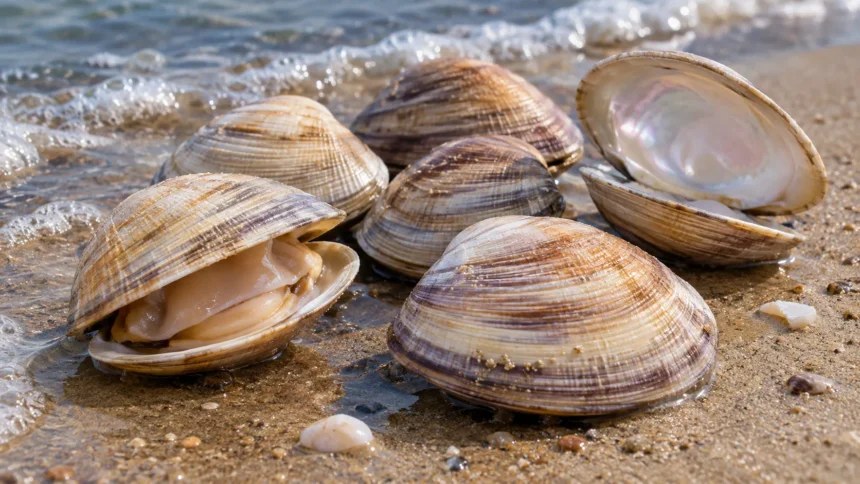
What Are Clam Shells?
Clam shells are hard, protective outer coverings found on clams, which are aquatic animals belonging to the mollusk family. These shells consist of two connected parts that open and close around the animal’s soft body. Clams live in oceans, coastal waters, rivers, and lakes. Their shells provide protection from predators, physical damage, and changing environmental conditions.
Understanding the meaning of clam shells begins with their unique structure. Each shell has two halves, called valves, that are joined by a flexible ligament and controlled by strong muscles. This arrangement allows clams to close their shells tightly when threatened. Their natural design offers an effective defense system while allowing the animal to feed and interact with its surroundings.
Clam shells are also important beyond the animals that create them. They contribute to aquatic ecosystems, provide habitats for small organisms, and offer clues about environmental history. People also collect shells for decoration, scientific research, and educational activities. Their distinctive shapes, colors, and patterns make them recognizable examples of natural marine structures.
How Are Clam Shells Formed?
Clam shells develop through a natural biological process controlled by an organ called the mantle. The mantle produces materials that gradually form the shell around the growing animal. Calcium carbonate is the main mineral component, combined with organic substances that help create the shell’s structure. This process begins early in the clam’s development and continues throughout its life.
As a clam grows, its mantle adds new shell material along the outer edges. Additional layers may also strengthen the existing structure from the inside. Environmental factors such as water chemistry, temperature, and food availability can influence shell development. The result is a durable protective covering that expands as the animal becomes larger.
Shell growth does not always occur at a constant rate throughout the year. Changes in environmental conditions can create visible growth marks on the shell’s surface. Scientists sometimes examine these patterns to study clam growth and environmental changes. However, growth marks do not always represent exact yearly intervals, so interpreting them requires knowledge of the species and habitat.
Understanding the Structure of a Clam Shell
A clam shell has two hard sections known as valves. These valves are connected near the hinge by a flexible ligament that helps them open when the closing muscles relax. Strong adductor muscles pull the valves together when the animal needs protection. This arrangement creates an effective mechanical system that supports both movement and survival.
The outer shell surface often contains ridges, grooves, and growth lines. These features vary depending on the clam species and its living environment. Some shells have smooth surfaces, while others display prominent patterns or rough textures. The shape and arrangement of these details can help researchers distinguish between different types of clams.
Inside the shell, the surface is often smoother than the exterior. Some species produce shiny inner layers, while others have relatively dull surfaces. The shell also contains structures that help attach muscles and support the soft body. Together, these features allow the clam to remain protected while carrying out essential biological functions.
Different Types of Clam Shells
Clam shells appear in many shapes and sizes because different species have adapted to different environments. Hard clams, soft-shell clams, razor clams, and giant clams are familiar examples. Their shells differ in thickness, shape, texture, and overall appearance. These variations reflect differences in habitat, feeding behavior, and protection requirements.
Hard clams typically have thick, rounded shells that offer strong protection against predators. Soft-shell clams have comparatively thin shells and often live buried in coastal sediments. Razor clams possess long, narrow shells that support their ability to burrow quickly. Each design helps the animal survive in its particular environment.
Giant clams are among the largest living bivalve mollusks and inhabit tropical marine environments. Their large shells have distinctive curved edges and can become extremely heavy. Unlike many smaller species, adult giant clams often remain in relatively fixed positions. Their shells support an unusual lifestyle that includes relationships with photosynthetic microorganisms living within their tissues.
Where Do Clams Live?
Clams live in a wide variety of aquatic environments, including oceans, estuaries, rivers, and freshwater lakes. Some species prefer sandy beaches, while others inhabit muddy coastal areas or deeper marine habitats. Their distribution depends on factors such as water temperature, salinity, oxygen availability, and suitable sediment conditions.
Many marine clams spend much of their lives buried beneath sand or mud. They use a muscular foot to move through sediment and establish a protected position. Special feeding structures called siphons allow many species to exchange water while remaining buried. This behavior helps them obtain food and oxygen while reducing exposure to predators.
Freshwater clams and related bivalves live in rivers, lakes, and streams with suitable environmental conditions. Some species are sensitive to pollution, habitat disturbance, and changing water quality. Their presence can contribute to scientists’ understanding of aquatic ecosystems. Protecting these habitats supports the survival of many shell-forming animals and the organisms that depend on them.
What Are Clam Shells Made Of?
Clam shells are made primarily of calcium carbonate, a mineral compound commonly found in marine shells and limestone. The mineral occurs in different crystal forms, including aragonite and calcite. Organic materials help bind these mineral structures together. This combination produces a protective shell that can be both strong and relatively lightweight.
The exact composition varies among clam species and shell layers. Some shells contain significant amounts of aragonite, while others include calcite or a combination of mineral forms. Proteins and other organic compounds influence how minerals are arranged. This organized structure provides mechanical strength and supports the animal’s long-term growth.
Water chemistry plays an important role in shell formation. Clams need suitable conditions to maintain the chemical processes involved in building calcium carbonate structures. Increasing acidity can make shell development more difficult for certain species, especially during sensitive growth stages. Scientists study these effects to better understand environmental changes affecting marine and freshwater ecosystems.
Why Are Clam Shells Important in Nature?
Clam shells provide essential protection for the animals living inside them. Their hard surfaces create barriers against predators and environmental hazards. Some clam species can close their shells tightly when disturbed, reducing the chance of injury. This protective function allows clams to survive in environments where other animals may actively search for food.
Clams also contribute to aquatic ecosystems through their feeding activities. Many species filter suspended particles from water, consuming microscopic organisms and organic material. This process can influence water clarity and nutrient movement. However, their environmental effects depend on population size, species characteristics, and surrounding ecosystem conditions.
After a clam dies, its empty shell may become part of the surrounding habitat. Small organisms can use shells for shelter, attachment, or protection. Shell fragments also contribute to sediments in certain coastal environments. Over time, these materials participate in natural processes that shape aquatic habitats and support ecological diversity.
How Do Clams Open and Close Their Shells?
Clams open and close their shells using a combination of muscles and a flexible hinge ligament. The adductor muscles pull the two shell valves together when they contract. When these muscles relax, the ligament helps separate the valves. This system allows the clam to control how much of its soft body remains exposed.
Closing the shell provides protection when a clam detects movement, changes in its environment, or possible predators. Many clams also remain partially open while feeding and exchanging water. Their internal muscles help maintain appropriate positions during these activities. The exact opening and closing behavior varies among different species and their environmental conditions.
Some clams can maintain tightly closed shells for extended periods, although their survival still depends on oxygen and other physiological needs. The ability to control shell movement supports feeding, protection, and environmental responses. Scientists examine these behaviors to understand bivalve physiology. These mechanisms also demonstrate how relatively simple biological structures can perform important functions efficiently.
Clam Shells vs Other Seashells
Clam shells belong to a group of mollusks called bivalves, which have two hinged shell sections. Other familiar bivalves include oysters, mussels, and scallops. Although these animals share a two-part shell structure, their shell shapes and lifestyles differ. Clams are often associated with burrowing habitats, while other bivalves may attach to surfaces or occupy exposed locations.
Snail shells are different because snails generally belong to the gastropod group. Most familiar shelled snails have a single shell that often forms a spiral. Clams instead possess two separate valves joined at a hinge. This distinction is one of the easiest ways to recognize common bivalve shells compared with many other seashells.
Clam shells also differ from oyster shells in texture and appearance. Oyster shells are frequently irregular and rough because many oysters attach permanently to hard surfaces. Clam shells are often more symmetrical, although their shapes vary widely. Understanding these characteristics helps beach visitors identify shells and appreciate the diversity of marine mollusks.
Common Uses of Clam Shells
Clam shells have been used by people for thousands of years in practical, decorative, and cultural activities. Their durability makes them useful for ornaments, crafts, and traditional objects. Some communities historically used selected shells as tools or materials for decorative beads. These uses demonstrate how natural resources have influenced human creativity and everyday life.
Today, clam shells are commonly displayed in coastal decorations, educational collections, and marine-themed artwork. Their natural patterns make them attractive materials for creative projects. Shells may also be studied in classrooms to explain biology and environmental science. However, collecting activities should follow local regulations and avoid harming living animals or sensitive habitats.
Discarded shells can sometimes be processed for specialized industrial or agricultural purposes because of their calcium carbonate content. Research also explores the potential use of shell waste in construction materials and environmental applications. Such uses require suitable processing and quality checks. Recycling shells responsibly may reduce waste while providing useful materials for selected applications.
How to Identify Different Clam Shells
Identifying clam shells begins with examining their overall shape, size, and surface texture. Some species have rounded shells, while others are elongated or triangular. Growth ridges, hinge structures, and shell thickness can provide additional clues. Observing several characteristics together generally produces better identification results than relying on color or shape alone.
Shell color can vary considerably even within the same species. Environmental conditions, mineral composition, age, and natural biological processes may influence appearance. Some shells display uniform colors, while others have stripes, spots, or complex patterns. Because coloration can change after a shell becomes empty, it should not be treated as the only identifying feature.
The location where a shell is found can also help narrow down its identity. Certain clam species occur mainly in particular regions or habitats. Comparing a shell with reliable identification guides can help distinguish similar species. When identifying unfamiliar shells, photographs of both valves, the hinge, and the interior surface can be especially useful.
Are Clam Shells Safe to Touch and Collect?
Empty clam shells are generally safe to handle, but some may have sharp edges or rough surfaces. Broken shell fragments can be especially pointed, so careful handling is recommended. It is also sensible to wash your hands after touching shells collected from natural environments. Avoid handling shells from visibly contaminated water or areas with pollution warnings.
Collecting empty shells is permitted in some coastal areas but restricted or prohibited in others. Protected beaches, marine reserves, and certain wildlife habitats may have special regulations. Visitors should check local rules before removing shells. Leaving living clams undisturbed is particularly important because these animals contribute to the health and balance of aquatic environments.
Shells can also provide shelter for small organisms, even when they appear empty. Examining them carefully before collecting helps reduce unnecessary disturbance. Responsible beach exploration focuses on observing natural features without damaging habitats. Photographing interesting shells is another way to appreciate their beauty while leaving coastal ecosystems largely undisturbed.
Clam Shells in Science and Environmental Research
Clam shells contain information that scientists can use to study aquatic environments. Their mineral layers develop over time and may preserve chemical signals associated with changing conditions. Researchers analyze shell growth and composition to investigate environmental history. These studies can provide insights into water temperature, ecosystem changes, and the lives of shell-forming animals.
Some scientific methods examine oxygen isotopes and other chemical measurements within shell material. These signals may help researchers reconstruct aspects of past environmental conditions. However, interpretation requires careful calibration because biological processes can influence shell chemistry. Scientists often combine shell analysis with additional environmental records to improve the reliability of their findings.
Clam shells are also useful in archaeological research. Shell remains can provide evidence about historical diets, coastal settlements, and resource use. Large accumulations of shells, sometimes called shell middens, may preserve information about past human activities. Studying these materials helps researchers understand relationships between people, aquatic resources, and changing coastal environments.
What Do Clam Shells Symbolize?
Clam shells can carry different symbolic meanings depending on cultural traditions and personal interpretations. Their hard protective surfaces are sometimes associated with safety, shelter, and resilience. Because shells develop naturally over time, they may also represent growth and adaptation. These symbolic connections are interpretations rather than scientific properties of the shells themselves.
In art and decoration, seashells frequently represent beaches, oceans, and connections with nature. Clam shells may appear in coastal designs because of their balanced shapes and recognizable forms. Their simple appearance can create a sense of natural beauty. Some people also associate paired shells with balance or partnership because of their two connected halves.
The meaning of clam shells can change according to the context in which they are used. A shell displayed in a home may simply serve as a decorative object. In a museum, the same shell might represent biological diversity or environmental history. Understanding both scientific facts and cultural interpretations provides a broader perspective on these natural structures.
Conclusion
Clam shells are protective structures produced by aquatic mollusks known as clams. Their two-part design, calcium carbonate composition, and specialized hinge system support the animals throughout their lives. Different species develop shells with distinctive shapes, sizes, and surface patterns. Understanding these features helps explain why clam shells are important examples of natural biological engineering.
Beyond protection, clam shells contribute to aquatic habitats and scientific research. Their structures can provide shelter for organisms, become part of coastal sediments, and preserve information about past environmental conditions. People also use empty shells in education, decoration, and traditional crafts. These varied roles show how a simple natural object can have considerable ecological and cultural significance.
Learning about clam shells encourages a better understanding of marine life and environmental conservation. Responsible observation and collection help protect the habitats where clams and other aquatic organisms live. Whether discovered on a beach or examined in a classroom, clam shells offer useful insights into nature. Their structure and history make them fascinating subjects for scientific exploration.
Frequently Asked Questions
What Are Clam Shells Made Of?
Clam shells are primarily made of calcium carbonate combined with organic materials. These substances form a hard protective structure that grows as the animal develops and helps protect its soft body.
Why Do Clams Have Two Shells?
Clams have two hinged shell sections called valves. These structures protect their soft bodies, while strong muscles and a flexible ligament allow the shells to open and close during feeding and protective responses.
Can Clam Shells Grow Back?
Clams can repair some shell damage by depositing new material through their mantle. However, severe damage may be impossible to repair, and an empty shell cannot grow because the living animal is no longer present.
Are Clam Shells and Seashells the Same Thing?
Clam shells are a type of seashell, but not all seashells come from clams. Seashells may belong to various mollusks, including snails, oysters, mussels, and other marine animals.
What Is the Purpose of Clam Shells?
The main purpose of clam shells is to protect the animal’s soft body from predators and environmental hazards. They also support essential biological functions and contribute to aquatic ecosystems after the clam dies.