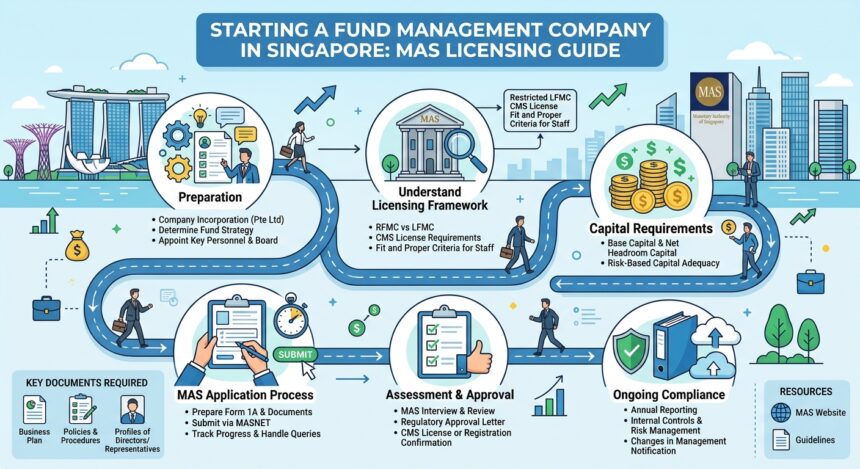
Starting a Fund Management Company in Singapore: MAS Licensing Guide
Singapore is an established centre for fund management, attracting investment professionals and fund sponsors seeking access to regional and global markets. However, starting a fund management company requires more than registering a business. Founders need to understand the regulatory framework, determine the appropriate licensing route and prepare the business to meet its ongoing obligations.
Understand the MAS Licensing Route
Before launching, founders should define the proposed investment activities, target investors, fund structure and operating model. These factors help determine which regulatory requirements may apply.
Fund management activities regulated under Singapore’s Securities and Futures Act generally require a Capital Markets Services (CMS) licence, unless an applicable exemption or alternative regulatory arrangement applies. The Monetary Authority of Singapore (MAS) assesses matters such as the applicant’s business plan, management expertise, financial resources, risk controls and compliance arrangements.
Applicants should review the relevant MAS licence application support in Singapore before deciding on their setup. Preparing a clear business model and identifying regulatory requirements early can help founders understand the work involved in an application.
Is the VCFM Regime Suitable?
Some venture capital fund managers may qualify for the Venture Capital Fund Manager (VCFM) regime, which has a simplified set of admission criteria compared with the standard fund management licensing framework. However, it is not a universal route for every private fund or investment strategy. Eligibility depends on specific fund and investment restrictions.
For example, a manager planning a conventional hedge fund should not assume that the VCFM regime is suitable. The intended strategy, fund terms, investor eligibility and types of investments need to be assessed against the applicable rules. Reviewing the MAS licensing requirements for venture capital fund managers can help clarify the distinction.
Prepare the Business for Regulatory Review
Licensing preparation should extend beyond completing forms. Founders should consider whether the business has suitable leadership, relevant expertise, appropriate office arrangements, adequate financial resources and workable operational controls.
Risk management and compliance should also be built into the business model from the beginning. Policies and procedures need to reflect how the firm will actually operate, including its investment activities, client onboarding, conflicts of interest, record-keeping and escalation processes.
Plan for Ongoing Compliance
Regulatory responsibilities do not end when a licence is granted. Fund managers may need to maintain compliance monitoring, review internal policies, track regulatory deadlines, manage relevant reporting and ensure that staff understand their responsibilities.
Depending on the firm’s size, complexity and regulatory obligations, an outsourced compliance arrangement may be worth considering instead of building the entire function internally. When evaluating an outsourced compliance officer in Singapore, firms should clarify the scope of support, reporting arrangements, independence, access to records and escalation procedures.
Outsourcing can support day-to-day compliance work, but it does not automatically remove the responsibilities of the firm’s board and senior management. Governance and oversight must remain appropriate to the business and applicable requirements.
Build the Right Foundation Before Launch
Starting a fund management company in Singapore involves connected decisions about licensing, fund structure, staffing, operations and compliance. Founders should establish the proposed business model first, assess the applicable regulatory route and prepare the necessary controls before committing to a launch timeline.
Because requirements depend on the activities and circumstances of each applicant, firms should consult current MAS guidance and obtain qualified regulatory advice where needed. A well-planned approach helps founders identify gaps early and build a more sustainable operating framework.