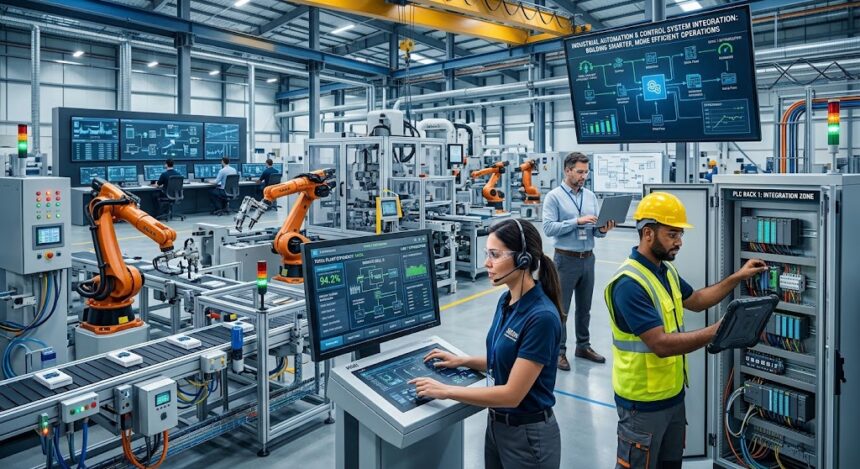
Industrial automation is transforming how businesses manage production, improve safety, and maintain consistent quality across complex operations. Through solutions such as scada system integration, companies can monitor equipment, collect real-time data, and make informed operational decisions. Experienced providers like Pacific Blue Engineering deliver tailored automation solutions for manufacturing, food and beverage, life sciences, entertainment, and transportation. Their expertise helps organizations optimize processes, modernize legacy controls, improve machine safety, enhance product quality, reduce operational risks, and gain valuable insights through advanced systems engineering and automation technologies.
Understanding the Role of Industrial Automation
Industrial automation involves using advanced control technologies, software, sensors, and machinery to perform tasks with minimal manual intervention. These systems help organizations maintain reliable production processes while reducing repetitive work and improving operational consistency.
Automation can support a wide range of activities, including material handling, equipment monitoring, production scheduling, quality inspection, and process control. By connecting different machines and systems, businesses can create more coordinated workflows and respond more effectively to changing operational requirements.
For industries with demanding production schedules or strict quality standards, automation also helps reduce human error and improve the repeatability of essential tasks. The result is a more controlled working environment where equipment performance and production outcomes can be measured and improved over time.
Why Control System Integration Matters
Modern industrial facilities often rely on multiple machines, software platforms, and control technologies that must work together. Without effective coordination, disconnected systems can create communication problems, limit visibility, and make troubleshooting more complicated.
control system integration connects these technologies into a unified operational environment. It enables equipment, programmable logic controllers (PLCs), supervisory software, sensors, and other industrial components to exchange information and perform coordinated functions.
A properly integrated control system can provide several important advantages:
-
Improved operational efficiency: Coordinated equipment reduces unnecessary delays and helps streamline production.
-
Greater process consistency: Automated controls maintain repeatable operating conditions and production standards.
-
Enhanced safety: Integrated safety functions can help identify hazardous conditions and initiate appropriate protective responses.
-
Simplified maintenance: Centralized monitoring helps technicians identify faults and investigate equipment problems more efficiently.
-
Better scalability: Flexible system architecture makes it easier to introduce new equipment and expand production capabilities.
The integration process typically begins with an assessment of existing equipment, business requirements, and operational challenges. Engineers then develop a suitable architecture, configure the necessary hardware and software, and test the complete system to verify that its components operate as intended.
The Importance of SCADA Systems in Industrial Operations
Supervisory Control and Data Acquisition (SCADA) systems play a significant role in monitoring and managing industrial processes. They collect information from field devices, display operating conditions, record historical data, and allow authorized operators to supervise equipment through centralized interfaces.
With effective SCADA system integration, businesses can connect existing controllers, sensors, industrial networks, and monitoring platforms to establish a clearer picture of their operations.
For example, a manufacturing facility can use SCADA software to monitor production line speeds, equipment temperatures, system alarms, and overall machine performance. Operators can review this information through graphical dashboards rather than relying entirely on individual machine interfaces or manual inspections.
SCADA platforms can also help organizations identify recurring inefficiencies. Historical records may reveal production bottlenecks, abnormal energy consumption, or equipment behavior that indicates a developing maintenance issue.
These insights support more informed decision-making and help managers prioritize improvements based on actual operating data. When designed around the facility’s needs, SCADA systems can improve visibility without requiring every existing component to be replaced.
Modernizing Legacy Industrial Controls
Many industrial facilities operate equipment that has been in service for years or even decades. Although these systems may continue to perform essential functions, outdated controllers, unsupported software, and obsolete communication technologies can introduce reliability and security concerns.
Replacing an entire control infrastructure can be expensive and disruptive. Modernization offers an alternative by upgrading selected components while preserving equipment that remains functional and suitable for continued use.
A modernization project may involve replacing obsolete PLCs, upgrading human-machine interfaces (HMIs), improving industrial network communications, or connecting previously isolated machines to centralized monitoring software.
Engineers must carefully evaluate compatibility, downtime requirements, operational risks, and future expansion plans before implementing changes. A phased approach can help businesses maintain production while gradually improving their technical infrastructure.
Successful modernization also requires thorough testing and documentation. Operators and maintenance teams need to understand the updated system, while backup and recovery procedures help support long-term reliability.
Improving Machine Safety and Reducing Operational Risks
Safety is a fundamental consideration in industrial automation. Manufacturing equipment, conveyor systems, robotic machinery, and automated production lines can present hazards when protective measures are inadequate or improperly configured.
Integrated safety solutions help businesses manage these risks through appropriate protective devices, safety controllers, interlocks, emergency-stop functions, and monitoring systems. Depending on the application, these measures can prevent equipment from operating under unsafe conditions or bring machinery to a controlled stop when a hazard is detected.
However, automation alone does not guarantee a safe workplace. Safety functions must be designed around a proper risk assessment and applicable standards, then validated to confirm that they perform as required.
Engineers should also consider how employees interact with automated equipment during maintenance, cleaning, setup, and troubleshooting. Clear procedures, suitable training, and appropriate lockout/tagout practices remain essential.
By incorporating safety into the design and integration process, organizations can improve protection for personnel while maintaining dependable production operations.
Enhancing Product Quality Through Process Control
Product quality depends on maintaining consistent operating conditions throughout production. Variations in temperature, pressure, timing, ingredient proportions, or machine settings can affect the final result, particularly in industries with strict manufacturing specifications.
Automated control systems help regulate these variables using sensors, controllers, and feedback mechanisms. When measurements move outside defined limits, the system can adjust equipment settings or alert operators to investigate the problem.
In food and beverage production, for instance, automation can support temperature monitoring, ingredient handling, mixing, and packaging operations. In life sciences, carefully designed systems can help manage controlled processes, record relevant operating data, and support traceability requirements.
Integrated monitoring also makes it easier to identify patterns associated with defective products or inconsistent production results. Businesses can use this information to investigate root causes and refine process parameters.
Although quality improvements depend on many factors, reliable automation provides the measurement, control, and documentation needed to make production more predictable.
Applying Automation Across Different Industries
Industrial automation is not limited to traditional manufacturing facilities. Its applications extend across numerous sectors, each with distinct operational requirements.
Manufacturing
Manufacturers use automation to coordinate production lines, control machinery, manage material movement, and monitor equipment performance. Integrated systems can help reduce bottlenecks and improve consistency across repetitive processes.
Food and Beverage
Automation supports mixing, processing, filling, packaging, and environmental monitoring. Properly configured controls can help maintain process conditions, reduce waste, and support hygiene and quality requirements.
Life Sciences
Facilities involved in life sciences may require precise process control, reliable data collection, and detailed records. Automation systems can support these needs when designed and validated for the specific application and relevant regulatory expectations.
Entertainment
Automation can coordinate lighting, moving equipment, audiovisual systems, and other technical infrastructure used in entertainment venues and attractions. Reliable control helps ensure that complex systems operate in a synchronized and predictable manner.
Transportation
Transportation infrastructure and related industrial facilities can use automation to monitor equipment, coordinate mechanical systems, and improve operational visibility. Integration can help operators identify faults and respond more effectively to changing conditions.
Across these sectors, the most effective solutions are those developed around the actual needs of the facility rather than relying on a one-size-fits-all approach.
Choosing the Right Systems Engineering Partner
Industrial automation projects involve more than installing controllers or configuring software. They require a clear understanding of process requirements, equipment behavior, safety considerations, communication protocols, and long-term maintenance needs.
An experienced engineering partner can help businesses evaluate their existing infrastructure and identify the most practical path toward improved performance.
Pacific Blue Engineering is an example of a provider focused on control system integration and tailored automation solutions across multiple industries. By combining systems engineering expertise with modern automation technologies, an integration partner can help organizations address outdated controls, improve equipment coordination, and establish better operational visibility.
When evaluating a potential provider, businesses should consider several factors:
-
Industry experience: Familiarity with the operational demands and technical requirements of the relevant sector.
-
Engineering capabilities: The ability to design, configure, integrate, and test suitable automation systems.
-
Legacy system expertise: Experience connecting new technologies with existing industrial equipment.
-
Safety and quality practices: Clear methods for risk assessment, validation, testing, and documentation.
-
Long-term support: Availability of troubleshooting, maintenance, training, and future system upgrades.
Clear communication is equally important. A strong engineering partner should explain the proposed solution, outline potential implementation challenges, and establish measurable objectives before work begins.
Planning a Successful Automation Project
A structured implementation process helps organizations achieve better results while minimizing unnecessary disruption.
The first step is to identify the problems the project should solve. These may include frequent equipment downtime, inconsistent product quality, limited process visibility, high operating costs, or difficulties maintaining obsolete controls.
Next, engineers assess the current infrastructure and determine which components can be retained, upgraded, or replaced. This evaluation informs the system architecture, equipment selection, integration requirements, and implementation schedule.
Testing should take place before the updated system enters full operation. Depending on the project’s complexity, this may include factory acceptance testing, site acceptance testing, functional verification, and safety validation.
Finally, operators and maintenance personnel need appropriate training and documentation. Establishing performance indicators such as downtime, throughput, defect rates, and energy consumption can help determine whether the investment is delivering the intended benefits.
Ongoing monitoring allows businesses to identify additional opportunities for improvement as operational demands evolve.
Conclusion
Industrial automation and control system integration help businesses build more efficient, reliable, and adaptable operations. By connecting equipment, modernizing legacy infrastructure, improving process monitoring, and incorporating appropriate safety measures, organizations can strengthen production performance while gaining greater control over their industrial environments.
From manufacturing and food processing to life sciences, entertainment, and transportation, integrated automation offers practical ways to improve consistency, reduce operational risks, and make better use of production data.
Working with an experienced engineering provider such as Pacific Blue Engineering can help businesses develop solutions suited to their technical requirements and long-term objectives. With careful planning, appropriate system design, and ongoing optimization, industrial automation can become a valuable foundation for sustainable operational improvement.