Kettlebells can transform an ordinary workout into a challenging combination of strength training, cardiovascular conditioning, balance, and functional movement. Unlike a traditional dumbbell, a kettlebell places most of its weight below the handle, creating an offset load that asks your grip, core, and stabilizing muscles to work together. This design makes kettlebell training suitable for controlled strength exercises as well as faster, more explosive movements.
The best kettlebell exercises are not necessarily the most complicated ones. Movements such as deadlifts, goblet squats, rows, presses, carries, and swings create a strong foundation because they train movement patterns used both inside and outside the gym. These exercises can help beginners learn proper technique while giving experienced trainees enough flexibility to increase weight, volume, speed, or movement complexity.
Kettlebell workouts are also convenient for people who do not have room for a large home gym. One or two appropriately selected kettlebells can be used for lower-body strength, upper-body training, core stability, mobility, and conditioning. Research suggests that structured kettlebell programs may improve muscular strength and aerobic fitness, although results depend on training intensity, exercise selection, consistency, and the individual’s starting fitness level.
This guide explains the best kettlebell exercises for beginners and experienced users, along with practical form cues and a simple workout structure. The goal is not to perform every movement in one exhausting session. It is to choose a manageable group of exercises, learn them properly, and progress gradually enough that your technique remains controlled as your strength and confidence improve.
Why Kettlebell Exercises Are Effective
One reason kettlebell exercises are so effective is that many of them involve several muscle groups at the same time. A goblet squat trains the hips, thighs, trunk, and upper back, while a kettlebell row involves the back, arms, shoulders, grip, and core. Compound movements make it possible to build a time-efficient full-body kettlebell workout without relying on numerous isolation exercises.
Kettlebell training can also develop strength through different movement patterns. Controlled exercises such as deadlifts and presses strengthen the body under steady tension, while ballistic movements such as swings and cleans train the ability to produce force more quickly. Current American College of Sports Medicine guidance emphasizes that resistance programs should be matched to individual goals and that consistent participation matters more than unnecessary complexity.
Another advantage is the continuous demand placed on core stability. When a kettlebell is held on one side, overhead, in the rack position, or beside the body during a carry, the torso must resist unwanted leaning and rotation. This does not mean every kettlebell movement is automatically a complete core workout, but it does allow many exercises to strengthen the trunk while the arms and legs are moving.
Kettlebell sessions may also raise the heart rate when exercises are performed in intervals or continuous circuits. Studies involving high-intensity kettlebell protocols have reported improvements in aerobic capacity, while research on kettlebell swings shows that the movement can create a meaningful cardiovascular and muscular demand. These findings do not make kettlebells a required replacement for walking, running, cycling, or swimming, but they support their value as a versatile conditioning tool.
Best Kettlebell Exercises for Lower-Body Strength and Power
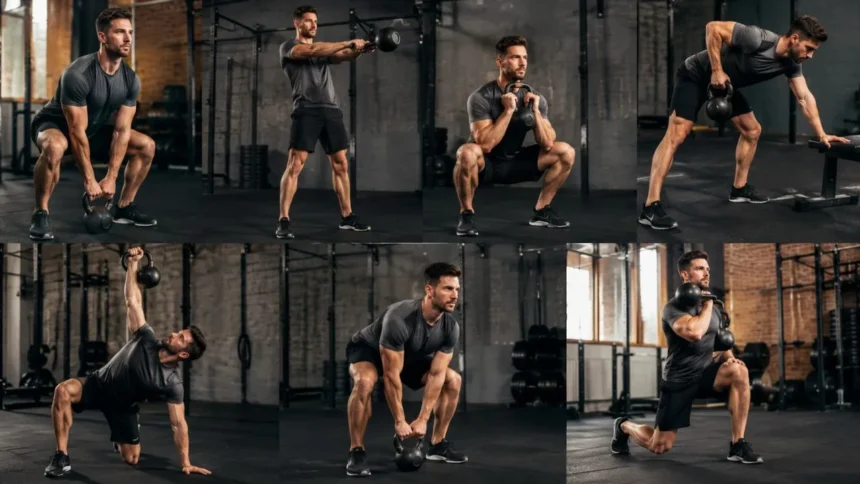
The kettlebell deadlift is one of the best kettlebell exercises for beginners because it teaches the hip-hinge pattern needed for swings, cleans, and many daily lifting tasks. Place the kettlebell between your feet, push your hips backward, soften your knees, and maintain a long neutral spine. Grip the handle, press your feet into the floor, and stand by extending your hips rather than pulling primarily with your arms.
The goblet squat develops the quadriceps, glutes, inner thighs, trunk, and upper-back muscles. Hold the kettlebell close to your chest by the horns or sides of the handle, keep your ribs stacked over your pelvis, and sit between your legs. Descend only as far as you can while keeping your heels grounded and your knees tracking comfortably in the same general direction as your toes.
The kettlebell swing is a powerful hip-hinge exercise that targets the posterior chain, particularly the glutes and hamstrings, while challenging the grip and cardiovascular system. The bell should be driven forward by forceful hip extension rather than lifted with the shoulders. Biomechanical research has examined the muscular activation, spinal loading, and hip demands of swings, reinforcing the importance of proper technique and suitable loading.
The kettlebell reverse lunge trains each leg independently and can improve lower-body control, balance, and coordination. Hold the kettlebell at your chest, in one hand by your side, or in the rack position. Step backward under control, lower your rear knee toward the floor, and push through the front foot to return. Beginners should first practise the movement without weight or with a light kettlebell.
Best Kettlebell Exercises for the Upper Body
The one-arm kettlebell row is a reliable exercise for building the upper back, rear shoulders, arms, and grip. Support your free hand on a bench or place it on your thigh, hinge forward, and keep your torso stable. Pull the kettlebell toward your hip while keeping your shoulder away from your ear, then lower it slowly without allowing your upper body to rotate toward the floor.
The kettlebell overhead press develops the shoulders, triceps, upper back, and trunk. Begin with the kettlebell resting securely in the rack position, lightly brace your abdominal muscles, and press it overhead without excessively arching your lower back. Finish with the arm extended and the weight balanced over the shoulder rather than drifting far in front of the body.
The kettlebell clean and press combines lower-body power with upper-body strength, making it one of the best full-body kettlebell exercises. The clean guides the bell smoothly from below the hips into the rack position before the press moves it overhead. Avoid allowing the bell to crash onto your forearm; keep it close to the body and rotate your hand around the kettlebell as it reaches the rack.
The kettlebell floor press provides a stable pressing option for the chest, shoulders, and triceps. Lie on your back with your knees bent, hold the bell with your forearm vertical, and press it upward until the arm is straight. Lower the weight until the upper arm gently contacts the floor. The limited range can make this a practical alternative for people who find deeper bench pressing uncomfortable.
Best Kettlebell Exercises for Core Stability and Mobility
The farmer’s carry appears simple, but it can build grip strength, trunk stability, postural control, and total-body endurance. Hold a kettlebell in each hand, stand tall, and walk with smooth, controlled steps without allowing the weights to swing excessively. A suitcase carry uses one kettlebell and creates a stronger anti-lateral-flexion challenge because the body must resist leaning toward the loaded side.
The kettlebell halo is commonly used as a controlled shoulder and upper-back mobility drill. Hold a light kettlebell by the horns and slowly circle it around your head while keeping your chin level and rib cage controlled. The movement should feel smooth rather than forced. Use a lighter load than you would select for squats, rows, or carries because mobility and control are more important than intensity.
The kettlebell windmill trains hip mobility, shoulder stability, obliques, and body awareness. Hold the kettlebell overhead, turn your feet slightly away from the loaded arm, shift your hips backward, and lower your free hand along the inside of your leg. Keep your eyes on the bell and stop before your spine rounds or your overhead shoulder loses its stable position.
The Turkish get-up is a multi-stage exercise that challenges shoulder control, core strength, hip mobility, coordination, and balance. It involves moving from the floor to standing while maintaining the kettlebell overhead, then reversing the sequence. Because the movement is technical, learn each position without weight first. A shoe balanced on the fist can be used to practise control before adding a kettlebell.
How to Build a Full-Body Kettlebell Workout
Begin each kettlebell workout with several minutes of movement preparation. Gentle bodyweight squats, hip hinges, glute bridges, arm circles, and controlled lunges can prepare the joints and muscles for the session. Practise one or two light sets of your first exercise before using your normal training load, especially when the workout includes swings, cleans, presses, or other technically demanding movements.
A balanced beginner session can include kettlebell deadlifts, goblet squats, one-arm rows, floor presses, and farmer’s carries. Complete two or three controlled sets of each movement, resting long enough to maintain good form. Repetition ranges can vary, but beginners often benefit from stopping each set while they could still complete several technically sound repetitions rather than pushing every exercise to failure.
After mastering the hip hinge, kettlebell swings can be added in short sets. For example, perform controlled rounds of swings followed by generous rest instead of attempting a long, breathless set. Clean and press variations, windmills, snatches, and Turkish get-ups should be introduced gradually because fatigue can make their more complex positions difficult to control.
Training frequency should reflect your experience, schedule, recovery, and overall activity level. Public health guidance recommends muscle-strengthening activity involving the major muscle groups on at least two days each week, while updated resistance-training guidance emphasizes regular participation and training major muscle groups consistently. A kettlebell program can contribute to that goal, but walking and other aerobic activities should still be included for balanced fitness.
Choosing the Right Kettlebell Weight
The right kettlebell weight is heavy enough to provide resistance but light enough to allow controlled positioning throughout every repetition. There is no universal starting weight based only on age, sex, or body size. Exercise experience, joint comfort, grip strength, movement skill, and the specific exercise all matter when selecting a suitable load.
You will usually need a lighter kettlebell for halos, Turkish get-ups, windmills, and overhead presses than for deadlifts, goblet squats, carries, or two-handed swings. A weight that feels manageable in a deadlift may be too demanding when held overhead. Selecting one weight for every movement can therefore limit technique or make some exercises unnecessarily easy.
Your final repetitions should feel challenging without causing your posture or movement pattern to collapse. Reduce the weight when you cannot control the lowering phase, maintain a stable spine, keep the bell securely positioned, or complete the intended range of motion. Technical failure should not be treated as a productive final repetition, particularly during swings, cleans, snatches, or overhead exercises.
Progress does not always require buying a heavier kettlebell. You can add a repetition, perform an additional set, slow the lowering phase, improve range of motion, shorten rest slightly, or move from a two-handed exercise to an appropriate one-sided variation. ACSM’s updated guidance supports individualizing resistance-training variables according to goals, safety, and long-term adherence rather than following a single rigid formula.
Common Kettlebell Mistakes to Avoid
One common mistake is turning the kettlebell swing into a front raise or squat. In an effective swing, the hips move backward during the backswing and extend powerfully to send the bell forward. The arms guide the weight but do not lift it through shoulder effort alone. Practising kettlebell deadlifts and unloaded hip hinges can make the correct movement pattern easier to understand.
Another mistake is allowing the kettlebell to pull the wrist backward during rack and overhead positions. The handle should sit diagonally across the palm so the wrist can remain relatively straight and strong. During cleans, guide the hand around the kettlebell instead of flipping the bell over the fist. A loud impact against the forearm usually indicates that the path needs improvement.
People also progress too quickly from controlled strength exercises to technical ballistic movements. A heavier kettlebell does not automatically create a better workout when the user cannot maintain balance, breathing, joint alignment, or spinal control. Current resistance-training guidance highlights consistency and appropriate effort rather than unnecessary complexity, supporting a gradual approach that prioritizes repeatable technique.
Stop the session when you experience sharp pain, sudden weakness, dizziness, chest discomfort, or unusual shortness of breath. Muscle fatigue and effort are expected during training, but they should not be confused with concerning symptoms. People with an injury, recent surgery, cardiovascular condition, significant balance limitation, pregnancy-related considerations, or another medical concern should obtain individualized guidance from a qualified healthcare or exercise professional.
A Simple Beginner Kettlebell Workout
Start with eight to ten kettlebell deadlifts, focusing on a controlled hip hinge and strong standing position. After resting, perform eight goblet squats while keeping the kettlebell close to your chest. Complete two or three rounds depending on your current fitness level, and stop the set when maintaining a neutral spine or stable knee position becomes difficult.
Next, perform eight one-arm rows on each side and six to ten floor presses per arm. Use a weight that allows you to pause briefly at the top without losing control. Rest between sides when needed. There is no benefit in rushing through the exercises when slower repetitions allow you to feel the intended muscles and practise better alignment.
Finish the strength portion with a farmer’s carry or suitcase carry lasting approximately 20 to 40 seconds. Walk slowly, maintain a tall posture, and avoid leaning or shrugging. Beginners who have learned the swing safely may then complete several short sets of controlled swings. Those who have not mastered the hinge should continue using deadlifts instead.
Repeat the workout two or three nonconsecutive days per week, adjusting the volume according to soreness and recovery. When all repetitions feel controlled, make one small progression rather than changing everything at once. You might add one repetition, extend a carry, add a set, or use a slightly heavier bell while keeping the same exercises.
Final Thoughts on the Best Kettlebell Exercises
The best kettlebell exercises are the movements that support your goals while allowing you to train safely and consistently. Deadlifts, goblet squats, rows, presses, carries, and floor presses provide a strong foundation. Swings, cleans, windmills, and Turkish get-ups can expand the program once the underlying movement patterns and positions are comfortable.
A successful kettlebell routine does not need to contain every exercise in this guide. Four to six well-chosen movements can create an effective full-body workout when they include a squat or lunge, hip hinge, push, pull, carry, and suitable core challenge. Rotating exercises too frequently can make it difficult to practise technique or measure improvement.
Consistency remains more important than creating the most intense or complicated workout. Recent ACSM guidance based on a large review of resistance-training research concludes that moving from no resistance training to regular training provides substantial benefits, while programming should be individualized according to ability, goals, enjoyment, and safety.
Start with a manageable kettlebell, give yourself time to learn the movements, and increase the challenge gradually. When technique improves alongside strength, kettlebell training can become a practical and engaging part of a wider fitness routine. Combine it with appropriate aerobic activity, mobility work, recovery, sleep, and nutrition to support sustainable long-term progress.
Frequently Asked Questions
What is the single best kettlebell exercise?
The kettlebell swing is one of the most efficient full-body options, but beginners should first master the kettlebell deadlift and hip hinge. The best exercise ultimately depends on your ability, goals, and technique.
Are kettlebell exercises good for beginners?
Yes, beginners can start with deadlifts, goblet squats, rows, floor presses, and carries. More technical movements such as swings, cleans, snatches, windmills, and Turkish get-ups should be learned gradually.
Can kettlebell exercises build muscle?
Kettlebell exercises can support muscle growth when they provide sufficient resistance, training volume, progressive overload, and recovery. Heavier squats, presses, rows, deadlifts, and carries are especially useful for strength-focused training.
How often should I perform kettlebell workouts?
Most beginners can start with two or three nonconsecutive kettlebell sessions per week. The ideal frequency depends on workout intensity, recovery, other physical activities, and individual training experience.
Can kettlebell exercises help with weight loss?
Kettlebell workouts can support weight management by increasing physical activity and helping preserve or build muscle. Sustainable fat loss also depends on nutrition, sleep, daily movement, stress, and long-term consistency.