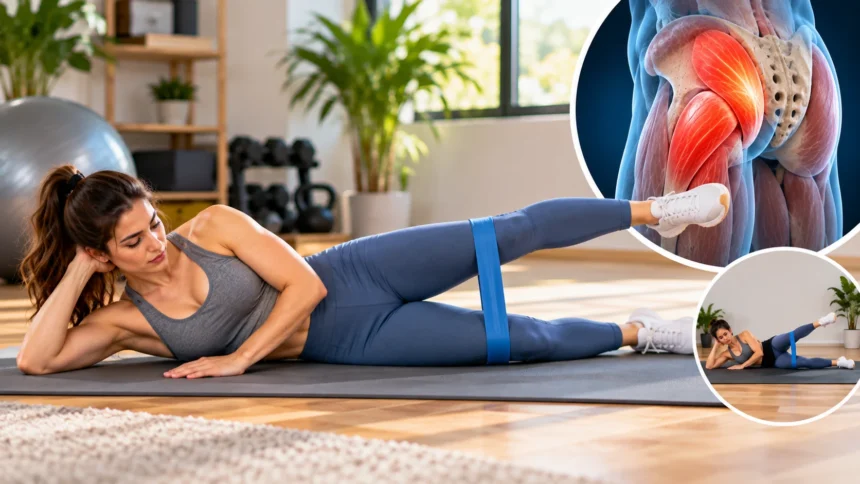
What Are Abductor Exercises?
Abductor exercises strengthen the muscles responsible for moving the leg away from the body’s midline. These muscles sit mainly around the outer hip and help control the pelvis during walking, running, climbing stairs, and standing on one leg. Training them can improve lower-body stability, movement control, and confidence during both everyday activities and athletic movements.
The major hip abductors include the gluteus medius, gluteus minimus, and tensor fasciae latae. These muscles work together to move the thigh outward while also helping prevent excessive dropping or shifting of the pelvis. Although they are relatively small compared with the gluteus maximus, their contribution to balance and hip control is significant.
Abductor exercises can be performed using body weight, resistance bands, cable machines, or gym equipment. Beginners usually benefit from simple movements that allow them to feel the outer hip working without excessive compensation. As strength improves, resistance and complexity can be increased gradually while maintaining controlled technique.
Why Strong Hip Abductors Matter
Strong hip abductors help stabilize the pelvis whenever your body weight shifts onto one leg. This happens repeatedly during normal walking because each step briefly places most of your weight on one side. If these muscles cannot control the pelvis effectively, other muscles and joints may have to work harder to maintain balance.
Hip abductor strength is also important during running, jumping, squatting, and changing direction. These movements create forces through the hips, knees, and ankles that need to be controlled efficiently. Well-conditioned abductors can help keep the thigh and pelvis more stable as the body absorbs impact and generates force.
Strength is only one part of healthy movement, however. Mobility, coordination, overall training load, and technique also influence how your lower body performs. Abductor exercises work best as part of a balanced program that includes hip extension, knee strength, calf work, core control, and movements that challenge the body in different directions.
What Muscles Do Abductor Exercises Work?
The gluteus medius is one of the most important muscles targeted during abductor exercises. It sits on the outer surface of the pelvis and helps move the leg sideways while stabilizing the pelvis during single-leg activities. Different fibers of the muscle may contribute to rotation and hip control depending on the position of the leg.
The gluteus minimus lies underneath the gluteus medius and also assists with hip abduction and stabilization. Although it is difficult to isolate completely, many side-lying, standing, and banded movements engage both muscles together. Its role becomes especially important when maintaining control of the pelvis while the opposite leg moves.
The tensor fasciae latae, often shortened to TFL, also participates in hip abduction. It works with other muscles to control movement of the hip and connects into the iliotibial band along the outer thigh. Good exercise technique helps distribute the workload across the intended muscles rather than allowing one structure to dominate every repetition.
Benefits of Abductor Exercises
One major benefit of abductor exercises is improved hip stability. Stronger outer-hip muscles can help control the position of the pelvis and thigh during walking, running, and strength training. This control may make movements feel smoother and reduce unnecessary side-to-side shifting when performing exercises such as lunges, step-ups, or single-leg squats.
Abductor training can also improve balance because standing on one leg requires the hip muscles to keep the pelvis relatively level. Better balance is useful for sports, daily activities, and exercises that involve changing direction. Older adults may also benefit from appropriate hip strengthening because stable lower-body movement supports confidence during walking and functional tasks.
These exercises can complement rehabilitation programs when weakness contributes to movement difficulties. However, they are not a universal treatment for every hip or knee problem. Pain can have many causes, so exercises should be selected according to your symptoms, current ability, and professional guidance when recovering from an injury.
How to Perform Side-Lying Hip Abduction
Lie on your side with your lower leg slightly bent for stability and your upper leg straight. Keep your hips stacked so the top hip does not roll backward. Gently brace your trunk, keep the upper leg in line with your body, and lift it toward the ceiling without turning the toes excessively upward.
Raise the leg only as high as you can without tilting the pelvis or leaning backward. Pause briefly at the top, then lower the leg slowly until it almost returns to the starting position. You should feel the effort mainly around the outer hip rather than in the front of the hip or lower back.
Start with eight to twelve controlled repetitions on each side and increase gradually as the movement becomes easier. A resistance band around the thighs or ankles can make the exercise more demanding. Avoid adding resistance until you can perform the bodyweight version smoothly without losing alignment or using momentum.
How to Do Standing Hip Abduction Correctly
Stand upright beside a wall, chair, or stable surface for light support. Shift your weight onto one leg while keeping your torso tall and pelvis level. Move the opposite leg slowly out to the side without leaning your upper body away from the working hip or rotating the toes excessively outward.
The movement does not need to be large to be effective. Once the leg reaches a comfortable range, pause briefly and return slowly to the starting position. Try to keep the standing leg stable throughout the repetition because that hip is also working to maintain balance and pelvic control.
Standing hip abduction can be progressed with a resistance band, ankle weight, or cable machine. Increase resistance only when you can maintain good posture and avoid swinging the leg. Controlled repetitions usually provide a better training effect than using heavy resistance while compensating through the trunk or lower back.
How to Perform Banded Lateral Walks
Place a resistance band around your thighs just above the knees or lower around the ankles for greater difficulty. Stand with your feet roughly hip-width apart and bend your knees slightly. Keep your chest upright, hips back comfortably, and maintain gentle outward tension against the band before beginning to move.
Step sideways with one foot, then allow the opposite foot to follow without letting the band become completely slack. Continue for several controlled steps in one direction before returning the other way. Keep your knees aligned with your feet and avoid allowing them to collapse inward as fatigue begins to build.
Banded lateral walks are useful because both hips remain active throughout the movement. The leading leg performs abduction while the opposite side helps stabilize and control the pelvis. Start with short distances and moderate resistance because excessive band tension can cause technique to deteriorate quickly.
How to Do Clamshell Exercises
Lie on your side with your hips and knees bent comfortably and your feet together. Keep your pelvis stacked and your torso still throughout the exercise. Without separating your feet, lift the top knee while avoiding the common mistake of rolling the entire pelvis backward to create a larger range of movement.
Pause when you feel the outer hip working and then lower the knee slowly. The movement may look small, but a large range is unnecessary if pelvic control is lost. Concentrate on smooth muscle engagement instead of opening the knee as far as possible with momentum or rotation through the lower back.
Clamshells can be made harder by placing a resistance band above the knees. They are frequently used during beginner hip-strengthening programs because the position provides support and is easy to modify. However, they should eventually be combined with standing and weight-bearing exercises when your goals involve walking, running, sports, or other functional activities.
Best Abductor Exercises for Functional Strength
Step-ups are a useful functional exercise because they train the hip abductors while also strengthening the quadriceps and glutes. Step onto a stable platform and focus on keeping the knee aligned with the foot as you rise. The hip of the working leg helps stabilize your pelvis while the rest of the lower body produces force.
Single-leg balance exercises are another simple way to challenge the abductors. Stand on one leg while keeping your pelvis level and your trunk relaxed. Once this becomes easy, you can add slow reaches, slight knee bends, or controlled arm movements to increase the stability demand without immediately adding heavy resistance.
Lateral lunges and controlled single-leg squats can provide more advanced strengthening. These movements require hip stability while the body moves through larger ranges and handles greater force. Progress gradually because increasing depth, resistance, and instability at the same time can make technique harder to control and may unnecessarily increase stress on the knees.
Common Mistakes During Abductor Exercises
One common mistake is leaning the torso to create the appearance of a larger leg movement. This reduces the demand on the target muscles and changes the exercise into a compensatory whole-body motion. Keep the pelvis and trunk as stable as possible while allowing movement to come mainly from the hip joint.
Another mistake is using resistance that is too heavy. Strong bands or excessive machine weight may cause swinging, pelvic rotation, or shortened repetitions. A lighter resistance that allows slow, controlled movement is usually more useful for developing strength and coordination than heavy resistance that causes technique to break down.
People also sometimes perform too many repetitions without considering overall training volume. The abductors can become fatigued like any other muscle group, especially when combined with squats, lunges, running, and lower-body workouts. Leave enough recovery between demanding sessions and reduce volume if soreness begins interfering with normal movement or exercise quality.
How Often Should You Train the Hip Abductors?
Most people can train their hip abductors two or three times per week as part of a balanced strength program. This frequency provides repeated practice while allowing time for recovery between sessions. Your ideal schedule depends on exercise intensity, training experience, total lower-body workload, and whether you are strengthening for general fitness or rehabilitation.
Beginners might start with two or three exercises per session and two or three sets of each movement. Moderate repetition ranges such as eight to fifteen controlled repetitions work well for many strengthening exercises. Isometric holds and lateral walks can also be included using time or distance rather than traditional repetitions.
More training is not automatically better. If the muscles remain significantly sore or your technique worsens, additional recovery may be more useful than another workout. Gradually increasing resistance, repetitions, or exercise difficulty provides a safer progression than dramatically increasing every part of the program at once.
Can Abductor Exercises Help Knee Control?
The hip abductors influence the position of the thigh, which means they can contribute to knee control during weight-bearing movements. During squats, running, and landing, the hips help manage the alignment of the leg as forces pass toward the knee. Strengthening them may therefore be included in programs designed to improve lower-body movement quality.
However, knee pain should not automatically be blamed on weak hip abductors. The knee itself, training load, ankle mobility, quadriceps strength, technique, and previous injuries may all contribute. For example, persistent quadriceps tendon pain requires appropriate evaluation rather than relying solely on outer-hip strengthening as a solution.
A balanced program typically includes exercises for the hips and knees together. Step-ups, squats, lunges, and controlled single-leg movements naturally require cooperation between these regions. When pain is present, choosing suitable resistance and range of motion becomes especially important so strengthening improves capacity without repeatedly aggravating sensitive tissues.
How to Progress Abductor Exercises Safely
Progression should begin only when you can perform your current exercises with consistent technique. You might first increase repetitions, then add a stronger resistance band or light external weight. Another option is moving from supported exercises, such as side-lying abduction, toward standing and single-leg variations that require greater balance and coordination.
Exercise tempo can also increase difficulty without adding much resistance. Slowing the lowering phase of a repetition or adding a brief pause can increase muscular effort while preserving control. This approach is especially useful when you have limited equipment or want to improve technique before introducing heavier resistance.
Only change one or two variables at a time so you can see how your body responds. Large jumps in training volume can create excessive soreness and make it difficult to determine which change caused discomfort. Gradual progression allows the muscles, tendons, and nervous system to adapt while reducing unnecessary setbacks.
When Should You Modify Abductor Exercises?
Mild muscle fatigue or temporary soreness can be expected after a new strengthening workout, particularly if the exercises are unfamiliar. Sharp pain in the hip, groin, knee, or lower back is different and should not be ignored. Reduce the resistance or range of movement when an exercise consistently causes uncomfortable joint or tendon symptoms.
People recovering from hip surgery, significant injuries, or persistent pain may require individualized modifications. Certain positions or levels of resistance may not be appropriate during specific stages of rehabilitation. A physiotherapist can help select exercises that challenge the abductors while respecting healing tissues and current movement restrictions.
Stop exercising and seek professional assessment if symptoms include significant weakness, sudden loss of function, persistent numbness, major swelling, or severe pain after injury. Abductor exercises are useful for strengthening, but they cannot diagnose or treat every musculoskeletal problem. Understanding when to modify training is part of exercising safely and effectively.
Conclusion
Abductor exercises strengthen the outer-hip muscles that help move the leg sideways and stabilize the pelvis. The gluteus medius, gluteus minimus, and tensor fasciae latae all contribute to this function. Building strength in these muscles can support balance, walking, running, lower-body training, and many activities that require control on one leg.
Side-lying leg raises, standing abduction, clamshells, lateral band walks, step-ups, and single-leg exercises can all be effective when performed correctly. Focus on controlled movement, stable pelvic positioning, and appropriate resistance instead of trying to create the largest possible range. Good technique allows the intended muscles to work without unnecessary compensation.
Train the abductors consistently while allowing adequate recovery and strengthening the rest of the lower body as well. Progress gradually from simple exercises toward more demanding weight-bearing movements as your control improves. If exercise causes persistent joint pain, weakness, or unusual symptoms, seek professional guidance before continuing to increase the difficulty.
FAQs
What are the best exercises for the hip abductors?
Side-lying hip abduction, standing leg raises, clamshells, lateral band walks, step-ups, and controlled single-leg exercises can all strengthen the hip abductors when performed with proper technique and suitable resistance.
How many abductor exercises should I do?
Two or three abductor exercises in a workout are usually enough for general strengthening. Perform a few controlled sets and gradually increase repetitions or resistance as your strength and movement quality improve.
Can I train hip abductors every day?
Daily hard training is usually unnecessary. Most people can strengthen the hip abductors two or three times per week while allowing recovery between sessions, although lighter mobility or rehabilitation work may follow different guidance.
Do abductor exercises make your hips stronger?
Yes. Abductor exercises strengthen muscles around the outer hip that support lateral movement and pelvic stability. Progressive resistance and consistent training are necessary if your goal is to develop meaningful improvements in strength.
Should I use an abductor machine at the gym?
An abductor machine can strengthen the outer-hip muscles and may be useful as part of a program. Combine it with standing and functional exercises because everyday movement also requires balance, coordination, and weight-bearing control.