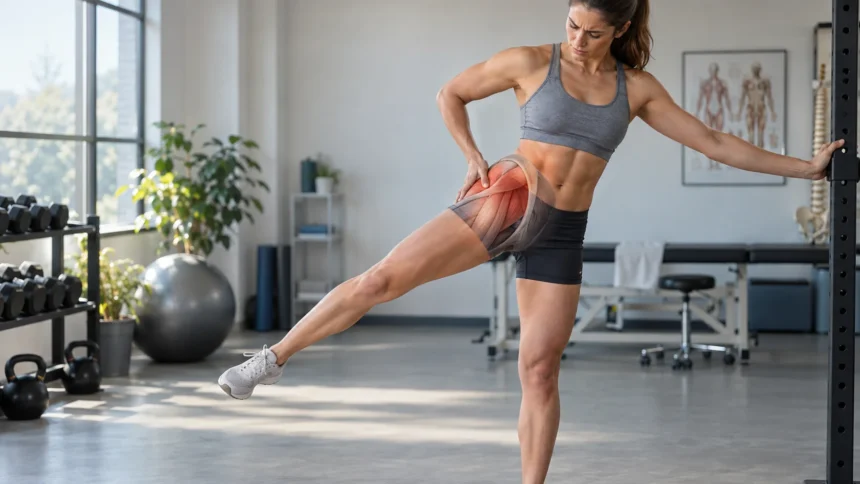
The hip abductors are an important group of muscles that help control movement, stability, and balance around the pelvis and upper leg. You use these muscles during everyday actions such as walking, standing on one leg, climbing stairs, exercising, and changing direction. When they work properly, they help keep the hips and pelvis aligned while supporting smooth lower-body movement.
Weakness, tightness, strain, or overuse of the hip abductor muscles can affect much more than the hip itself. Problems in this muscle group may contribute to discomfort during walking, reduced stability, altered movement patterns, or pain around the outer hip. Understanding their location, function, and common issues can make it easier to recognize problems and care for your hips appropriately.
What Are the Hip Abductors?
The hip abductors are a group of muscles responsible primarily for moving your leg away from the centerline of your body. For example, when you stand upright and raise one leg sideways, your hip abductors produce much of that movement. They also provide stability when your feet remain on the ground during walking, running, or standing.
Several muscles contribute to hip abduction, but the gluteus medius and gluteus minimus are among the most important. The tensor fasciae latae, commonly called the TFL, also assists with moving the thigh outward and supporting hip stability. Other surrounding muscles can contribute depending on the position of the hip and the type of movement being performed.
These muscles work together rather than functioning completely independently. They coordinate with the gluteus maximus, core muscles, hip rotators, and muscles surrounding the knee to control lower-body movement. Because of these connections, weakness in the hip abductors may influence movement patterns throughout the legs, pelvis, and even the lower back.
Where Are the Hip Abductor Muscles Located?
Most of the primary hip abductor muscles are located around the outer side of the pelvis and upper thigh. The gluteus medius sits beneath part of the gluteus maximus and stretches from the outer pelvis toward the upper portion of the thigh bone. Its location allows it to generate significant sideways movement while stabilizing the pelvis.
The gluteus minimus lies deeper underneath the gluteus medius and is smaller in size. It connects the pelvis to the femur and contributes to both hip abduction and rotational control. Although it cannot easily be seen from the outside, it plays an important role in maintaining efficient hip mechanics during walking and other weight-bearing activities.
The tensor fasciae latae is positioned toward the front and outer portion of the hip. It connects with the iliotibial band, which travels along the outside of the thigh toward the knee. Because of this anatomical connection, excessive tension or poor movement around the hip may sometimes influence how the outside of the thigh and knee feel during activity.
What Is the Main Function of the Hip Abductors?
The most obvious function of the hip abductors is moving the thigh outward, away from the body’s midline. This movement is known as hip abduction and occurs during exercises such as side leg raises or lateral band walks. However, these muscles perform several additional functions that are equally important during normal daily movement.
One major responsibility of the hip abductors is keeping the pelvis stable while you walk or stand on one leg. When you take a step, one foot briefly supports most of your body weight while the opposite leg moves forward. The hip abductors on the supporting side help prevent the pelvis from dropping excessively toward the opposite side.
Hip abductors also contribute to controlling rotation and alignment of the femur during dynamic movements. This becomes particularly important during running, jumping, squatting, and changing direction. Effective hip control can help the lower body maintain better alignment, allowing the knees, ankles, pelvis, and trunk to work together more efficiently.
Why Hip Abductor Strength Matters
Strong hip abductors provide a stable foundation for many lower-body activities. They help control the position of the pelvis and thigh when you walk, run, climb stairs, or perform athletic movements. Adequate strength may also make it easier to maintain proper form during exercises such as squats, lunges, lateral movements, and single-leg activities.
Hip abductor strength becomes especially important when performing tasks that require balance on one leg. Each time you walk, your body repeatedly transitions through short periods of single-leg support. If the supporting hip muscles cannot manage the load effectively, other muscles and joints may need to compensate for reduced pelvic stability.
Balanced strength throughout the body is generally more useful than focusing on one isolated area. For example, upper-body strengthening exercises such as band pull-aparts can complement a broader training routine that includes hip, core, and lower-body exercises. A balanced program helps develop strength and movement control across multiple muscle groups rather than overworking one area.
What Causes Weak Hip Abductors?
Hip abductor weakness can develop when these muscles are not challenged regularly. Long periods of sitting and limited physical activity may reduce opportunities for the gluteal muscles to work through meaningful ranges of motion. Over time, some people may notice reduced strength, endurance, or control when performing demanding movements such as running or standing on one leg.
Training habits can also contribute to weakness or muscle imbalance. Someone who focuses mainly on forward and backward movements may perform plenty of squats or walking but very little lateral movement. Adding properly selected side-to-side exercises can help challenge muscles that may receive less direct attention during traditional lower-body training.
Injury, pain, or changes in movement patterns may also affect hip abductor strength. People sometimes unconsciously reduce how much they use a painful area, causing surrounding muscles to become less active or conditioned. Because weakness can have several causes, persistent problems should be assessed rather than automatically assuming that more strengthening exercises will solve the issue.
Common Signs of Hip Abductor Weakness
One possible sign of weak hip abductors is difficulty maintaining pelvic control when standing on one leg. You might notice your pelvis shifting or dropping, or your upper body leaning significantly to maintain balance. These movement changes do not automatically prove weakness, but they may suggest that hip strength and control deserve closer attention.
Some people notice that their knees move inward during squats, running, landing, or climbing stairs. Hip weakness can sometimes contribute to reduced control of the thigh, although ankle mobility, technique, fatigue, and other factors may also influence knee position. Movement patterns should therefore be considered as part of the entire lower-body system rather than blamed on one muscle.
Reduced endurance during side-to-side exercises can be another noticeable clue. For example, lateral band walks or controlled side leg raises may quickly produce fatigue around the outer hip. Occasional fatigue is normal during exercise, but a significant difference between sides or persistent difficulty with everyday activities may justify professional assessment.
Common Hip Abductor Injuries and Problems
Hip abductor strains can occur when the muscles are overloaded, overstretched, or exposed to sudden force. A strain may develop during sports involving sprinting, quick direction changes, or forceful sideways movement. Symptoms can include localized pain, tenderness, weakness, or discomfort when moving the leg away from the body.
Tendons associated with the gluteal muscles can also become irritated or painful. Gluteal tendinopathy commonly causes discomfort around the outside of the hip and may become noticeable during walking, lying on the affected side, climbing stairs, or standing for prolonged periods. Symptoms can vary considerably, so outer hip pain should not automatically be treated as a muscle strain.
Other conditions can produce symptoms in similar areas, including referred pain from the lower back or irritation involving nearby tissues. Hip bursae, tendons, joints, nerves, and muscles are positioned close together, which can make self-diagnosis difficult. Persistent, worsening, or unexplained pain is therefore best evaluated by a qualified healthcare professional.
Hip Abductor Pain: What Does It Feel Like?
Pain involving the hip abductors is often felt around the outer side of the hip, although the exact location depends on which structure is affected. Some people describe an aching sensation, tenderness, or soreness that becomes more noticeable during physical activity. Others may experience sharper discomfort during specific movements or when placing pressure on the affected side.
Muscular discomfort may become noticeable when lifting the leg sideways, walking uphill, running, or repeatedly climbing stairs. Pain may also appear after suddenly increasing exercise volume, intensity, or lateral movement. Delayed muscle soreness following unfamiliar exercise can also affect the outer hip, but it usually improves progressively rather than continuing to worsen.
Pain that interferes with normal walking, sleep, balance, or everyday movement should receive more attention. Sudden severe pain, inability to bear weight, significant swelling, or symptoms following a major injury may require prompt medical evaluation. Identifying the actual source of symptoms is important because different hip conditions can require different management strategies.
How to Strengthen the Hip Abductors
Side-lying leg raises are a simple exercise commonly used to train the hip abductors. Lying on one side, the upper leg is slowly lifted while keeping the pelvis controlled and avoiding excessive rotation. Performing the movement gradually can help you focus on the outer hip muscles rather than using momentum to lift the leg.
Lateral band walks are another popular option for developing hip strength and endurance. A resistance band can be positioned around the thighs, knees, or ankles depending on the desired difficulty and exercise technique. Small controlled sideways steps encourage the hip abductors to remain active while the lower body maintains alignment against resistance.
Single-leg exercises can also challenge the abductors because they require the pelvis to remain stable while one leg supports the body. Step-ups, controlled single-leg balance drills, and appropriately programmed single-leg squats may gradually increase the demand. Exercises should match your current strength and mobility rather than becoming painful or causing significant compensation.
How to Stretch and Improve Hip Mobility
Stretching the muscles surrounding the hip can be helpful when stiffness limits comfortable movement, although not every feeling of tightness means a muscle needs aggressive stretching. Gentle mobility work can help you explore available hip motion while keeping movements controlled. The goal should generally be comfortable mobility rather than forcing the hip into painful positions.
A standing hip stretch can be performed by crossing one leg behind the other and gently shifting the hips sideways. Some people feel a mild stretch along the outer hip and thigh during this movement. The position should remain comfortable, and bouncing or forcing deeper range should be avoided, especially when the area already feels irritated.
Hip mobility can also be supported through controlled movements such as hip circles, gentle rotations, and dynamic warm-up drills. Strength and mobility often work best together because flexible joints still require muscular control throughout their available range. A routine combining movement, strength, recovery, and progressive loading may provide more benefit than relying entirely on static stretching.
How the Hip Abductors Affect Walking and Running
During walking, the hip abductors become particularly important when one foot leaves the ground. The muscles on the supporting side help stabilize the pelvis so the opposite side does not drop excessively. This control allows the trunk, pelvis, and legs to remain coordinated as body weight moves from one side to the other.
Running increases the forces passing through the lower body, making hip stability even more demanding. The hip abductors help control thigh movement each time the foot contacts the ground and the body passes over the supporting leg. Strength, coordination, running technique, training volume, and fatigue can all influence how effectively this process occurs.
When hip control is limited, movement may be redistributed to other parts of the body. The trunk may lean, the pelvis may shift, or the thigh may rotate differently during each step. These changes do not necessarily mean an injury will occur, but improving hip strength can be useful when weakness is identified as part of a broader movement problem.
How to Keep Your Hip Abductors Healthy
Regular movement is one of the simplest ways to support healthy hip muscles. Walking, resistance training, mobility work, and varied physical activities expose the hips to different types of movement. Instead of relying exclusively on forward-facing exercises, including occasional lateral and single-leg movements can help maintain strength across multiple directions.
Progressing exercise gradually can also reduce unnecessary overload. Increasing running distance, resistance, training frequency, or exercise difficulty too quickly may exceed what muscles and tendons are prepared to tolerate. Gradual progression gives the body time to adapt while allowing you to identify soreness or movement problems before they become more disruptive.
Recovery is another important part of maintaining healthy muscles. Adequate sleep, appropriate rest between demanding sessions, and balanced training can help the body respond to physical stress. If hip pain repeatedly returns despite modifying activity, professional guidance may help identify contributing factors and create a more individualized exercise or rehabilitation approach.
Conclusion
The hip abductors are a group of muscles around the outer hip that help move the leg sideways and stabilize the pelvis. The gluteus medius, gluteus minimus, and tensor fasciae latae are major contributors to these functions. They play an important role in walking, running, balancing, exercising, and controlling lower-body alignment.
Weakness, overuse, strains, tendon problems, and movement changes can sometimes affect the hip abductors. Symptoms may include outer hip discomfort, reduced balance, muscle fatigue, or difficulty controlling the pelvis during activity. Because different conditions can produce similar symptoms, persistent pain should not automatically be assumed to result from weak muscles.
Strengthening exercises, mobility work, varied movement, and gradual training progression can help support healthy hip function. Exercises should remain controlled and appropriate for your ability, especially when returning from discomfort or injury. Maintaining strong and coordinated hip muscles can support comfortable movement during both everyday activities and more demanding physical exercise.
FAQs
What are the main hip abductor muscles?
The main hip abductors include the gluteus medius, gluteus minimus, and tensor fasciae latae. These muscles work together to move the thigh outward and help stabilize the pelvis during movement.
Where are the hip abductors located?
The primary hip abductors are located around the outer side of the pelvis and upper thigh. The gluteus medius and minimus connect the pelvis to the femur, while the TFL sits toward the outer-front hip.
What causes hip abductor weakness?
Hip abductor weakness may develop because of inactivity, prolonged sitting, insufficient lateral training, injury, pain, or altered movement patterns. The exact cause varies, so persistent weakness may require professional evaluation.
Can weak hip abductors cause pain?
Weakness may contribute to altered movement and increased demand on surrounding tissues, but pain can have many possible causes. Muscle strains, tendon problems, joint conditions, and referred pain can produce similar symptoms.
What exercises strengthen the hip abductors?
Common hip abductor exercises include side-lying leg raises, lateral band walks, step-ups, and controlled single-leg exercises. Resistance and difficulty should be increased gradually while maintaining comfortable, controlled technique.