Lunges are among the most versatile lower-body exercises because they strengthen several muscle groups while challenging balance and coordination. Whether you exercise at home or in a gym, a lunges workout can help improve leg strength, hip stability, and everyday movement. The exercise requires little equipment, making it accessible to people with different fitness levels and training goals.
However, performing lunges correctly is important for developing strength while avoiding unnecessary discomfort. Small adjustments to your stance, knee position, and movement speed can influence how the exercise feels. This guide explains the main benefits of lunges, proper technique, muscles worked, useful variations, and practical ways to include them in a balanced workout routine.
What Is a Lunges Workout?
A lunges workout is a lower-body training routine that includes movements performed with one leg positioned in front of or behind the other. During a basic lunge, you bend your knees and lower your body while maintaining control. The exercise challenges the legs and hips while requiring coordination between several muscle groups.
Lunges are considered compound exercises because multiple joints and muscles contribute to each repetition. The hips, knees, and ankles work together as the body lowers and rises. Muscles around the abdomen and pelvis also help maintain stability throughout the movement, particularly when balance becomes challenging.
A lunges workout can include forward lunges, reverse lunges, walking lunges, and other variations. Each version changes the movement pattern and places slightly different demands on the body. Choosing suitable exercises allows beginners and experienced individuals to develop strength while working toward their personal fitness goals.
What Muscles Do Lunges Work?
Lunges primarily target the quadriceps, gluteal muscles, and hamstrings. These muscle groups help control movement at the hips and knees while supporting the body during each repetition. The exact contribution of each muscle depends on stride length, torso position, and the particular lunge variation being performed.
The quadriceps help extend the knee as you rise from the lowered position. The gluteus maximus contributes to hip extension, while the hamstrings assist with movement and joint control. These muscles work together to produce a coordinated lower-body exercise rather than functioning independently.
Additional muscles, including the calves, hip stabilizers, and abdominal muscles, help maintain balance. The gluteus medius plays an important role in controlling pelvic position during single-leg movements. Because several muscle groups participate, lunges provide a practical way to challenge lower-body strength and coordination simultaneously.
How to Perform a Forward Lunge Correctly
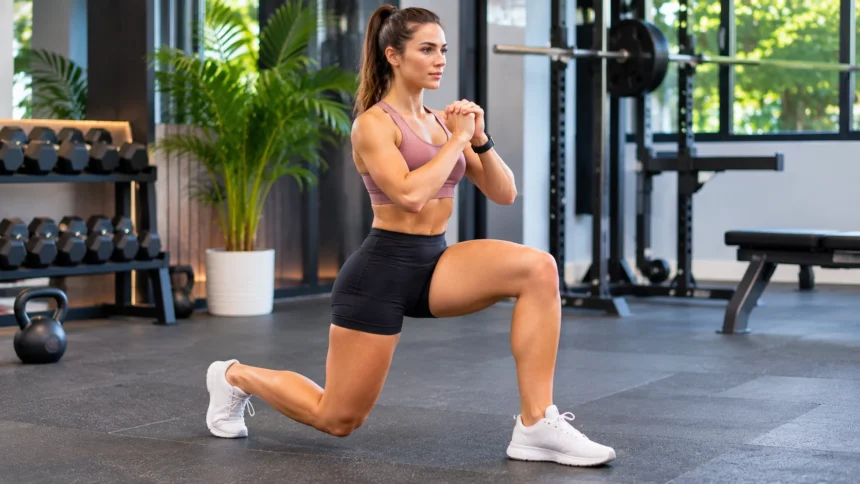
Begin by standing comfortably with your feet approximately hip-width apart. Keep your torso upright and look forward while maintaining a relaxed shoulder position. Step one foot forward far enough to create a stable stance, allowing your weight to remain controlled between both legs.
Bend both knees gradually as you lower your body toward the floor. Your front knee should move comfortably in line with your foot, while your back knee travels downward. Lower only as far as you can maintain balance and control without sharp pain or excessive strain.
Push through your front foot to return to the starting position, then repeat with the opposite leg. Move slowly enough to maintain stability throughout the exercise. If stepping forward feels difficult, begin with a supported split squat before progressing to dynamic lunges.
Why Proper Lunge Form Matters
Proper technique allows the muscles and joints to work together during each repetition. When the body moves with control, the exercise becomes easier to adjust according to individual strength and mobility. Poor balance or excessive momentum can make the movement less predictable and more uncomfortable.
Knee position is one important consideration during lunges. Allow your front knee to follow the general direction of your toes rather than forcing it inward. It is normal for the knee to move forward beyond the toes when the movement is comfortable and controlled.
Your torso position also influences how the exercise loads different muscle groups. A relatively upright torso can emphasize knee extension, while a slight forward lean may increase hip involvement. Neither position is universally correct, so focus on maintaining comfortable alignment and a stable movement pattern.
Key Benefits of Doing Lunges Regularly
One major benefit of lunges is improved lower-body strength. The movement challenges several important muscle groups, including the quadriceps and glutes. With suitable resistance and consistent practice, lunges can contribute to muscular development and make everyday activities feel more manageable.
Lunges also challenge balance because the feet are positioned separately rather than side by side. This requires muscles around the hips, ankles, and trunk to coordinate movement. Regular practice may improve your ability to maintain control during similar physical activities.
Another advantage is the flexibility of the exercise. Lunges can be performed using body weight, dumbbells, or other appropriate resistance. Different variations make it possible to adjust difficulty, movement range, and training emphasis without requiring a completely different workout routine.
How Lunges Strengthen Your Quadriceps
The quadriceps are a group of four muscles located at the front of the thigh. Their primary role is extending the knee, although one muscle also contributes to hip movement. During lunges, the quadriceps help control the lowering phase and produce force as the body rises.
The front leg often experiences considerable quadriceps demand, particularly when the knee bends deeply under control. A shorter stance or more upright torso may change the emphasis of the movement. However, individual anatomy and comfort influence how each variation feels.
Stronger quadriceps contribute to activities such as climbing stairs, standing from a chair, and walking uphill. Lunges can help develop this strength alongside squats and other lower-body exercises. Gradual progression is important because increasing resistance too quickly may create unnecessary fatigue or discomfort.
How Lunges Work the Glutes and Hamstrings
The gluteus maximus is an important muscle for extending the hip during activities such as standing, climbing, and running. Lunges challenge this muscle as the body rises from the lowered position. The amount of glute involvement depends partly on stride length and hip movement.
The hamstrings also contribute during lunges, although they are not always the primary muscles producing the movement. They help coordinate hip and knee actions while supporting lower-body control. Their involvement works alongside the quadriceps and glutes to create a stable movement.
A slightly longer stance may increase the hip extension demands of some lunge variations. However, exaggerated stride lengths can make balance difficult or place the joints in uncomfortable positions. Choose a stance that allows controlled movement instead of trying to force one particular muscle to work harder.
Can Lunges Improve Balance and Stability?
Lunges challenge balance because the body must control its position while the legs support weight in a staggered stance. The movement requires coordination between muscles around the hips, knees, and ankles. This makes lunges useful for practicing lower-body control during changing positions.
Balance demands become more noticeable during walking lunges or reverse lunges because the feet move between repetitions. The nervous system must coordinate these movements while maintaining stability. Over time, appropriately challenging exercises can support improvements in balance and movement confidence.
People who find lunges difficult can begin by holding a stable surface for support. This reduces the balance challenge while allowing attention to leg strength and technique. Support can gradually be reduced as control improves, provided the movement remains comfortable and appropriate.
Forward Lunges vs. Reverse Lunges
Forward lunges involve stepping ahead of the starting position before lowering the body. Reverse lunges use a backward step, creating a different movement pattern. Both exercises challenge similar lower-body muscles, including the quadriceps, glutes, and supporting stabilizers.
Some people find reverse lunges easier to control because the front foot remains planted during the stepping phase. Others prefer forward lunges because the movement feels more familiar. Neither variation is automatically safer for everyone, and individual comfort should guide exercise selection.
Beginners may benefit from trying both versions with a small range of motion. The best choice is the one that allows comfortable knee movement and stable balance. More experienced exercisers can include both variations to introduce different coordination challenges into their lower-body training.
Walking Lunges: Form and Benefits
Walking lunges involve stepping forward into successive lunge positions rather than returning to the same starting location. This creates a continuous movement pattern that challenges the legs and balance. The exercise is commonly used in strength training and athletic conditioning routines.
To perform walking lunges, take a controlled step forward and lower into a comfortable lunge. Rise through the front leg and bring the back leg forward into the next repetition. Maintain a steady pace and allow enough space to move safely without obstacles.
Walking lunges can increase coordination demands compared with stationary variations. They may also challenge muscular endurance when performed through several controlled repetitions. However, people who struggle with balance should first build confidence using supported or stationary lunges before attempting continuous movement.
Side Lunges for Lower-Body Mobility
Side lunges, also called lateral lunges, involve stepping sideways rather than forward or backward. This movement changes the direction of loading and challenges the hips and legs differently. It can be a useful addition to routines that mainly involve forward and backward exercises.
During a side lunge, one knee bends while the opposite leg remains relatively straight. The hips move backward as the body lowers toward the stepping leg. Maintaining a comfortable range of motion helps avoid forcing the hips or knees into positions beyond current mobility.
Lateral lunges challenge the quadriceps, glutes, and muscles around the inner thighs. They can also introduce useful side-to-side movement variety. Beginners should start with shallow movements and gradually increase the range as strength, mobility, and confidence develop.
Curtsy Lunges: What You Should Know
Curtsy lunges involve stepping one leg diagonally behind the other before bending the knees. This creates a different movement pattern from traditional forward or reverse lunges. The exercise challenges lower-body coordination and can involve the gluteal muscles and surrounding stabilizers.
Because the legs cross behind one another, curtsy lunges may create additional rotational demands around the hips and knees. Some people find the movement comfortable, while others experience unnecessary joint stress. It is not essential for developing strong glutes or achieving effective lower-body training.
If you choose to perform curtsy lunges, begin with a shallow range and avoid forcing excessive crossover. Maintain control and stop if the movement causes discomfort. Reverse lunges or lateral lunges provide practical alternatives when diagonal stepping does not suit your movement abilities.
Dumbbell Lunges for Strength Training
Adding dumbbells increases the resistance during a lunges workout and challenges the lower-body muscles more strongly. Dumbbells are commonly held beside the body while performing forward, reverse, or walking lunges. This variation is suitable when bodyweight lunges can already be completed with comfortable technique.
Start with manageable weights that allow you to maintain balance and controlled knee movement. Holding heavier dumbbells changes the total loading demands and may increase fatigue. It is usually more useful to progress gradually than to select challenging weights before mastering the movement.
Dumbbell lunges can be included in strength sessions alongside squats, rows, and other compound exercises. The amount of resistance depends on training experience and individual goals. Proper rest between demanding sets helps maintain technique and supports muscular recovery.
Lunges vs. Squats: Which Exercise Is Better?
Lunges and squats both train the lower body, but they involve different movement demands. Squats generally require both legs to work together in a relatively symmetrical stance. Lunges use a staggered position, creating additional balance and coordination challenges.
Both exercises involve the quadriceps, glutes, and other supporting muscles. Lunges may help identify differences in strength or control between the legs, while squats provide another way to train coordinated lower-body force production. Neither movement is automatically superior for every fitness goal.
A balanced strength routine can include both exercises when they are comfortable and appropriate. Squats may serve as a primary bilateral movement, while lunges provide additional single-leg emphasis. Choosing exercises based on individual needs is more useful than trying to identify one universally best lower-body exercise.
Common Lunge Mistakes to Avoid
One common mistake is stepping into a stance that feels too narrow or unstable. Placing the feet directly along one line can make balancing more difficult. Keeping some space between the feet allows a wider base of support and may improve control.
Another mistake is using momentum to move through repetitions too quickly. Rapid movements can reduce balance and make it harder to maintain comfortable knee alignment. Slowing down helps you focus on controlling the lowering and rising phases of each lunge.
Some people also continue lunges despite sharp knee, hip, or ankle pain. Exercise should be challenging without causing significant joint discomfort. Reducing the movement range, choosing a different variation, or seeking professional guidance may be appropriate when symptoms persist.
How Many Lunges Should Beginners Do?
Beginners may start with a small number of comfortable repetitions on each leg. For example, one or two sets of six to eight controlled lunges per side can provide an introduction to the exercise. The appropriate number depends on strength, balance, and previous training experience.
The goal is to learn the movement before increasing training volume. If balance becomes difficult or technique deteriorates, take a break or reduce repetitions. A supported split squat may be more suitable than a moving lunge during the early stages.
As strength and coordination improve, additional repetitions or resistance may be introduced gradually. Progress should reflect comfortable movement rather than pressure to complete a particular number. Consistency, appropriate recovery, and controlled technique are more important than performing high-volume workouts immediately.
How Often Should You Include Lunges in Workouts?
Lunges can be included in lower-body workouts or full-body strength sessions depending on your exercise schedule. The appropriate frequency depends on resistance, total training volume, and recovery needs. Many people benefit from allowing time between demanding lower-body sessions.
Bodyweight lunges performed at an easy intensity may create different recovery demands from heavy weighted lunges. More challenging workouts require greater attention to fatigue and muscle recovery. A training program should account for other exercises that involve the same muscle groups.
Rather than performing lunges intensely every day, focus on balanced activity and gradual progression. Strength training can be combined with walking, mobility work, and other suitable movements. Adjust frequency when soreness or fatigue begins interfering with normal activities or exercise technique.
How to Make Lunges Easier or Harder
Lunges can be modified to suit different abilities without changing their basic purpose. Beginners may use a wall, sturdy chair, or railing for support while performing a split squat. Reducing the depth of the movement can also make it easier to maintain balance.
As confidence improves, the exercise can progress through a greater comfortable range of motion. Dynamic stepping variations introduce additional coordination demands. Dumbbells or other suitable resistance can eventually provide a stronger muscular challenge when basic technique feels controlled.
Advanced variations should be selected according to training goals rather than difficulty alone. A person does not need jumping lunges or complicated movements to build lower-body strength. Controlled resistance exercises can provide meaningful progress while allowing attention to comfort and technique.
Who Should Modify or Avoid Lunges?
Lunges may need modification for people experiencing knee, hip, or ankle pain. Some injuries or medical conditions make deep knee bending or loaded single-leg exercise uncomfortable. A qualified healthcare professional can help identify suitable alternatives when movement restrictions are necessary.
People recovering from surgery or significant lower-body injuries should follow individualized rehabilitation instructions. The appropriate lunge variation depends on tissue healing, strength, mobility, and balance. Returning to demanding movements too quickly may interfere with recovery or aggravate existing symptoms.
Balance difficulties can also make unsupported lunges challenging. Using a stable support or beginning with a stationary exercise may reduce the risk of losing balance. The most useful exercise is one that matches current ability and can be performed without unnecessary pain or instability.
How to Add Lunges to a Balanced Workout
A balanced lunges workout should consider overall lower-body strength rather than focusing on one movement alone. Lunges can be combined with squats, hip hinges, and calf exercises to challenge different muscles. Including varied exercises helps develop strength across multiple movement patterns.
Lunges may be performed early in a workout when balance and coordination are important. Alternatively, lighter variations can be included later as supplementary exercises. The best placement depends on training goals, available energy, and the other movements included in the session.
A warm-up involving comfortable lower-body movements can help prepare for lunges. Begin with manageable resistance and gradually increase difficulty as technique improves. Regularly reviewing comfort, control, and recovery makes it easier to maintain a sustainable training routine.
Conclusion
Lunges are versatile lower-body exercises that strengthen the quadriceps, glutes, hamstrings, and supporting muscles. They also challenge balance, coordination, and controlled movement around the hips, knees, and ankles. Different variations allow the exercise to be adapted to a wide range of fitness levels and training preferences.
Performing lunges correctly involves choosing a stable stance, maintaining comfortable knee alignment, and moving at a controlled pace. Beginners can start with supported or stationary variations before progressing to dynamic movements. More experienced individuals may introduce dumbbells, walking lunges, or lateral variations to create additional training challenges.
A lunges workout can be a valuable part of a balanced strength training program when it matches individual abilities and recovery needs. Focus on gradual progress and avoid exercises that create sharp or persistent discomfort. With consistent practice and appropriate technique, lunges can help develop useful lower-body strength for everyday activities.
Frequently Asked Questions
What muscles do lunges work the most?
Lunges primarily work the quadriceps and gluteal muscles, with contributions from the hamstrings, calves, and hip stabilizers. Core muscles also help maintain balance and trunk control throughout the exercise.
Are lunges good for beginners?
Yes, beginners can perform lunges using a comfortable range of motion and appropriate support. Stationary split squats or supported reverse lunges may be easier starting points than walking lunges.
Are lunges better than squats?
Neither exercise is universally better. Squats and lunges both strengthen the lower body, but lunges introduce additional balance demands and greater single-leg emphasis. Including both can provide useful training variety.
How many lunges should I do in a workout?
Beginners may start with one or two sets of six to eight controlled repetitions per leg. The appropriate amount depends on fitness level, resistance, exercise technique, and recovery needs.
Can lunges cause knee pain?
Lunges may cause discomfort when the exercise exceeds current strength, mobility, or injury tolerance. Reducing the movement depth or changing variations may help, but persistent knee pain should be assessed by a healthcare professional.