What Is a Single Leg Balance Reach?
The single leg balance reach is a functional exercise that challenges balance, coordination, lower-body strength, and body control at the same time. You stand on one leg while reaching the opposite foot, hand, or both toward a chosen direction. The movement looks simple, but maintaining stability requires several muscles and joints to work together efficiently.
This exercise is commonly used in fitness training, sports conditioning, rehabilitation programs, and movement assessments because it reveals how well the body controls itself on one leg. Your ankle, knee, hip, core, and supporting muscles must respond continuously to small changes in position. The exercise can therefore highlight differences in stability between the left and right sides.
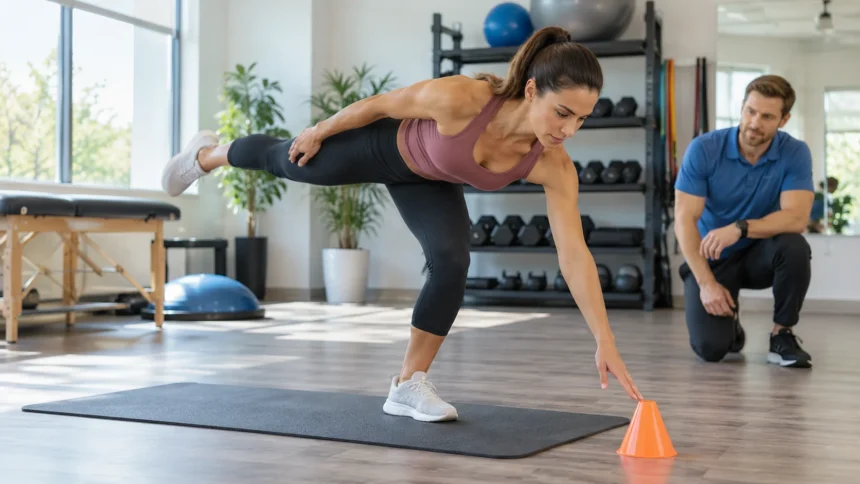
There are several versions of the movement, including forward reaches, diagonal reaches, side reaches, and backward reaches. Some variations involve touching the floor with the free foot, while others use the hand to reach toward a target. Regardless of the version, the main goal is maintaining controlled alignment rather than reaching as far as possible.
Muscles Used During the Single Leg Balance Reach
The gluteal muscles play an important role during the single leg balance reach because they help stabilize the pelvis and control the position of the thigh. The gluteus medius is especially important for keeping the pelvis level while standing on one leg. Strong hip muscles can also help the knee remain aligned during the reaching portion of the exercise.
The quadriceps and hamstrings work together to control the standing knee as the body lowers and returns upright. Meanwhile, the calf muscles and smaller muscles around the ankle continuously adjust to maintain balance. These muscles respond to small shifts in body weight, helping the foot stay connected to the ground while the rest of the body moves.
Your core muscles also contribute because the trunk must remain controlled as your center of mass moves away from the standing leg. Abdominal, spinal, and pelvic muscles help prevent excessive twisting or leaning. The exercise is therefore not simply a leg movement; it is a coordinated full-body stability drill that depends on control from the foot through the torso.
How to Perform the Single Leg Balance Reach
Begin by standing tall with your feet about hip-width apart and your weight evenly distributed. Shift your body weight onto one leg and gently lift the opposite foot from the floor. Keep the standing knee slightly bent rather than locked, maintain a tall posture, and focus your eyes on a stable point in front of you.
Slowly reach the free foot forward while allowing the standing knee and hip to bend slightly. Move only as far as you can while keeping your balance and maintaining good alignment through the standing leg. Lightly touch the floor with the reaching foot if needed, then return to the starting position with controlled movement rather than using momentum.
Repeat the reach in different directions once you can perform the forward version comfortably. Side and diagonal reaches increase the stability challenge because they move your body weight in less familiar directions. Begin with a small range of motion, complete several controlled repetitions on each side, and increase the reaching distance only when your technique remains steady.
Why the Single Leg Balance Reach Is Useful
One major benefit of the single leg balance reach is improved lower-body stability. Many daily activities, including walking, climbing stairs, stepping over obstacles, and getting in or out of a vehicle, briefly require the body to support itself on one leg. Training this ability can help improve confidence and movement control during ordinary activities.
The exercise can also improve proprioception, which is the body’s ability to sense joint position and movement without constantly looking at the limbs. Better proprioceptive control allows the nervous system to make faster adjustments when balance changes unexpectedly. This ability is especially valuable for athletes who need to cut, jump, land, accelerate, and change direction during sport.
Another advantage is that the movement can reveal side-to-side differences that may not be obvious during two-legged exercises. One leg may feel stronger, more stable, or more coordinated than the other. Noticing these differences does not automatically mean something is wrong, but it can help guide balanced strength and stability training.
Common Form Mistakes to Avoid
One common mistake is allowing the standing knee to collapse noticeably inward as you reach. Some natural movement is expected, but excessive inward motion may reduce control and place additional stress on surrounding structures. Focus on keeping the knee generally aligned with the middle of the foot while allowing the hip and ankle to participate naturally.
Another mistake is reaching too far before adequate balance has been developed. People sometimes prioritize touching a distant point and compensate by twisting the pelvis, collapsing the trunk, or losing control of the standing foot. A shorter controlled reach is more useful than a longer reach performed with unstable technique or repeated loss of balance.
Holding the breath or stiffening the entire body can also make the exercise unnecessarily difficult. Breathe normally and allow small adjustments at the ankle, knee, and hip. Balance is dynamic rather than completely motionless, so minor movement is expected. The goal is controlled correction, not forcing the body to remain perfectly still throughout every repetition.
How the Exercise Can Support Knee and Hip Control
The single leg balance reach encourages the hip and knee to work together during weight-bearing movement. When performed with good technique, the hip muscles help control the position of the thigh while the quadriceps and hamstrings manage knee movement. This coordination is useful for activities that involve stepping, squatting, running, or changing direction.
People who experience recurring inner knee pain should avoid assuming that balance exercises alone will solve the problem. Knee discomfort can have several causes, and pain may require professional assessment before loading exercises are progressed. If the movement increases pain, reduce the range, stop the exercise, or seek appropriate guidance.
For people without pain, practicing controlled single-leg movements may help build strength and confidence around the knee and hip. The emphasis should remain on quality rather than fatigue. Once the standing leg becomes too tired to maintain alignment, technique often deteriorates, so ending the set before control is lost is usually more productive.
How to Make the Exercise Easier
Beginners can start by performing a simple single-leg stand before adding any reaching movement. Stand beside a wall, sturdy chair, or countertop so you have support available if balance is lost. Hold the position for a comfortable period while keeping the standing knee slightly bent and the pelvis level before progressing to small reaches.
Another option is to keep the reaching foot close to the ground and tap it lightly rather than extending far away from the body. This reduces the shift in your center of mass and makes balance easier to control. You can gradually increase the reaching distance as strength, coordination, and confidence improve over several sessions.
Wearing supportive footwear and practicing on a firm, non-slip surface can also make the exercise more manageable. Avoid starting on soft cushions or unstable platforms because these add difficulty before basic control has been established. A slow progression allows the nervous system and supporting muscles to adapt without introducing unnecessary instability too early.
How to Make the Exercise More Challenging
Once the basic movement feels controlled, you can gradually increase the reaching distance or add more directions. Forward, lateral, diagonal, and backward reaches each challenge the body differently. Moving through several directions in a sequence can increase coordination demands while requiring the standing hip, knee, ankle, and core to respond to changing positions.
You can also perform the movement more slowly or pause briefly at the farthest controlled point. Slower repetitions reduce the ability to rely on momentum and increase the time your stabilizing muscles must work. Holding the position for one or two seconds can make a small reach considerably more challenging without requiring additional equipment.
Advanced exercisers sometimes use light weights, resistance bands, unstable surfaces, or more complex reaching patterns. These progressions should only be added when the basic version can be performed consistently with good alignment. Increasing difficulty too quickly may simply create compensation, so progression should focus on maintaining control rather than making the exercise look more complicated.
Who Can Benefit From Single Leg Balance Training?
Single leg balance exercises can be useful for recreational exercisers who want to improve lower-body stability and coordination. Because many common movements briefly place the body on one leg, practicing controlled single-leg support has practical value. The exercise can also complement strength training by challenging smaller stabilizing muscles that may receive less attention during basic machine-based workouts.
Athletes may use variations of the balance reach as part of warm-ups, conditioning, or movement preparation. Sports involving running, cutting, jumping, kicking, or rapid direction changes place significant demands on single-leg control. Improving balance does not guarantee injury prevention, but strong coordination and movement quality can support broader athletic training programs.
Older adults may also benefit from appropriately scaled balance work because balance becomes increasingly important for safe movement and confidence. However, anyone with a recent injury, significant dizziness, severe joint pain, or a history of falls should use additional support and professional guidance when needed. Exercise difficulty should always match the individual’s current ability and health status.
How Often Should You Practice the Exercise?
The single leg balance reach does not usually require long training sessions. Beginners can practice a few controlled repetitions on each side two or three times per week, depending on their overall exercise program. Because the goal is coordination and stability, performing the exercise while relatively fresh often produces better technique than waiting until the legs are heavily fatigued.
A simple starting approach is to perform five to eight controlled reaches in each chosen direction on both legs. Rest briefly between sets if balance or alignment begins to decline. The exact number is less important than maintaining smooth movement, stable breathing, and control of the standing knee, hip, and foot throughout each repetition.
Progress can be measured by improved control, longer reaching distance, fewer balance corrections, or better symmetry between sides. Avoid increasing every variable at once. Change one challenge at a time, such as adding distance, directions, pauses, or resistance, so you can identify whether the body is adapting well without sacrificing movement quality.
When to Stop or Modify the Exercise
Balance training should feel challenging, but it should not cause sharp, increasing, or unusual pain. Stop the exercise if you develop sudden knee, ankle, hip, or back pain during the movement. Mild muscular effort is expected, but joint pain, catching, giving way, or a sensation that the leg cannot support you deserves more caution.
Dizziness, lightheadedness, or repeated loss of balance is another reason to stop and reassess. Use a stable support nearby if you are uncertain about your balance ability. People recovering from lower-body surgery or significant injury should follow the progression recommended by their healthcare or rehabilitation professional rather than introducing difficult single-leg drills independently.
Persistent pain after the exercise should also be taken seriously, especially if symptoms worsen with walking or daily activity. A physical therapist or other qualified healthcare professional can assess movement, strength, joint function, and possible underlying issues. Modifying an exercise is not a setback; it is a practical way to keep training appropriate for your current condition.
Conclusion
The single leg balance reach is a practical exercise for improving balance, coordination, lower-body stability, and movement awareness. It challenges the ankle, knee, hip, core, and nervous system simultaneously while requiring the body to remain controlled on one leg. Its simplicity makes it easy to include in many fitness and movement programs.
Good technique matters more than reaching the greatest possible distance. Keeping the standing leg controlled, moving slowly, and progressing gradually allows the exercise to provide a useful stability challenge without unnecessary compensation. Beginners can start with small reaches and external support before moving toward more complex directions or added resistance.
Pay attention to how your body responds during and after each session. Sharp pain, repeated giving way, dizziness, or worsening joint discomfort are reasons to stop and seek appropriate guidance. When performed at the right difficulty level, the single leg balance reach can be a valuable addition to a balanced strength and mobility routine.
FAQs About the Single Leg Balance Reach
What does the single leg balance reach improve?
The exercise can improve balance, coordination, proprioception, hip stability, knee control, and ankle strength. It also trains the body to maintain alignment while the center of mass moves in different directions.
Is the single leg balance reach good for beginners?
Yes, beginners can perform a simplified version with short reaches and a wall or chair nearby for support. Difficulty should increase gradually as balance, confidence, and movement control improve.
How long should I balance on one leg?
There is no single ideal time for everyone. Beginners may start with short holds of 10–20 seconds before adding reaches, while more experienced exercisers can focus on controlled repetitions instead of longer static holds.
Why does my knee move inward during the exercise?
Limited hip strength, ankle control, fatigue, or movement habits may contribute to inward knee movement. Reduce the reaching distance and focus on alignment rather than forcing a deeper or longer reach.
Can I do single leg balance reaches every day?
Light balance practice may be appropriate frequently for some people, but harder variations require adequate recovery. Adjust frequency according to difficulty, overall training volume, soreness, and how well your technique remains controlled.