Squats are one of the most widely used lower-body exercises because they train several major muscle groups at the same time. Whether you perform bodyweight squats, goblet squats, or weighted barbell variations, the movement mainly targets the thighs and hips while also requiring your core and upper body to stabilize the position.
Understanding which muscles squats work can help you improve technique, choose the right variation, and build a more balanced workout routine. The exact muscle emphasis changes depending on stance, depth, load, and squat style. However, most squat variations involve the quadriceps, glutes, hamstrings, adductors, calves, and trunk muscles working together.
What Muscles Do Squats Work?
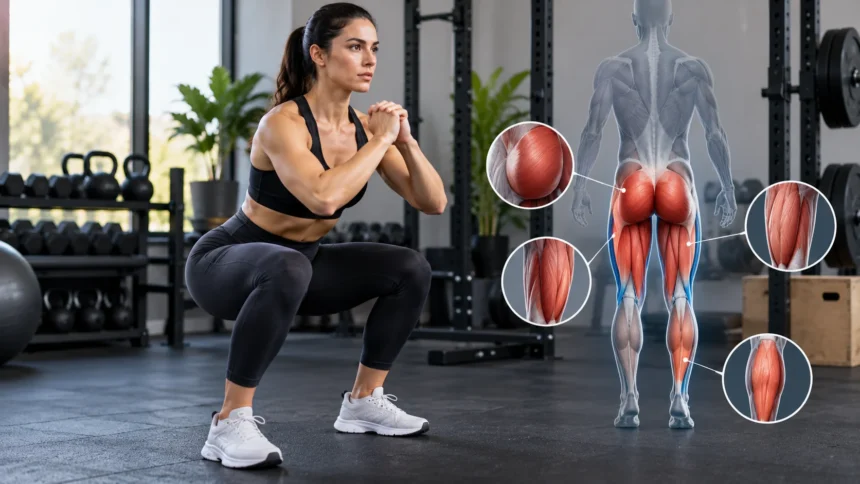
Squats primarily target the quadriceps and gluteal muscles because these muscle groups generate much of the force required to lower and raise your body. The quadriceps extend the knee as you stand, while the glutes help extend the hips. Together, they provide much of the power needed to complete each repetition.
The hamstrings and inner-thigh muscles also contribute throughout the movement. They help control the hips, stabilize the knees, and assist with maintaining proper alignment as you descend and stand. Although they may not always work as strongly as the quadriceps and glutes, their role remains important for smooth and controlled movement.
Your core, lower back, calves, and other stabilizing muscles also participate. They help keep your torso controlled, maintain balance, and transfer force between your upper and lower body. This combination of prime movers and stabilizers is one reason squats are considered a highly effective compound exercise for overall lower-body development.
How Squats Target the Quadriceps
The quadriceps are located at the front of the thigh and are among the primary muscles worked during squats. Their main responsibility during the exercise is extending the knee as you rise from the bottom position. They also help control knee bending as you lower yourself during the eccentric phase.
Squat depth can influence how much work the quadriceps perform. As the knees bend farther, the quads generally need to produce more force to reverse the movement and return you to standing. Front squats, heel-elevated squats, and narrower stance variations may also place greater emphasis on knee movement and quadriceps involvement.
Strong quadriceps can support activities such as climbing stairs, standing from a chair, jumping, and running. Training them through squats can improve lower-body strength while developing coordination with the hips and ankles. Proper technique matters, however, because increasing load too quickly can reduce movement quality and make the exercise unnecessarily uncomfortable.
How Squats Work the Glutes
The gluteus maximus is another major muscle involved in squatting. It helps extend the hips as you drive upward from the bottom of the movement. The deeper the hip flexion during a squat, the more the glutes may contribute to producing force as you return toward a standing position.
The smaller gluteal muscles also contribute by helping stabilize the pelvis and control hip position. They work to prevent excessive inward movement of the knees and support balance throughout each repetition. This stabilizing role becomes especially noticeable during single-leg squat variations, split squats, and other exercises requiring greater control.
If your goal is to emphasize the glutes, squat depth, stance, and loading style can influence the movement. A comfortable deeper squat and variations that involve substantial hip flexion may increase glute involvement. However, glute growth also depends on training volume, resistance, progression, recovery, and including other hip-extension exercises in your program.
Hamstrings, Adductors, and Calves During Squats
The hamstrings run along the back of the thigh and contribute to hip extension and knee stability during squatting. Their role is more complex than simply bending the knee because both the hip and knee are moving simultaneously. They often function alongside the glutes to control the hip and maintain stability throughout the exercise.
The adductors, located along the inner thigh, also work during squats. The adductor magnus in particular can assist with hip extension when rising from a deeper squat position. A wider stance may increase the demand placed on certain inner-thigh muscles, although stance should still feel comfortable and allow the knees to track naturally.
The calves assist with ankle control and balance as the knees move forward over the feet. The soleus in particular works to stabilize the lower leg during knee flexion. Limited ankle mobility can change squat mechanics, sometimes causing the heels to rise or the torso to lean excessively forward to maintain balance.
How Squats Work Your Core and Back
Squats are primarily considered a lower-body exercise, but your core works continuously to stabilize the torso. The abdominal muscles create tension that helps resist excessive bending or rotation while you move. This becomes increasingly important when performing goblet, front, or barbell squats with additional resistance.
The spinal erectors along the back help maintain an appropriate torso position during the exercise. They work isometrically to prevent the spine from collapsing forward under load. This does not mean the back should remain perfectly vertical, because some forward torso lean is normal depending on your body proportions and the squat variation.
Bracing effectively allows force generated by the legs and hips to move through a stable trunk. Before descending, gently create abdominal tension as though preparing for a controlled impact while continuing to breathe appropriately. Heavy lifting may require more specific bracing techniques, which can be learned with coaching if you are progressing into advanced strength training.
How Different Squat Variations Change Muscle Emphasis
Bodyweight squats are a good starting point for learning basic movement mechanics without external resistance. They train the quadriceps, glutes, and stabilizing muscles while allowing you to focus on balance and depth. Beginners can use them to develop confidence before introducing dumbbells, kettlebells, or barbells.
Goblet squats place a weight in front of the body, which can help some people maintain a more upright torso. Front squats also position the load anteriorly and typically create significant quadriceps demand. Back squats allow heavier loads for many lifters and can involve substantial contributions from both the hips and knees.
Wide-stance and sumo-style squats may increase involvement from the adductors and hips, while heel-elevated variations can emphasize knee flexion and the quadriceps. Single-leg and split squat variations increase balance demands and expose differences between sides. No single variation is universally best, so exercise choice should match your mobility, comfort, goals, and experience.
Benefits of Doing Squats Regularly
One major benefit of squats is improved lower-body strength. Stronger quadriceps, glutes, and supporting muscles can make everyday activities such as standing, lifting, climbing stairs, and carrying objects easier. Squat strength can also transfer to many athletic movements that involve jumping, running, accelerating, or changing direction.
Squats can also help develop muscle when resistance and training volume gradually increase. Because several large muscle groups work simultaneously, the exercise can be an efficient addition to strength or hypertrophy programs. Different variations allow you to continue progressing even when your equipment, mobility, or training goals change over time.
Another benefit is improved movement coordination. Squatting requires the hips, knees, ankles, and trunk to work together while maintaining balance. Practicing controlled repetitions can improve awareness of how these joints move together, although exercise should always remain appropriate for your current mobility and any existing joint conditions.
How to Perform a Squat With Good Form
Begin with your feet placed around shoulder width apart or at another comfortable position that allows you to squat naturally. Your toes may point slightly outward depending on your hip structure. Keep your whole foot in contact with the floor and create gentle tension through your core before beginning the descent.
Bend your knees and hips together as you lower yourself, allowing the knees to travel in the same general direction as your toes. Keep your chest comfortably lifted without forcing your spine into an exaggerated position. Descend only as far as you can while maintaining control, balance, and a comfortable range of motion.
To stand, push through the feet and extend the knees and hips together. Avoid letting the knees collapse sharply inward as you rise. Move smoothly rather than bouncing out of the bottom position, especially when learning the exercise or using additional resistance for the first time.
Squats and Knee Comfort: What to Know
Squats do not automatically damage healthy knees, but technique, load, mobility, and existing conditions can influence how the movement feels. Some people experience discomfort when they increase depth or resistance too quickly. Reducing the range of motion temporarily and rebuilding gradually can sometimes make the movement more manageable.
Knee pain should not simply be ignored or treated as something you must push through. If you have ongoing or severe symptoms, learning more about issues such as bone-on-bone knee pain can help you understand why individualized exercise guidance may be important. Persistent swelling, locking, instability, or sharp pain deserves professional assessment.
People with sensitive knees can sometimes begin with box squats, supported squats, or shallower ranges before progressing. Foot position and ankle mobility may also influence knee comfort. The best squat depth is not necessarily the deepest possible position; it is the deepest range you can currently perform with control and without aggravating symptoms.
Common Squat Mistakes to Avoid
One common mistake is allowing the knees to collapse excessively inward during the descent or ascent. Small natural movement can occur, but repeated uncontrolled inward collapse may reduce stability. Focus on keeping the knees moving generally in line with the toes while maintaining even pressure through the feet.
Another mistake is lifting the heels from the floor. This can happen because of limited ankle mobility, poor balance, or attempting a depth that exceeds your current range. Using a comfortable stance, improving ankle mobility, or temporarily elevating the heels can help some people maintain better contact with the ground.
Adding too much weight before mastering the movement is another frequent problem. Heavy resistance can exaggerate technique issues and turn a controlled exercise into an unstable one. Build load gradually and prioritize consistent repetitions, because long-term strength gains depend more on sustainable progression than on performing one unnecessarily heavy set.
How to Add Squats to Your Workout Routine
Beginners can start with bodyweight squats two or three times per week, allowing recovery between sessions. Focus on controlled repetitions and stop the set before technique noticeably deteriorates. Once you can perform the movement comfortably, gradually increase repetitions or introduce light external resistance.
More experienced lifters can adjust squat volume according to their strength, muscle-building, or athletic goals. Lower-repetition sets with heavier loads may emphasize strength, while moderate repetitions can be useful for muscle development. Your total program should also include other movement patterns such as hip hinges, lunges, pulling exercises, and pushing exercises.
Recovery matters as much as training. Muscles adapt when they receive adequate nutrition, sleep, and time between challenging sessions. If soreness, fatigue, or joint discomfort keeps increasing instead of improving, reduce training volume or intensity and review your technique before continuing to progress.
Conclusion
Squats work several major muscle groups at once, with the quadriceps and glutes performing much of the movement. The hamstrings, adductors, calves, core, and back muscles also contribute by stabilizing joints and controlling the body. This combination makes squats an efficient compound exercise for lower-body training.
Different squat variations change how much emphasis is placed on particular muscles. Front squats may increase quadriceps demand, deeper squats can involve substantial glute and adductor work, and single-leg variations challenge balance and stability. Choosing a variation that fits your mobility, experience, and training goals is more important than copying someone else’s technique.
Good squat training should focus on comfortable movement, gradual progression, and consistent form. Start with a manageable range, keep the feet stable, and allow the hips and knees to move together naturally. If persistent joint pain, swelling, weakness, or instability develops, seek appropriate professional guidance before continuing to increase resistance.
FAQs About Squats Muscles Worked
What muscles do squats work the most?
Squats primarily work the quadriceps and gluteus maximus. The hamstrings, adductors, calves, abdominal muscles, and spinal stabilizers also contribute to controlling the movement and maintaining balance.
Do squats work the hamstrings?
Yes, the hamstrings participate in squats by assisting with hip control and knee stability. However, exercises such as Romanian deadlifts and leg curls generally provide more direct hamstring loading.
Do squats make your glutes bigger?
Squats can help build the glutes when performed with appropriate resistance, volume, and progression. Results also depend on nutrition, recovery, genetics, and including other effective glute exercises in your program.
Are deep squats better for building muscle?
A deeper comfortable range can increase muscle involvement in some areas, but deeper is not automatically better for everyone. Use the greatest depth you can control without pain or losing stable technique.
Can I do squats every day?
Some people can perform light bodyweight squats frequently, but challenging resistance training requires adequate recovery. Training frequency should depend on intensity, volume, experience, soreness, and your overall exercise program.