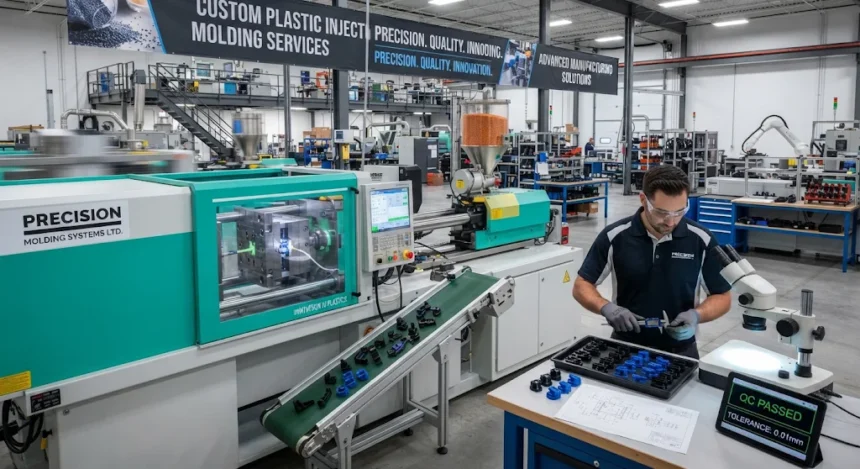
Custom plastic injection molding is an essential manufacturing process for producing durable, accurate, and complex plastic components across various industries. From aerospace and medical equipment to electronics and consumer products, businesses rely on experienced manufacturers to meet demanding production requirements. Companies such as Plastic Molded Concepts (PMC) demonstrate how advanced manufacturing capabilities and material expertise can support high-quality results. As an ISO 9001:2015 certified company with 50 years of experience, PMC specializes in high-precision injection molding, overmolding, and insert molding. Its services also include mold design, material selection, prototype development, forensic failure analysis, and secondary operations. Selecting suitable materials, including eva resin, is another important consideration when developing plastic components for specific performance and application requirements.
Understanding Custom Plastic Injection Molding
Custom plastic injection molding is a manufacturing technique that involves heating plastic materials until they become molten and injecting them into specially designed molds. Once the material cools and solidifies, the finished component is removed from the mold.
This process allows manufacturers to create parts with precise dimensions, consistent quality, and complex geometries. It is particularly useful for businesses that require large production volumes or specialized components that cannot be easily manufactured through conventional methods.
One of the biggest advantages of injection molding is its flexibility. Manufacturers can adjust mold designs, select different plastic materials, and modify production parameters to achieve specific product requirements. This makes the process suitable for everything from small electronic components to large industrial parts.
The Importance of Material Selection
Choosing the right plastic material is one of the most important steps in injection molding. Different applications require different levels of flexibility, strength, temperature resistance, chemical resistance, and durability.
Manufacturers evaluate several factors before selecting a resin, including the component’s intended environment, mechanical requirements, production volume, and expected lifespan.
For example, resin hdpe (high-density polyethylene) is commonly used in applications requiring excellent chemical resistance, impact strength, and moisture resistance. Its durability makes it suitable for containers, industrial components, protective products, and various consumer applications.
EVA resin, or ethylene-vinyl acetate, is another material used in manufacturing. It is valued for its flexibility, softness, impact absorption, and resistance to cracking. Depending on the application and material formulation, EVA can be useful in products requiring cushioning, flexibility, and improved comfort.
Working with an experienced injection molding manufacturer helps businesses identify materials that balance performance, cost, and manufacturing requirements.
Different Types of Injection Molding Services
Modern plastic manufacturing involves several specialized processes. Understanding these options helps businesses choose the right production method for their components.
High-Precision Injection Molding
High-precision injection molding focuses on producing components with tight dimensional tolerances and consistent specifications. It is especially important in industries where even minor manufacturing variations can affect product performance.
Medical devices, aerospace equipment, and electronic assemblies often require highly accurate plastic components. Advanced machinery, carefully controlled production conditions, and detailed quality inspections help manufacturers maintain consistent results.
Overmolding
Overmolding involves combining two or more materials to create a single finished component. A secondary material is molded over an existing part, allowing manufacturers to improve grip, flexibility, insulation, or protection.
This technique is commonly used in medical equipment, electronic devices, automotive components, and consumer products. For example, manufacturers can add a soft exterior layer to a rigid plastic handle to improve comfort and usability.
Insert Molding
Insert molding involves placing a pre-manufactured component, such as a metal insert, into a mold before injecting plastic around it.
The process creates an integrated component that combines the properties of multiple materials. It can reduce assembly requirements, improve structural strength, and create reliable connections between plastic and metal parts.
This approach is particularly useful for electrical connectors, threaded components, industrial equipment, and specialized mechanical assemblies.
Industries That Benefit from Custom Injection Molding
Custom injection molding supports a wide range of industries because it offers flexibility, repeatability, and the ability to manufacture complex designs.
Aerospace Industry
Aerospace manufacturers require components that meet demanding performance and safety requirements. Plastic injection molding can produce lightweight parts used in interior assemblies, housings, insulation systems, and specialized equipment.
Material selection and quality control are particularly important because aerospace components may operate under challenging environmental conditions.
Medical Industry
Medical manufacturing requires precision, consistency, and materials appropriate for their intended applications. Injection molding is used to produce equipment housings, instrument components, medical device parts, and specialized plastic assemblies.
Manufacturers must carefully evaluate material compatibility, dimensional accuracy, and applicable regulatory requirements throughout production.
Electronics Industry
Electronic products frequently contain plastic housings, connectors, insulation components, and protective enclosures. Injection molding makes it possible to manufacture these parts with precise dimensions and consistent performance.
Overmolding and insert molding are also valuable for producing components that combine plastic materials with electrical or metal elements.
The Role of Mold Design and Prototype Development
A successful injection molding project begins long before the manufacturing process starts. Mold design plays a significant role in determining the quality, accuracy, and cost-effectiveness of the finished product.
Engineers consider several factors when developing a mold, including part geometry, wall thickness, material flow, cooling requirements, and potential shrinkage. Proper design helps prevent common manufacturing problems such as warping, incomplete filling, and dimensional inconsistencies.
Prototype development is equally important. Creating an initial sample allows businesses to evaluate the design, test functionality, and identify potential improvements before moving into full-scale production.
This approach can reduce development costs, minimize manufacturing errors, and shorten the time required to bring new products to market.
Material Selection and Manufacturing Expertise
Selecting a suitable resin requires more than simply identifying a material with the desired physical properties. Manufacturers must also consider how the material behaves during processing.
Factors such as melting temperature, flow characteristics, cooling time, shrinkage, and compatibility with other materials can influence the final result.
Experienced manufacturers help clients compare available materials and determine which options best match their project requirements. This technical guidance is particularly valuable when developing components for demanding applications.
Companies like Plastic Molded Concepts provide additional engineering support through material selection, mold design, prototype development, and manufacturing consultation. These services help businesses address potential challenges early in the production process.
Forensic Failure Analysis and Secondary Operations
Even well-designed plastic components can experience problems during manufacturing or actual use. Cracking, warping, dimensional inconsistencies, and premature material failure can affect product reliability.
Forensic failure analysis helps identify the underlying causes of these problems. Manufacturers examine material properties, component design, molding conditions, and potential environmental factors to understand why a part has failed.
This information can guide improvements to materials, mold configurations, and production processes.
Secondary operations also contribute to the quality and functionality of finished components. Depending on project requirements, these operations may include trimming, machining, assembly, finishing, and other specialized processes.
By offering additional services alongside injection molding, manufacturers can simplify production workflows and deliver components that are closer to their final application requirements.
Benefits of Working With an Experienced Injection Molding Company
Choosing an experienced manufacturing partner can significantly influence the success of a plastic component development project.
Some important benefits include:
- Consistent product quality: Advanced equipment and controlled manufacturing processes help maintain dimensional accuracy across production runs.
- Lower production costs: Optimized mold designs and efficient processes can reduce material waste and manufacturing expenses.
- Engineering support: Technical expertise helps businesses overcome design challenges and select appropriate materials.
- Scalable production: Injection molding can accommodate prototype development and high-volume manufacturing.
- Improved product durability: Proper material selection and manufacturing techniques contribute to longer-lasting components.
- Reduced assembly requirements: Processes such as insert molding and overmolding can combine multiple elements into a single component.
An ISO 9001:2015 certified manufacturer also demonstrates a commitment to structured quality management practices, although certification alone does not replace application-specific testing or regulatory compliance.
How to Choose the Right Plastic Injection Molding Partner
Finding the right injection molding company requires evaluating more than its production capabilities. Businesses should consider the manufacturer’s experience, technical resources, quality management practices, and ability to handle specialized requirements.
Start by reviewing its experience with similar components and industries. A manufacturer familiar with aerospace, medical, or electronics applications may better understand the precision and documentation requirements involved.
It is also important to evaluate engineering support. Services such as mold design, material recommendations, prototype development, and failure analysis can make the entire manufacturing process more efficient.
Finally, consider communication, production capacity, quality inspection procedures, and the ability to provide secondary operations. A reliable manufacturing partner should be able to explain its processes clearly and work with clients throughout the product development cycle.
Conclusion
Custom plastic injection molding plays an important role in modern manufacturing by allowing businesses to produce accurate, durable, and specialized plastic components. From high-precision injection molding to overmolding and insert molding, these processes support a wide range of applications across aerospace, medical, electronics, and industrial markets.
Material selection, mold engineering, prototype development, and quality control all contribute to successful manufacturing outcomes. Working with an experienced company such as Plastic Molded Concepts (PMC) gives businesses access to comprehensive manufacturing and engineering services backed by decades of industry experience.
By choosing the right materials, refining product designs, and partnering with knowledgeable manufacturers, businesses can develop high-quality plastic components that meet demanding performance requirements while supporting long-term production efficiency.