The clamshell exercise is a simple side-lying movement used to strengthen the muscles around the hips and glutes. It requires little equipment, fits easily into home workouts, and is commonly included in strength, rehabilitation, and mobility routines. Although the movement looks easy, good technique matters because small changes in hip and pelvic position can determine which muscles actually do the work.
When performed correctly, clamshells can help improve hip stability, glute strength, lower-body control, and movement quality. They may be useful for runners, gym beginners, active adults, and people working on hip strength under professional guidance. Understanding proper clamshell exercise form, common mistakes, resistance options, and progression strategies can help you get more benefit without turning a controlled exercise into an awkward twisting movement.
What Is the Clamshell Exercise?
The clamshell is a side-lying hip exercise performed with the knees bent and the feet kept together. You lift the top knee away from the bottom knee while keeping your pelvis relatively still, creating a movement that resembles a clamshell opening. The exercise primarily challenges muscles responsible for controlling and stabilizing the hip during lower-body movement.
Unlike squats or lunges, the clamshell does not require you to support your full body weight while standing. This makes it useful as an introductory strengthening exercise or as part of a warm-up before more demanding movements. It can also help people become more aware of how their hip muscles work without requiring complicated equipment or coordination.
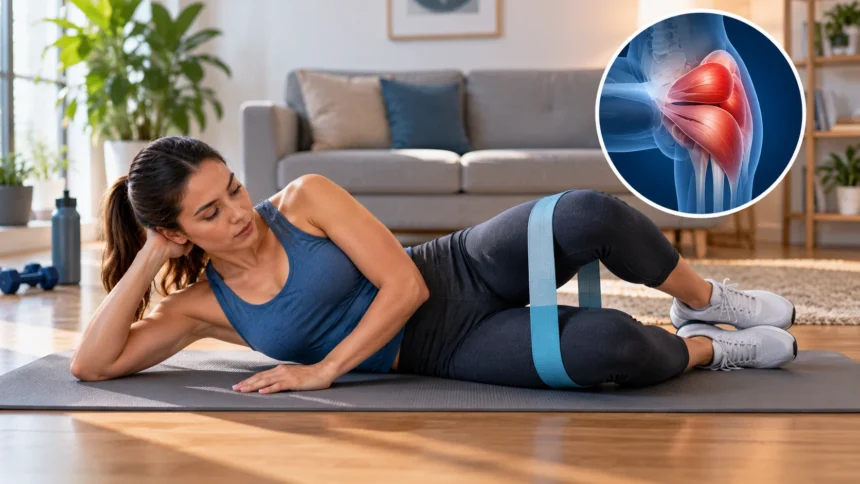
The exercise can be performed using only body weight or with a resistance band placed around the thighs. Beginners often benefit from mastering the basic version first because adding resistance too early can encourage poor technique. Once the movement feels controlled and consistent, resistance can be increased gradually to make the exercise more challenging.
What Muscles Does the Clamshell Exercise Work?
The clamshell mainly targets muscles on the outer and back portion of the hip, particularly the gluteus medius and other muscles involved in hip rotation and stability. These muscles help control the position of the pelvis and thigh during activities such as walking, running, climbing stairs, and performing single-leg movements.
The gluteus maximus may also contribute depending on your hip position and how the movement is performed. Other smaller muscles around the hip can assist with rotation and stabilization. Because several muscles work together, the goal should be controlled movement rather than trying to isolate one muscle completely during every repetition.
You may feel the exercise primarily in the side or back of your upper hip rather than directly in the front of the thigh. If you mostly feel strain in the lower back or notice your entire pelvis rolling backward, your form may need adjustment. Slower repetitions and a smaller range of motion often help improve muscle engagement.
How to Do a Clamshell Exercise With Proper Form
Lie on one side with your hips and shoulders stacked comfortably. Bend your knees and bring them slightly forward while keeping your feet together. Rest your head on your lower arm or a pillow so your neck remains relaxed, and gently engage your abdominal muscles to help keep your trunk and pelvis stable.
Without separating your feet, slowly lift the top knee toward the ceiling as far as you can without allowing your pelvis to roll backward. Pause briefly at the top while maintaining control. Lower the knee slowly until it returns to the starting position, then repeat while focusing on consistent movement rather than completing repetitions quickly.
Your range of motion may be smaller than expected, and that is completely acceptable. Lifting the knee higher by rotating your entire body reduces the value of the exercise because the hip muscles no longer perform the movement independently. Quality repetitions with a stable pelvis are generally more useful than a large but poorly controlled range.
Common Clamshell Exercise Mistakes to Avoid
One of the most common mistakes is allowing the pelvis to roll backward as the top knee rises. This creates the appearance of greater movement but reduces the demand on the intended hip muscles. Imagine your hips remaining stacked vertically throughout each repetition, and stop lifting once maintaining that position becomes difficult.
Another mistake is performing repetitions too quickly. Fast movement can create momentum, allowing the knee to swing up and down without enough muscular control. Slow the exercise down and focus on lifting, briefly pausing, and lowering with control. This usually makes a bodyweight clamshell feel considerably more challenging without adding any resistance.
Placing a strong resistance band around the knees before mastering basic technique can also create problems. Excessive resistance may encourage compensation through the lower back or pelvis. Start with body weight or light resistance and progress only when you can perform each repetition smoothly while keeping your feet together and your trunk stable.
Benefits of the Clamshell Exercise
One major clamshell exercise benefit is improved hip muscle strength. Stronger hip stabilizers can help control the thigh and pelvis during everyday activities and exercise. This control becomes particularly important during movements that place more weight on one leg, such as walking, running, stepping onto a curb, or climbing stairs.
Clamshells can also be useful as an activation exercise before larger lower-body movements. Performing controlled repetitions before squats, lunges, or running may help you become more aware of your glute muscles. However, activation exercises should complement progressive strength training rather than replace more challenging exercises when your goal is building substantial lower-body strength.
The movement is also convenient because it requires very little space and can be performed without gym equipment. A resistance band provides an easy progression once the bodyweight version becomes comfortable. This makes clamshells practical for home workouts, travel routines, warm-ups, and rehabilitation programs designed by an appropriate healthcare or fitness professional.
How Clamshells Can Support Hip and Knee Stability
The muscles around the hip help control the position of the femur during walking, running, and other lower-body activities. When these muscles work effectively, they contribute to smoother movement and better control of the pelvis. Clamshells can strengthen part of this system, particularly when the exercise is performed with slow, controlled technique.
Hip strength can also influence how the knee moves during activities such as squatting, jumping, or stepping. However, knee discomfort can have many causes, and strengthening one hip muscle does not automatically solve every knee problem. Clamshell exercises work best as one part of a broader program that considers strength, mobility, training load, and individual movement patterns.
If you are using clamshells because of persistent knee or hip pain, professional assessment may be worthwhile. A physical therapist can determine whether the exercise matches your specific condition and recommend other movements when necessary. Exercise selection should be based on what your body needs rather than assuming one popular rehabilitation exercise works for everyone.
How Many Clamshells Should You Do?
Beginners can often start with approximately 8 to 15 controlled repetitions per side for one or two sets. The exact number matters less than the quality of the movement. Stop the set when your pelvis begins rolling, your lower back takes over, or you can no longer lift and lower the knee smoothly.
As strength improves, you can gradually increase repetitions, add another set, or introduce resistance. Performing more and more repetitions is not always the best progression because very high repetition counts can become inefficient. A resistance band can make the exercise harder while allowing you to maintain a moderate number of high-quality repetitions.
Frequency depends on the rest of your training program and why you are performing the exercise. Some people include clamshells in warm-ups several times a week, while rehabilitation routines may follow different instructions. Give the muscles appropriate recovery and reduce volume if you experience persistent soreness, discomfort, or declining movement quality.
How to Progress the Clamshell Exercise
The simplest progression is adding a resistance band around the thighs just above the knees. The band increases resistance as the knee opens, requiring the hip muscles to work harder. Start with a light band because excessive resistance can shorten your range of motion or cause the pelvis to rotate instead of keeping the movement isolated.
You can also make the exercise more challenging by slowing the lowering phase or holding the top position briefly. These changes increase the amount of time the muscles remain under tension without requiring heavier equipment. Maintaining precise technique during these variations is more important than making the exercise feel difficult simply for the sake of intensity.
Eventually, stronger individuals may benefit from progressing toward standing or weight-bearing hip exercises. Lateral band walks, step-ups, split squats, single-leg exercises, and other movements can challenge hip stability in different ways. Clamshells remain useful, but they should not necessarily be the final stage of a long-term lower-body strengthening program.
How to Stay Comfortable While Lying on Your Side
Side-lying exercises should feel stable rather than painful. Support your head with your arm, pillow, or folded towel so your neck stays in a comfortable position. Keep your shoulders relaxed instead of placing unnecessary weight through the lower arm, especially when performing multiple sets on each side.
If side-lying causes significant shoulder discomfort, adjust your position or use additional padding. People experiencing persistent tingling, numbness, weakness, or radiating shoulder nerve pain should avoid assuming the discomfort is simply part of the exercise. Those symptoms may need separate evaluation rather than being pushed through during a hip-strengthening routine.
You can sometimes perform clamshells with your upper body slightly repositioned to reduce pressure on the lower shoulder while keeping the pelvis stable. Comfort should not require twisting the torso significantly. If no side-lying position feels comfortable, a fitness professional or physical therapist may suggest another hip-strengthening exercise that targets similar muscles without aggravating the shoulder.
When to Stop or Modify Clamshell Exercises
A normal clamshell may create muscular fatigue or a mild working sensation around the outer hip. Sharp pain, strong joint discomfort, increasing numbness, or radiating symptoms are different and should not be ignored. Stop the exercise if symptoms clearly worsen with each repetition rather than trying to force your way through a prescribed number.
Hip clicking does not always indicate a serious problem, but painful or persistent clicking deserves attention. Reduce the range of motion and check whether your pelvis is remaining stable. If discomfort continues despite technique changes, professional assessment can help identify whether the clamshell is appropriate for your current condition.
People recovering from surgery, significant injuries, or ongoing hip and lower-back conditions should follow individualized medical or rehabilitation advice. An exercise that is generally considered low impact may still be inappropriate at certain stages of recovery. Progress should be based on symptom response, strength, and professional guidance rather than comparing your repetitions with someone else’s workout.
How to Add Clamshells to Your Workout Routine
Clamshells can work well near the beginning of a lower-body workout as part of a short activation sequence. One or two controlled sets can prepare the hip muscles before squats, lunges, step-ups, or running. Keep the volume moderate so your hips are not excessively fatigued before the main exercises begin.
They can also be performed later in a workout as an accessory exercise. In this position, a resistance-band clamshell can add focused hip work after larger compound movements are completed. Choose the placement based on your goal, remembering that warm-up activation and strength-focused accessory work may require different resistance levels and repetition ranges.
For home training, clamshells can be combined with glute bridges, side steps, squats, and other lower-body exercises to create a more balanced routine. Avoid relying exclusively on one movement. Hip strength involves several muscles and movement patterns, so variety and gradual progression generally produce a more complete training program.
Conclusion
The clamshell exercise is a simple but useful movement for strengthening muscles around the hip, particularly those involved in stability and rotation. Good form requires keeping the feet together, lifting the top knee under control, and preventing the pelvis from rolling backward. A smaller controlled movement is usually better than forcing a large range through compensation.
Clamshell benefits can include stronger hip stabilizers, improved lower-body control, and an easy way to add targeted glute work to warm-ups or home workouts. Resistance bands, slower repetitions, and longer holds provide simple progressions. As strength improves, standing and weight-bearing exercises can provide additional challenges that more closely resemble everyday and athletic movements.
Pay attention to how your body responds rather than focusing only on repetition numbers. Muscular fatigue is expected, but sharp pain, worsening numbness, or significant joint discomfort should not be pushed through. When performed appropriately and combined with broader strength training, clamshells can be a practical addition to a balanced lower-body exercise routine.
FAQs
What muscles do clamshell exercises work?
Clamshells mainly target hip stabilizers, including the gluteus medius, while other gluteal and hip-rotation muscles can assist. Proper pelvic positioning helps keep the exercise focused on the intended muscles.
How many clamshell exercises should I do?
Beginners can often start with 8 to 15 controlled repetitions per side for one or two sets. Increase resistance or volume gradually once you can maintain good form throughout every repetition.
Should I use a resistance band for clamshells?
A resistance band can make clamshells more challenging, but it is not necessary for beginners. Master the bodyweight movement first, then add light resistance without allowing your pelvis to rotate backward.
Why do I feel clamshells in my lower back?
You may be rotating your pelvis or using too much resistance. Reduce the range, slow the movement, keep your hips stacked, and stop if you experience actual back pain rather than muscular effort.
Can I do clamshell exercises every day?
Some people can tolerate frequent light clamshell work, but daily training is not necessary for everyone. Your ideal frequency depends on resistance, total workout volume, recovery, symptoms, and your overall exercise program.