Agonal Breathing: Signs, Causes & What to Do
Agonal breathing is an abnormal breathing pattern that can occur when the brain is not receiving enough oxygen, often during cardiac arrest or another severe medical emergency. It may look like occasional gasping, snorting, choking, or irregular breaths rather than normal, steady breathing. Because these gasps can sometimes resemble breathing, bystanders may mistakenly assume that a person is still breathing adequately and delay calling emergency services or starting CPR. That delay can be dangerous. If someone is unresponsive and is only gasping or breathing abnormally, the safest assumption is that normal breathing has stopped. Immediate emergency action can make a major difference in the person’s chances of survival.
Agonal respirations are not the same as healthy breathing, even though air may move in and out of the chest. The breaths are typically slow, irregular, labored, or separated by long pauses, and they may produce unusual sounds. In cardiac arrest, they can occur because the brainstem is briefly triggering primitive breathing movements despite inadequate circulation. The person may also collapse suddenly, fail to respond when spoken to or touched, and have no normal breathing pattern. Agonal breathing can last for a short period and may disappear completely as the emergency progresses. Recognizing it quickly is therefore an important first-aid skill for anyone, not only healthcare professionals.
When agonal breathing is suspected, the priority is not to spend several minutes trying to identify the exact cause. Call emergency medical services, begin CPR if the person is unresponsive and not breathing normally, and use an automated external defibrillator, or AED, as soon as one becomes available. Emergency dispatchers can guide you through CPR if you are unsure what to do. For an adult who suddenly collapses, chest compressions are especially important because they help move blood toward the brain and other vital organs. This guide explains the signs of agonal breathing, possible causes, how it differs from other breathing patterns, what to do immediately, and how to respond safely until professional help arrives.
What Is Agonal Breathing?
Agonal breathing refers to abnormal, ineffective breathing that may occur when the brain is severely deprived of oxygen. It is most strongly associated with cardiac arrest, although it can appear in other critical conditions that interfere with circulation or oxygen delivery. The term “agonal” can sound as though it describes emotional suffering, but medically it refers to a characteristic abnormal respiratory pattern. The person may make sudden gasps, snorts, grunts, or irregular attempts to breathe. These movements do not provide the same effective ventilation as normal breathing. A person who is unresponsive and only gasping should therefore be treated as though they are not breathing normally.
Normal breathing has a relatively regular rhythm and usually occurs continuously without long pauses. Agonal breathing is different because breaths may be widely spaced, shallow, forceful, noisy, or unpredictable. A person may take one deep gasp and then remain completely still for several seconds before another gasp occurs. The chest may rise unexpectedly, and the mouth may open as though the person is trying to draw in air. These movements can be confusing to someone who has never seen cardiac arrest. It is important to understand that occasional gasping does not mean the heart and lungs are working effectively enough to sustain the body.
During cardiac arrest, the heart suddenly stops pumping blood effectively. As circulation falls, oxygen delivery to the brain drops rapidly. The brainstem, which helps control automatic functions such as breathing, may continue producing brief respiratory movements for a short time. These movements are what can create agonal gasps. Because the heart is not providing adequate circulation, however, the gasps do not solve the underlying problem. The brain and other organs remain at risk of severe oxygen deprivation. CPR and defibrillation, when appropriate, are needed to restore circulation and improve the chance of survival.
Agonal breathing may be present immediately after collapse or develop shortly afterward. It can sometimes be more noticeable during the first minutes of cardiac arrest and then become less frequent as oxygen deprivation progresses. This means a bystander may see several gasps at first and then no breathing at all. Waiting to see whether the breathing improves can waste critical time. Emergency response should begin as soon as the person is found to be unresponsive and not breathing normally. Dispatchers are trained to recognize descriptions of gasping and may instruct callers to start chest compressions immediately.
Although agonal breathing is often discussed in relation to adults with sudden cardiac arrest, the general principle applies to anyone who is unresponsive and not breathing normally. Children and infants can also experience severe respiratory or circulatory emergencies, although recommended CPR techniques differ by age. The most important skill for a bystander is recognizing that abnormal gasping is not reassuring. If there is uncertainty, contacting emergency services is always appropriate. Trying to diagnose the exact breathing pattern before calling for help is less important than recognizing that the person may be in immediate danger.
What Does Agonal Breathing Look and Sound Like?
Agonal breathing can appear as occasional, exaggerated gasps separated by long pauses. The person may seem to take one sudden breath and then stop moving for several seconds. Another breath may follow, but the pattern remains irregular rather than becoming steady. The mouth may open widely, and the neck or chest muscles may appear to work hard during each attempt. Some people describe the movement as “gasping like a fish” because the mouth repeatedly opens while breathing remains ineffective. This appearance can be alarming, but recognizing it as a possible cardiac arrest sign can help a bystander respond quickly instead of freezing or waiting.
The sounds associated with agonal breathing vary. A person may snort, grunt, gasp, gurgle, moan, or make a choking-like noise. These sounds occur because air is moving irregularly through the airway during ineffective respiratory efforts. The breathing may also resemble heavy snoring, which is one reason cardiac arrest can sometimes be mistaken for sleep, especially when collapse occurs in bed or after a person sits down. If someone cannot be awakened and their breathing sounds unusual, irregular, or interrupted by long pauses, the situation should be treated seriously. Normal sleep breathing should not be accompanied by complete unresponsiveness to attempts to wake the person.
The rate of agonal respirations is usually much slower and less consistent than normal breathing. Instead of a predictable rise and fall of the chest every few seconds, there may be isolated breaths with no clear rhythm. A breath may appear deep while the next is barely noticeable. The pauses between breaths may grow longer over time. These characteristics make counting the breathing rate less useful than simply determining whether the person is breathing normally. First-aid guidance emphasizes normal versus abnormal breathing because bystanders should not spend too much time analyzing an emergency before beginning CPR.
Body movements can add to the confusion. Some people in cardiac arrest may briefly twitch, stiffen, or have seizure-like movements as blood flow to the brain falls. Combined with gasping, this can lead observers to believe the person has experienced a seizure rather than cardiac arrest. A seizure can certainly cause loss of consciousness, but normal breathing should return afterward in many cases. If the person remains unresponsive and is only gasping, emergency cardiac arrest treatment should not be delayed. Calling emergency services allows trained dispatchers to help interpret what is happening and guide the next steps.
Color changes may also occur as oxygen levels fall. The lips, face, or skin may become pale, gray, or bluish, although these signs are not always obvious and can vary with skin tone and lighting. Waiting for visible color changes is unnecessary because they may appear late or be difficult to recognize. The combination of sudden collapse, unresponsiveness, and abnormal gasping is already enough to justify immediate emergency action. Bystanders should focus on responsiveness and normal breathing rather than trying to identify every possible sign. Simple recognition rules are valuable because cardiac arrest requires a rapid response.
What Causes Agonal Breathing?
Cardiac arrest is the most important cause of agonal breathing because it requires immediate CPR and, when appropriate, defibrillation. Cardiac arrest occurs when the heart suddenly fails to pump blood effectively to the brain and body. It can result from dangerous abnormal heart rhythms, heart attacks, severe heart disease, electrical problems, or other medical emergencies. When circulation stops, the brain quickly becomes oxygen deprived. Agonal gasps may briefly appear as the nervous system reacts to this loss of blood flow. Because these gasps can occur during the early stages of cardiac arrest, recognizing them can provide a valuable opportunity for rapid intervention.
A severe heart attack can sometimes lead to cardiac arrest and agonal breathing. A heart attack occurs when blood supply to part of the heart muscle becomes blocked, while cardiac arrest refers to loss of effective heart pumping. The two conditions are related but not identical. Someone having a heart attack may initially remain conscious and breathe normally, even while experiencing chest pressure, sweating, nausea, or shortness of breath. If the heart attack triggers a life-threatening rhythm and the person collapses, cardiac arrest may follow. At that point, abnormal gasping may replace normal breathing and CPR becomes urgently necessary.
Stroke and other severe brain injuries can also cause abnormal breathing patterns, although not every unusual breath should automatically be labeled agonal. A major stroke, brain hemorrhage, traumatic brain injury, or lack of oxygen to the brain can disrupt normal respiratory control. In some cases, the resulting breathing may be irregular or gasping. If the person is unresponsive and not breathing normally, the emergency response remains the same regardless of the exact neurological cause. Call emergency services immediately and follow dispatcher instructions. Trying to determine whether the problem is primarily cardiac or neurological should not delay lifesaving first aid.
Severe respiratory emergencies can eventually lead to cardiac arrest and agonal respirations if oxygen levels fall far enough. Examples include choking, drowning, severe asthma, respiratory failure, poisoning, or drug overdose. These situations may initially involve difficulty breathing rather than sudden heart stoppage. As oxygen deprivation progresses, consciousness can be lost and breathing may become irregular or cease. In children, cardiac arrest is more often preceded by respiratory failure than in adults, which is one reason rescue breaths play an especially important role in pediatric CPR. Regardless of age, unresponsiveness combined with no normal breathing requires immediate emergency action.
Other critical conditions can also disrupt circulation and oxygen delivery sufficiently to produce gasping respirations. Massive blood loss, severe allergic reactions, major pulmonary embolism, electrical injury, profound shock, or severe infection can ultimately lead to cardiac arrest. The exact cause matters greatly for hospital treatment, but bystanders are not expected to diagnose it at the scene. Their task is to recognize the emergency, activate professional help, support circulation with CPR, and use an AED if available. This simple sequence addresses the immediate threat while paramedics determine the underlying cause and provide advanced treatment.
Agonal Breathing vs Normal Breathing, Snoring and Seizure Breathing
The most important difference between agonal breathing and normal breathing is regularity and effectiveness. Normal breaths occur continuously and create a predictable pattern of chest movement. Agonal gasps are usually isolated, irregular, and separated by noticeable pauses. A person who is breathing normally should also show other signs of life, such as responsiveness or purposeful movement, unless another condition is affecting consciousness. Someone in cardiac arrest is typically unresponsive and cannot be awakened. If normal breathing is absent, occasional gasps should not be interpreted as adequate respiration. This distinction is central to recognizing cardiac arrest quickly.
Snoring can sometimes sound similar to agonal respirations, especially when cardiac arrest happens during sleep or when the person’s airway is partially obstructed. Ordinary snoring usually occurs in someone who continues to breathe rhythmically and can often be awakened with sufficient stimulation. Agonal breathing, by contrast, is associated with profound unresponsiveness and irregular or absent normal respiration. If someone appears to be sleeping but does not respond to shouting and gentle physical stimulation, their breathing should be checked immediately. Loud snoring alone does not prove a medical emergency, but abnormal snoring combined with unresponsiveness should never be ignored.
Seizures can also complicate recognition. During a generalized seizure, breathing may briefly become irregular, and the person may have stiffening or rhythmic jerking movements. Afterward, breathing usually returns, although the person may remain confused or deeply sleepy for some time. Cardiac arrest can occasionally produce brief seizure-like movements because reduced blood flow affects the brain. If the movements stop but the person remains unresponsive and only gasps, CPR may be necessary. Bystanders should not assume that every collapse with twitching is simply epilepsy. Checking for normal breathing after the movements end is an important step.
Choking can produce gasping as well, but the presentation may differ depending on whether the airway is partially or completely blocked. A conscious person with severe choking may be unable to speak, cough effectively, or breathe normally and may show obvious distress. If the person becomes unresponsive, emergency CPR procedures should begin, with attention to the possibility of airway obstruction. Agonal breathing in cardiac arrest may occur without a visible choking event. Because the two situations can overlap, emergency dispatch guidance is particularly useful. The priority remains restoring effective circulation and addressing airway problems according to appropriate first-aid procedures.
Other abnormal breathing patterns can occur in serious illness, including Cheyne-Stokes breathing, severe respiratory distress, and noisy breathing caused by airway obstruction. These patterns have different mechanisms and may occur in different clinical situations. A layperson does not need to memorize every respiratory pattern before providing emergency help. The practical question is whether the person is responsive and breathing normally. If the answer is no, emergency medical services should be contacted immediately. Simplifying the decision in this way helps reduce hesitation, which is particularly important when cardiac arrest is possible.
What to Do If Someone Has Agonal Breathing
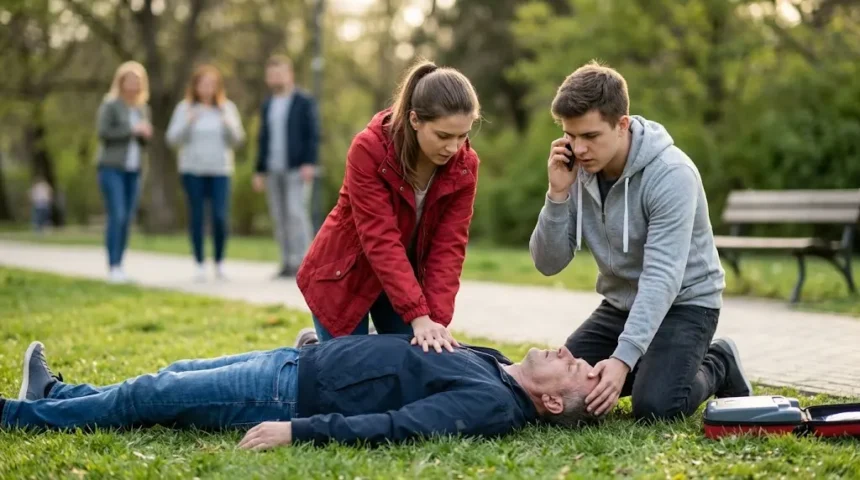
If you find someone who has collapsed, first make sure the environment is safe enough for you to approach. Check whether the person responds by speaking loudly and gently tapping or shaking the shoulder as appropriate. If there is no response, look for normal breathing rather than spending a long time checking every possible sign. Gasping, snorting, or occasional irregular breaths are not normal breathing. Call your local emergency number immediately or direct another specific person to call. If you have a phone, using speaker mode can allow the dispatcher to guide you while you remain beside the person.
For an unresponsive adult who is not breathing normally, begin CPR as soon as possible. Place the person flat on their back on a firm surface if this can be done safely. Position the heel of one hand in the center of the chest, place the other hand on top, and push hard and fast. Adult chest compressions are generally performed at a rate of about 100 to 120 compressions per minute, with a depth of approximately 5 to 6 centimeters, or about 2 inches. Allow the chest to fully recoil after each compression. Interruptions should be kept as short as possible because continuous compressions help maintain blood flow.
If you are trained and willing to provide rescue breaths, conventional adult CPR commonly uses cycles of 30 chest compressions followed by two breaths. If you are not trained or are uncomfortable providing mouth-to-mouth breathing, hands-only CPR with continuous chest compressions is strongly preferable to doing nothing for a suddenly collapsed adult. Situations such as drowning, overdose, respiratory arrest, or pediatric emergencies may make rescue breathing particularly important because lack of oxygen may be the primary cause. Emergency dispatchers can provide instructions based on the situation. Follow their guidance if it differs from general advice.
Use an automated external defibrillator as soon as one becomes available. AEDs are designed so that members of the public can use them by following spoken and visual instructions. Turn the device on, expose the chest, attach the pads as shown, and allow the AED to analyze the heart rhythm. Make sure nobody is touching the person during rhythm analysis or when a shock is being delivered. If the device advises a shock, follow its instructions, then immediately resume CPR. If no shock is advised, resume CPR as directed. The AED will continue guiding rescuers until emergency professionals arrive.
Continue CPR until the person begins breathing normally and shows clear signs of life, trained emergency responders take over, the environment becomes unsafe, or you are physically unable to continue. Occasional gasps during CPR do not necessarily mean circulation has returned, so do not stop compressions solely because one unusual breath occurs. If normal, regular breathing clearly resumes, monitor the person closely while waiting for emergency services. Avoid giving food, drink, or medication to an unconscious or barely responsive person. The most valuable actions are rapid emergency activation, high-quality CPR, and early AED use.
Why CPR and an AED Matter During Agonal Breathing
CPR is important because cardiac arrest stops effective blood circulation. Without circulation, oxygen already present in the blood cannot reach the brain, heart, and other organs efficiently. Chest compressions manually squeeze the heart between the breastbone and spine, helping create enough pressure to move some blood through the body. CPR does not usually restart the heart by itself, but it can preserve organ function long enough for defibrillation and advanced medical treatment to work. The sooner compressions begin, the less time the brain remains without blood flow. This is why bystander CPR is such an important part of cardiac arrest survival.
An AED can analyze the heart’s electrical activity and determine whether a shockable rhythm is present. Certain types of cardiac arrest occur because the heart’s electrical system becomes chaotic, preventing coordinated pumping. Defibrillation can interrupt these abnormal electrical patterns and potentially allow a more effective rhythm to return. Not every cardiac arrest rhythm can be shocked, which is why the AED performs an analysis before giving instructions. Bystanders do not need to interpret the rhythm themselves. The device decides whether a shock is appropriate, making it suitable for public use in airports, workplaces, schools, gyms, shopping centers, and other locations.
Timing matters because the effectiveness of defibrillation generally decreases as cardiac arrest continues without circulation. CPR helps slow that decline by maintaining some blood flow until an AED arrives. This relationship explains why rescuers should not wait for an AED before beginning chest compressions. One person can start CPR while another retrieves the device if multiple bystanders are present. When the AED arrives, pauses in compressions should remain as brief as possible while pads are attached and the device analyzes the rhythm. Coordinated action improves the chances that both CPR and defibrillation are delivered quickly.
Agonal breathing can actually create an important opportunity because it may occur relatively early in cardiac arrest. If bystanders recognize the gasps correctly, they may begin treatment during a period when defibrillation and CPR can still be particularly valuable. Unfortunately, misinterpreting gasps as signs of adequate breathing can delay those interventions. Education therefore focuses heavily on the phrase “not breathing normally” rather than simply “not breathing.” This wording reminds rescuers that gasping is abnormal. Someone does not need to be completely motionless and silent before CPR becomes appropriate.
The fear of doing something incorrectly can prevent people from helping, but emergency situations require practical action. For an unresponsive person who is not breathing normally, starting chest compressions is generally far safer than waiting while cardiac arrest continues untreated. Dispatchers can coach inexperienced rescuers through the process and help correct hand placement or compression speed. AEDs also provide step-by-step instructions. Even imperfect CPR can provide some circulation while professional responders are on the way. The goal for a bystander is not to perform hospital-level medicine but to keep blood moving and give the person the best possible chance of receiving definitive care.
What Not to Do During Agonal Breathing
One of the most dangerous mistakes is waiting to see whether the person “starts breathing properly” on their own. Agonal gasps may continue for a short period, but they do not indicate adequate circulation or ventilation. Every minute spent observing instead of acting can reduce the chance of a good outcome during cardiac arrest. If the person is unresponsive and not breathing normally, call emergency services and begin CPR. You do not need to confirm the exact medical diagnosis before taking action. Emergency dispatchers can help determine the next steps while professional responders are being sent.
Do not assume that the person is merely sleeping because they are making snoring or gasping sounds. Try to wake them and assess responsiveness. If they cannot be awakened and their breathing is abnormal, treat the situation as an emergency. This is particularly important when someone has collapsed after complaining of chest pain, shortness of breath, dizziness, or feeling suddenly unwell. It is also important after suspected overdose or choking. Unusual breathing sounds should never provide false reassurance when the person does not respond normally.
Do not spend several minutes trying to find a pulse if you are an untrained bystander. Pulse checks can be difficult even under calm conditions and can delay CPR when someone is actually in cardiac arrest. Standard bystander response focuses on unresponsiveness and absence of normal breathing. Trained healthcare professionals may perform pulse checks according to their protocols, but the general public should prioritize rapid action. If you are uncertain whether the person is breathing normally, tell the emergency dispatcher exactly what you see and hear. Their questions can guide you toward the appropriate response.
Do not give water, food, pills, or other substances to an unconscious person. Someone who cannot respond normally may not be able to protect their airway, creating a risk of choking or aspiration. Do not try to force the person to sit or stand, and do not repeatedly move them unless there is an immediate environmental danger or movement is needed for CPR. If trauma is suspected, unnecessary movement should be minimized, but lifesaving CPR still takes priority when there is no normal breathing. Emergency responders can manage spinal precautions and other advanced considerations once they arrive.
Do not stop CPR because you are worried about causing rib injuries if the person remains in cardiac arrest. Chest compressions need sufficient depth to create meaningful blood flow, and injuries can sometimes occur even when CPR is performed correctly. A rib injury is treatable; untreated cardiac arrest is immediately life-threatening. Stop compressions only for appropriate reasons, such as clear return of normal breathing and signs of life, takeover by trained responders, AED analysis when instructed, unsafe conditions, or physical inability to continue. Remaining focused on these priorities can prevent hesitation during the most critical minutes of the emergency.
Agonal Breathing After Cardiac Arrest and During End-of-Life Care
Agonal breathing is most urgent when it occurs suddenly in a person who was previously functioning normally because this can indicate cardiac arrest. In that setting, CPR and emergency medical treatment are usually appropriate unless there is a known valid decision not to attempt resuscitation. The appearance of gasping should not be interpreted as evidence that the person has enough oxygen or circulation. Emergency responders may continue to observe irregular respiratory movements while providing CPR and advanced life support. Changes in breathing can occur as circulation improves or deteriorates, so professional monitoring is necessary.
Agonal or irregular breathing can also occur near the end of life in people with terminal illness. In hospice or palliative-care situations, breathing patterns may change significantly as the body weakens. Long pauses, irregular breaths, noisy respirations, or gasping movements can appear during the dying process. These situations differ from unexpected cardiac arrest because the person’s goals of care may specifically focus on comfort rather than resuscitation. Families should follow the patient’s advance care plan and contact the hospice or palliative-care team for guidance. The correct response depends on previously established treatment wishes.
This distinction can be emotionally difficult because the same abnormal breathing pattern may lead to very different actions depending on the situation. If a person has a documented do-not-resuscitate order or equivalent plan and is receiving end-of-life care, healthcare professionals may focus on symptom relief rather than chest compressions. If there is no known plan and the collapse is unexpected, emergency services should generally be called immediately. Bystanders should not assume that an older or seriously ill person’s gasping automatically means resuscitation is unwanted. When treatment preferences are unclear, emergency dispatchers and clinicians can help guide the response.
Families caring for someone with advanced illness may benefit from discussing expected breathing changes before the final stage of life. Knowing that irregular breathing can occur may reduce confusion when it happens. Hospice teams can explain what symptoms are expected, how comfort medications are used, and whom to contact if breathing becomes distressing. This preparation is different from learning CPR for sudden cardiac arrest, but both involve understanding that abnormal breathing has context. The presence of gasps alone does not tell you whether resuscitation is appropriate; the person’s medical situation and documented wishes also matter.
For the general public, the safest rule remains straightforward: unexpected unresponsiveness plus abnormal or absent breathing is a medical emergency. Call emergency services and follow their instructions. Only well-established medical orders or end-of-life care plans should change that response. If you are unsure whether a document such as a do-not-resuscitate order applies, tell the dispatcher what you know rather than trying to interpret complicated medical instructions alone. This approach respects patient preferences while minimizing the risk of delaying lifesaving care when sudden cardiac arrest occurs.
Can Agonal Breathing Be Prevented?
Agonal breathing itself is a sign of a severe underlying emergency rather than a disease that can usually be prevented directly. Prevention therefore focuses on reducing the risk of conditions that lead to cardiac arrest, respiratory failure, or severe oxygen deprivation. Cardiovascular disease is particularly important because it contributes substantially to sudden cardiac arrest in adults. Managing blood pressure, cholesterol, diabetes, smoking, physical inactivity, and excess body weight can reduce cardiovascular risk over time. Regular medical care also makes it easier to identify heart disease before a life-threatening event occurs.
Recognizing warning symptoms can sometimes help prevent progression to cardiac arrest. Chest pressure, unexplained shortness of breath, sudden severe weakness, fainting, or new palpitations may indicate a serious heart problem. Stroke symptoms such as facial drooping, arm weakness, speech difficulty, or sudden severe neurological changes also require immediate emergency evaluation. People should not drive themselves to care when symptoms suggest a major cardiovascular emergency. Calling emergency services allows treatment to begin sooner and provides monitoring during transport. Early action can sometimes prevent deterioration before circulation or breathing stops completely.
Drug overdose prevention is another important area. Opioids can suppress breathing, potentially leading to severe oxygen deprivation and cardiac arrest. People at risk of opioid overdose and those around them may benefit from access to naloxone and training in how to use it. If a suspected overdose causes unresponsiveness and abnormal or absent breathing, emergency services should still be called immediately. Rescue breathing and CPR may be required depending on the person’s condition and local first-aid guidance. Naloxone can reverse opioid effects, but it does not replace emergency assessment because its effects may wear off or additional substances may be involved.
Drowning and choking prevention can reduce other causes of severe oxygen deprivation. Supervision around water, swimming skills, barriers around pools, and appropriate life jackets can reduce drowning risk. Eating carefully, keeping choking hazards away from young children, and learning choking first aid can reduce airway emergencies. In workplaces and public settings, having AEDs that are visible, accessible, and maintained properly can improve response when cardiac arrest occurs. CPR training also increases the likelihood that someone nearby will recognize abnormal breathing and act quickly. Community preparedness is therefore an important part of prevention.
No prevention strategy can eliminate every case of cardiac arrest, which is why emergency response skills remain essential. A person with no known heart disease can still collapse unexpectedly. Learning CPR, knowing where AEDs are located, and understanding that gasping is not normal breathing can prepare someone to act during those first critical minutes. Training courses allow participants to practice compressions and AED use rather than relying only on written explanations. Even people who have never taken a formal class should call emergency services and follow dispatcher instructions if a collapse occurs. Recognition and rapid response remain among the most practical ways to improve outcomes.
Frequently Asked Questions About Agonal Breathing
Is agonal breathing the same as normal breathing?
No. Agonal breathing consists of abnormal, ineffective gasps or irregular breaths and should not be treated as normal respiration, especially when the person is unresponsive.
Does agonal breathing mean someone is in cardiac arrest?
Agonal breathing commonly occurs during cardiac arrest, although other severe conditions can also cause abnormal gasping. If someone is unresponsive and only gasping, call emergency services and begin CPR according to dispatcher guidance.
How long can agonal breathing last?
Agonal respirations may last for seconds or several minutes and can become less frequent as oxygen deprivation continues. Their presence should never be used as a reason to delay CPR or emergency care.
Should you perform CPR if a person is gasping?
Yes, if an adult is unresponsive and is not breathing normally, occasional gasping should be treated as a sign of possible cardiac arrest. Call emergency services, start chest compressions, and use an AED as soon as one is available.
Can a person recover after agonal breathing?
Recovery is possible when the underlying emergency is treated quickly, particularly when cardiac arrest receives rapid CPR and early defibrillation when appropriate. Outcome depends on the cause, how long circulation was interrupted, and how quickly effective treatment began.