How Self-Driving Cars Work
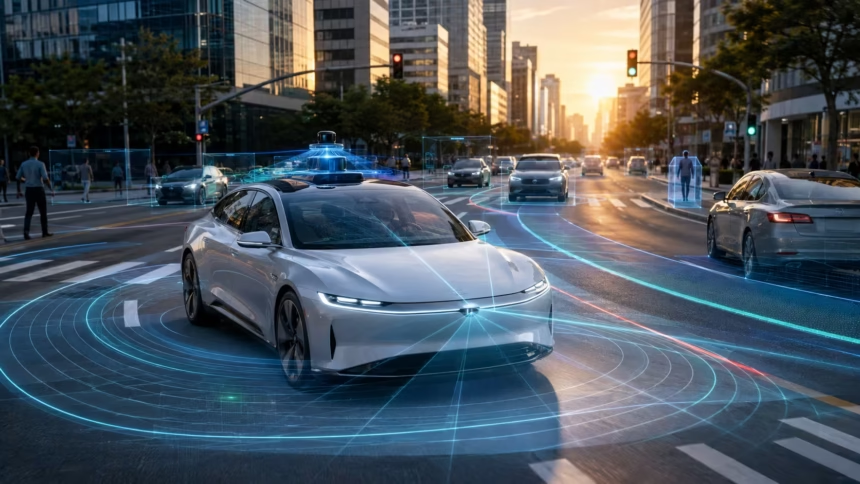
Self-driving cars may look like ordinary vehicles, but their operating systems are constantly performing complex calculations. Cameras, radar, lidar, maps, artificial intelligence and onboard computers work together to identify the road, understand surrounding traffic and decide how the vehicle should move. These decisions must be made accurately within fractions of a second.
An autonomous vehicle does not simply follow a route from a navigation application. It must detect pedestrians, read traffic signals, recognize lane markings and anticipate what nearby drivers might do next. It must then choose a safe path while controlling its steering, acceleration and braking smoothly enough to avoid confusing other road users.
The term “self-driving car” can also be misleading because not every vehicle advertised with automated features can drive without supervision. Many modern cars offer advanced driver-assistance systems that help with lane positioning or speed control, but the person behind the wheel remains responsible for monitoring the road and taking action.
Fully autonomous driving is significantly more difficult because public roads contain unpredictable situations. Construction zones, emergency vehicles, faded markings, unusual weather and human behaviour can challenge even advanced software. Understanding how self-driving cars work reveals both the remarkable progress of autonomous driving technology and the problems engineers are still working to solve.
What Is a Self-Driving Car?
A self-driving car is a vehicle equipped with hardware and software that can perform some or all driving tasks. Depending on its automation level, it may control speed, steering, lane changes, braking and navigation. More advanced systems can also observe the environment and respond to road conditions without continuous human supervision.
The vehicle gathers information through several types of autonomous vehicle sensors. These may include cameras, radar units, lidar scanners, ultrasonic sensors and positioning equipment. Powerful computers process the incoming data and create a continuously updated digital representation of the vehicle’s surroundings.
Artificial intelligence then helps the vehicle classify objects and understand the driving situation. The system may identify a nearby shape as a cyclist, determine that a traffic light is red and recognize that another vehicle is preparing to enter its lane. It uses this understanding to calculate an appropriate response.
Self-driving capability is normally limited by specific conditions. A vehicle might operate autonomously on selected motorways, within a mapped city or below a particular speed. These boundaries are known as the operational design domain and can include restrictions involving geography, road type, weather, lighting and traffic conditions.
The Six Levels of Driving Automation
The internationally recognized driving-automation scale contains six levels, beginning with Level 0 and ending with Level 5. The levels describe who performs the driving task and who must monitor the road. They do not simply rank vehicles according to how advanced or expensive their technology appears.
At Level 0, the person performs all driving tasks, although the vehicle may provide warnings or emergency interventions. Level 1 can continuously assist with either steering or acceleration and braking. Adaptive cruise control and lane-centering assistance are common examples, but the human driver remains responsible.
Level 2 systems can control steering and speed at the same time under appropriate conditions. However, the driver must continue watching the road and be ready to intervene immediately. Most consumer systems commonly described as hands-free or semi-autonomous remain driver-assistance technology rather than true driverless operation.
Level 3 allows the system to perform the entire driving task under limited conditions, but a driver must be available when a takeover is requested. Level 4 can operate without a human driver inside its defined domain, while Level 5 represents automation capable of driving anywhere a competent human could drive.
How a Self-Driving Car Makes Decisions
The autonomous driving process can be divided into several connected stages. The car first collects information about the road and surrounding environment. It then determines its location, recognizes relevant objects, predicts how those objects may move and calculates the safest available driving path.
This process is often described as the sense, understand, decide and act cycle. Sensors allow the vehicle to sense the environment, while perception software helps it understand what the measurements represent. Prediction and planning systems decide what should happen, and electronic controls carry out the selected action.
The cycle repeats many times every second because road conditions change continuously. A pedestrian can step toward a crossing, a vehicle can brake suddenly or a traffic light can change. The autonomous driving system must update its understanding and modify its plan without producing unstable or uncomfortable movements.
Each part of the self-driving stack depends on the quality of the others. An excellent planning system cannot avoid a cyclist that the perception software failed to detect. Similarly, accurate perception provides little value if the vehicle cannot calculate a safe path or apply its brakes reliably.
Cameras Give the Car a Visual View
Cameras help autonomous vehicles recognize many of the visual details that human drivers use. They can capture lane markings, traffic signs, signal colours, vehicle brake lights and the appearance of pedestrians. Several cameras placed around the car may provide overlapping views of the road in different directions.
Computer-vision software analyzes each image and searches for meaningful features. Machine-learning models can classify objects, estimate their boundaries and determine whether they are moving. A camera system may distinguish a pedestrian from a lamp post or identify the difference between a red traffic signal and an unrelated red object.
Cameras are particularly valuable because they capture colour, texture and written information. Radar cannot read a speed-limit sign, while lidar generally does not interpret its printed number. High-resolution cameras can provide these details when the view is clear and the lighting conditions are suitable.
Their limitations become more noticeable in fog, darkness, glare, heavy rain or snow. Dirt and water on a lens can also reduce image quality. Autonomous systems therefore use lens cleaning, heating, image enhancement and additional sensors to reduce dependence on a perfect camera view.
Radar Measures Distance and Movement
Radar sensors send out radio waves and measure how those signals reflect from surrounding objects. This allows the vehicle to estimate an object’s distance and relative speed. Radar is commonly used in adaptive cruise control, collision warnings and automatic emergency braking.
One of radar’s greatest advantages is its ability to measure movement directly. It can quickly determine whether the car ahead is pulling away or rapidly slowing down. This information is valuable when the autonomous vehicle must adjust its speed or prepare for an emergency stop.
Radar can also function in darkness and may continue working through conditions that make camera images less reliable. Rain, fog and dust can still affect performance, but radar is often more resilient than a purely visual system. Long-range radar can help detect vehicles farther down the road.
Traditional automotive radar provides less detailed information about an object’s exact shape than a camera or lidar sensor. Newer imaging radar systems offer greater resolution, but the software must still interpret noisy reflections. For this reason, radar information is frequently combined with other sensor measurements.
Lidar Builds a Three-Dimensional View
Lidar stands for light detection and ranging. A lidar sensor emits laser pulses and measures how long they take to return after reflecting from an object. These measurements produce a three-dimensional collection of points representing roads, vehicles, buildings, trees and other surrounding features.
The resulting point cloud allows the self-driving system to estimate shapes and distances with high precision. Lidar can help identify the edge of a road, measure the space between vehicles and reveal obstacles that may not be obvious in a flat camera image. It can also support accurate localization within a mapped area.
Lidar works during the day and at night because it supplies its own light pulses. However, rain, fog, snow, dust and reflective surfaces can interfere with the returning signals. Engineers use filtering software and supporting sensor data to separate real objects from weather-related noise.
Not every autonomous driving developer uses lidar in the same way. Some Level 4 robotaxi systems rely on multiple lidar units, while certain consumer-focused approaches emphasize cameras and radar. The choice depends on cost, vehicle design, operating environment and the developer’s broader safety strategy.
Ultrasonic Sensors Handle Close-Range Objects
Ultrasonic sensors emit high-frequency sound waves and measure their reflections. They are designed for relatively short distances and have long been used in parking-assistance systems. Small circular ultrasonic sensors are often visible on the front and rear bumpers of modern vehicles.
These sensors can detect walls, curbs, parked cars and other objects near the vehicle. They are particularly useful during low-speed manoeuvres when even a few centimetres of distance matter. An automated parking system may use several ultrasonic sensors to judge whether a space is large enough.
Ultrasonic measurements are less suitable for understanding fast-moving traffic at longer distances. Their range and detail are limited compared with radar, lidar and cameras. They therefore play a supporting role rather than providing the primary view needed for high-speed autonomous driving.
Some newer vehicle designs reduce or remove ultrasonic hardware and rely more heavily on cameras or other sensing technologies. Whether that approach works effectively depends on sensor placement, software performance and operating conditions. Close-range detection must remain reliable regardless of the selected hardware.
Sensor Fusion Creates a More Reliable Picture
Sensor fusion combines information from cameras, radar, lidar and other devices into one coherent understanding of the road. Each sensor has different strengths and weaknesses. Combining them can provide greater confidence than relying on one measurement source for every decision.
A camera might recognize that an object is a pedestrian, while lidar measures its exact position and radar confirms its movement. The software connects these observations and determines that they refer to the same person. It can then track the pedestrian as the vehicle approaches.
The measurements do not always agree perfectly. Sensors operate at different speeds, use different coordinate systems and produce different types of data. The fusion system must align their timing, correct for vehicle movement and estimate which readings are currently the most trustworthy.
Redundancy is another reason for using multiple sensors. If bright sunlight temporarily reduces camera quality, radar or lidar may still detect the vehicle ahead. Sensor fusion does not make errors impossible, but it can prevent one weak or obstructed sensor from becoming the only source of critical information.
Localization Tells the Car Where It Is
Before choosing a route, a self-driving car must determine its position with greater accuracy than ordinary phone navigation usually provides. Standard GPS can place a vehicle within several metres under good conditions, but safe autonomous driving may require lane-level or even more precise localization.
Autonomous vehicles can combine satellite positioning with wheel-motion sensors, inertial measurement units, cameras, lidar and radar. These sources help the system calculate the vehicle’s direction, speed and exact position. When one source becomes unreliable, the others can help maintain an accurate estimate.
Buildings, tunnels, bridges and trees can weaken or reflect satellite signals. The vehicle may therefore compare nearby road features with previously stored map information. A lidar sensor might match the shape of buildings or signs with a detailed map to determine the car’s location.
Localization is continuously updated as the vehicle moves. Small errors can accumulate if the system relies only on wheel rotations or motion estimates, a problem called drift. Combining multiple independent methods allows the software to correct these errors before they affect driving decisions.
High-Definition Maps Add Road Knowledge
Many autonomous vehicles use high-definition maps that contain more information than standard navigation maps. An HD map may describe lane boundaries, traffic signals, stop lines, road curvature, permitted turns and other features that help the car understand how the road is organized.
Maps provide useful context before objects become visible to onboard sensors. The vehicle may know that a junction or sharp bend is approaching even when another car blocks the camera’s view. This allows the planning system to slow down or prepare for a manoeuvre earlier.
The car does not blindly follow the map because road conditions can change. Construction work, temporary closures and newly painted lanes may make stored information outdated. Sensors must verify the current environment and override map expectations when the observed road no longer matches the recorded version.
Some developers depend heavily on detailed maps, particularly for Level 4 services within carefully defined areas. Others pursue systems that can operate with less pre-mapping. Both approaches still require reliable localization and an ability to understand temporary changes in the driving environment.
Perception Software Identifies Road Users
Perception is the stage where raw sensor data becomes meaningful information. The system detects objects and estimates their position, size, direction and speed. Important categories include cars, buses, motorcycles, cyclists, pedestrians, animals, traffic cones and emergency vehicles.
Machine-learning models are trained using large datasets containing labelled road scenes. Engineers show the system examples of objects under different weather, lighting and traffic conditions. The model gradually learns visual and geometric patterns that help it recognize similar objects in new situations.
Detection is only part of the challenge. The vehicle must track the same road user across multiple sensor frames. A pedestrian should not disappear from the system’s understanding simply because a pole temporarily blocks the camera or another vehicle passes between them.
The perception system must also recognize open road space, lane boundaries, signals and signs. It needs to determine not only what objects exist but how they relate to the vehicle’s route. A parked car on the roadside requires a different response from a car stopped directly in the travel lane.
Prediction Estimates What Happens Next
Safe driving requires anticipating movement rather than reacting only after it occurs. Prediction software estimates how pedestrians, cyclists and vehicles could behave during the next several seconds. These forecasts allow the autonomous car to begin adjusting before a dangerous conflict develops.
A pedestrian standing near a crossing might continue waiting, step into the road or turn away. The system may generate several possible paths and assign a probability to each one. It then creates a driving plan that remains safe across the most realistic possibilities.
Road context helps improve these predictions. A vehicle positioned in a turning lane is more likely to turn, while a cyclist looking over their shoulder may be preparing to change direction. Traffic rules, signal phases and the movement of nearby road users provide additional clues.
Human behaviour is difficult to predict with complete certainty. People may break traffic rules, hesitate or communicate through eye contact and gestures. Autonomous vehicles therefore need cautious margins that allow them to respond even when another road user behaves differently from the most likely forecast.
Path Planning Selects a Safe Route
Path planning converts perception and prediction into a practical driving decision. The system evaluates possible movements and selects a route through the immediate environment. Its plan must avoid collisions, obey traffic rules and move toward the passenger’s destination.
The planner may consider whether to remain in the lane, change lanes, stop, yield or pass an obstacle. Each option is scored according to safety, legality, efficiency and passenger comfort. A mathematically possible path may be rejected if it requires sudden braking or creates confusion for other drivers.
Planning occurs at more than one level. A route planner chooses the streets leading to the destination, while a behaviour planner selects actions such as turning or yielding. A motion planner then calculates the detailed path and speed needed to carry out the chosen behaviour.
The plan must be updated constantly because the environment does not remain fixed. If a vehicle enters the lane or a pedestrian begins crossing, the planner recalculates its options. The car may slow down, create more space or select an entirely different path.
Vehicle Controls Carry Out the Decision
Once the system chooses a path, electronic controllers translate it into steering, braking and acceleration commands. This is the actuation stage of autonomous driving. The control system must follow the planned route while keeping the vehicle stable and comfortable.
The computer compares the intended movement with the vehicle’s actual response. It checks steering angle, wheel speed, acceleration and other measurements. When wind, road slope or surface conditions push the car away from its planned path, the controller makes small corrections.
Smooth control is important because technically safe driving can still feel unpleasant. Harsh braking, nervous steering and repeated speed changes can make passengers uncomfortable and confuse nearby road users. Engineers tune the system to behave predictably while maintaining sufficient safety margins.
Higher-level autonomous vehicles may include redundant steering, braking, electrical and computing systems. If a primary component fails, a backup can help the vehicle slow down or reach a minimal-risk condition. This redundancy is essential when no human driver is expected to take control.
How Artificial Intelligence Learns to Drive
Artificial intelligence helps self-driving cars interpret complex sensor data and recognize patterns. Deep-learning models are particularly useful for perception because road scenes contain more variation than engineers could describe through fixed rules. The software learns from examples rather than receiving a separate instruction for every possible object.
Training data can come from real-world driving, test tracks and simulated environments. Engineers select examples involving different road layouts, seasons, weather conditions and human behaviours. Rare or difficult events receive special attention because they may reveal weaknesses that do not appear during normal driving.
Some autonomous systems use a modular architecture in which perception, prediction and planning are developed as separate components. Others use end-to-end learning for selected tasks, allowing a model to connect sensor inputs more directly with driving decisions. Many developers combine learned models with conventional safety logic.
Artificial intelligence does not understand roads exactly as a human does. It produces outputs based on patterns learned from data and the objectives defined by engineers. Careful validation is therefore necessary to identify situations where a model appears confident but has interpreted the environment incorrectly.
Simulation Tests Rare and Dangerous Events
Real-world testing is necessary, but relying on public-road kilometres alone would be inefficient and risky. Some critical events happen so rarely that collecting enough natural examples could take an extremely long time. Simulation allows developers to recreate these situations whenever they need them.
A simulated environment can test sudden pedestrian movement, unusual vehicle behaviour, sensor failure or severe weather without placing people in danger. Engineers can change one variable at a time and observe how the autonomous driving software responds. The same scenario can be repeated after every software update.
Developers can also modify events recorded during real journeys. They may change the speed of another vehicle, move a pedestrian closer or alter a traffic signal. These variations reveal how much safety margin the system has and whether a slightly different situation would create failure.
Simulation cannot perfectly reproduce the complexity of reality. Sensor behaviour, road surfaces and human actions may differ from their virtual versions. Effective validation therefore combines software simulation, closed-course testing, public-road operation and analysis of real-world safety performance.
Safety Systems Prepare for Failures
A safe autonomous vehicle must be designed around the possibility that hardware or software will fail. Sensors can become blocked, computers can overheat and electrical components can malfunction. The system needs to detect these problems rather than continuing as though every component is working normally.
Diagnostic software continuously monitors sensor quality, communication links and vehicle controls. It can recognize when a camera view is obstructed or when two measurements disagree unexpectedly. Depending on the severity, the system may reduce speed, request human control or stop in a safer location.
Level 4 vehicles must generally be capable of reaching a minimal-risk condition without depending on a passenger. This could involve pulling over, stopping within the lane or moving to another suitable location. The safest response depends on the traffic environment and the type of failure.
Safety evaluation extends beyond avoiding ordinary collisions. Developers must assess interactions with emergency responders, vulnerable road users and unusual road layouts. They also need processes for software updates, incident investigation and deciding whether a new system version is ready for public deployment.
The Operational Design Domain Sets Limits
An operational design domain, often shortened to ODD, defines the conditions in which an automated driving feature is designed to function. These limits can include geographic areas, road types, speed ranges, weather conditions, lighting and the presence of suitable lane markings.
A motorway automation feature may be unavailable on city streets because urban driving includes crossings, cyclists and complex junctions. A robotaxi may operate throughout one city but stop at the boundary of its approved service area. These restrictions allow developers to focus on a manageable range of conditions.
The vehicle must recognize when it is approaching or leaving its operational design domain. A Level 3 system may request that the human driver take control. A Level 4 system should manage the situation itself and move toward a safe state when continued operation is no longer possible.
ODD limits are a major reason the term “self-driving” requires context. A car that drives without supervision in one mapped location is not necessarily capable of navigating every rural road, mountain pass or snowstorm. Automation level and operating conditions must always be considered together.
Weather Remains a Major Challenge
Heavy rain can blur camera images, create reflections and reduce the range of lidar. Snow may hide lane markings, cover road signs and change the appearance of familiar landmarks. Fog reduces visibility, while standing water can affect both sensing and tyre grip.
Autonomous systems can estimate weather conditions using their sensors and external information. They may increase following distance, reduce speed or avoid certain routes. Sensor heaters, cleaning systems and protective housings help keep cameras and lidar units operational.
The vehicle must also understand how weather changes road physics. A safe braking distance on dry pavement may be inadequate on ice or heavy rain. Control systems can use wheel-slip and stability information to adjust their behaviour, but extreme conditions may exceed the vehicle’s intended capabilities.
A responsible system should not continue driving merely because its sensors still detect the road. It must decide whether it can operate with an acceptable safety margin. In some situations, delaying the journey or moving to a safe stopping point is the correct autonomous decision.
Edge Cases Are Difficult to Predict
An edge case is an unusual situation that appears rarely but can still create serious consequences. Examples include a person in an unexpected costume, an overturned vehicle, unusual hand signals from a traffic officer or an object falling from a truck.
The difficulty is not only detecting something unfamiliar. The system must determine how the unusual object or event should affect its driving. A plastic bag moving across the road requires a different response from a child or animal, even when their motion initially looks similar.
Developers search recorded driving data for rare patterns and use them to improve training. Generative tools and simulation can also produce variations that have not occurred naturally. These methods help expose blind spots before they appear during public operation.
No testing programme can list every event that may occur on a road. Autonomous systems therefore need general reasoning, cautious fallback behaviour and enough flexibility to handle uncertainty. Solving the long tail of rare events remains one of the central challenges in driverless car development.
Remote Assistance Supports Unusual Situations
Some Level 4 fleets use remote assistance when the autonomous system encounters a confusing or uncommon situation. A remote specialist may provide additional context about a blocked road, unusual construction zone or temporary instruction that the vehicle cannot interpret confidently.
Remote assistance is not necessarily the same as remotely driving the vehicle. In many systems, the human provides information or guidance while the onboard autonomous driving system remains responsible for controlling the car. The vehicle can evaluate the advice and execute an appropriate movement itself.
This approach can help resolve rare events without placing a safety driver inside every vehicle. However, the service must be reliable, secure and capable of supporting multiple vehicles. Developers also need procedures for communication failures and situations where human advice is delayed.
The vehicle should still be able to stop safely without a remote connection. Cellular coverage can disappear, networks can become congested and remote systems can experience outages. Assistance can support autonomy, but it should not become the only method preventing unsafe movement.
Do Self-Driving Cars Need Internet Access?
Self-driving cars use powerful onboard computers because critical driving decisions cannot depend on a continuous internet connection. Steering around an obstacle or applying emergency braking must happen immediately. Sending sensor data to a distant server would introduce unacceptable delays and connection risks.
Connectivity can still support mapping updates, fleet coordination, maintenance information and remote assistance. Vehicles may upload selected driving data so developers can examine difficult scenarios and improve future software. Robotaxi services also use networks for ride requests and passenger support.
Vehicle-to-everything communication could eventually allow cars to receive information from other vehicles, traffic signals and road infrastructure. This technology may warn an autonomous car about hazards outside its sensor range. However, the vehicle must remain cautious because external messages could be missing, incorrect or malicious.
A loss of internet access should not cause an autonomous car to become uncontrollable. Depending on its design, it may continue within its current capabilities, complete a safe manoeuvre or stop. The exact response depends on how important connectivity is to that system’s operational design domain.
Cybersecurity and Data Privacy Matter
Autonomous vehicles contain connected computers, sensors and software that create potential cybersecurity risks. An attacker could theoretically target communication systems, software updates or vehicle controls. Security must therefore be considered throughout design rather than added after deployment.
Developers use encrypted communication, access controls, secure software updates and network separation to reduce risk. Critical driving systems can be isolated from passenger entertainment features. Continuous monitoring may help identify unusual activity before it affects vehicle operation.
Self-driving cars also produce detailed data about location, routes and sensor observations. Some of this information is necessary for navigation, maintenance and safety analysis. However, it can reveal sensitive details about passengers and people appearing near the vehicle.
Clear privacy policies should explain which information is collected, why it is needed and how long it is retained. Companies must protect stored data and limit unnecessary access. As autonomous driving expands, privacy and cybersecurity rules will become increasingly important to public trust.
Self-Driving Cars in 2026
By 2026, most vehicles available to ordinary buyers still rely on driver-assistance systems rather than unrestricted self-driving capability. Level 2 features can manage speed and steering under selected conditions, but the driver remains responsible for supervision and must respond when the system makes a mistake.
Limited Level 3 systems are available in certain markets and operating conditions. They can perform the driving task when their requirements are met, but the human must remain available for a takeover request. Their use may be restricted by speed, road type, location and weather.
Level 4 robotaxi services operate without a human driver in selected cities and service areas. These vehicles are capable of handling the complete driving task inside their operational design domain. Expansion occurs gradually because each new city introduces different roads, regulations, weather and driving behaviour.
Level 5 automation remains a future goal rather than a widely deployed consumer reality. Driving safely on every road and in every reasonable condition requires broader capability than today’s systems provide. Progress is real, but the difference between supervised assistance and genuine driverless operation remains essential.
Benefits of Autonomous Vehicles
Self-driving technology could reduce crashes caused by distraction, impairment, fatigue and certain forms of human error. An automated system does not become tired, look at a phone or drive after drinking alcohol. It can also monitor several directions continuously.
Autonomous transport may provide greater independence for people who cannot drive because of age, disability or another limitation. A reliable driverless service could improve access to employment, healthcare, education and social activities without requiring a family member to provide transportation.
Automated driving could also make traffic movement more consistent. Vehicles might maintain safer following distances, reduce unnecessary acceleration and coordinate routes more efficiently. These improvements could lower energy use in some situations, although empty vehicle travel could create additional congestion.
Commercial applications include delivery vehicles, shuttles, warehouses, ports and long-distance freight. Controlled environments may adopt automation faster because their roads and operating rules are more predictable. Public streets remain more difficult because they involve a wider variety of people and situations.
Limitations of Self-Driving Technology
Autonomous vehicles can make mistakes when sensors are blocked, maps are outdated or software misinterprets an unfamiliar situation. They may struggle with informal human communication, unusual road layouts and conditions that fall outside their training data.
Cost is another limitation. High-performance computers, redundant controls, lidar units and maintenance systems can make advanced autonomous vehicles expensive. Fleet operators must also clean and calibrate sensors regularly to preserve reliable performance.
Regulation and legal responsibility vary between locations. Authorities must decide how vehicles should be tested, how incidents should be reported and who is responsible when an automated system causes harm. Emergency responders also need clear procedures for interacting with driverless vehicles.
Public trust will depend on transparent evidence rather than impressive demonstrations. An autonomous car does not need to be perfect to provide value, but developers must show that it manages risk responsibly. Safety claims should be supported by real-world data, independent evaluation and clearly defined operating limits.
The Future of Self-Driving Cars
The near-term future is likely to involve gradual expansion rather than an overnight switch to driverless roads. Level 2 assistance will become more capable, Level 3 functions may appear in additional vehicles and Level 4 services may enter more carefully selected locations.
Improvements in artificial intelligence could help vehicles understand unusual objects and predict human behaviour more accurately. Cheaper sensors and more efficient computers may reduce vehicle costs. Better simulation tools could expose weaknesses before new software reaches public roads.
Autonomous systems may also become more specialized. Robotaxis, motorway pilots, delivery vehicles and fixed-route shuttles have different technical requirements. Solving each defined use case may be more practical than creating one system that immediately handles every possible journey.
The speed of adoption will depend on safety performance, regulation, cost, public acceptance and infrastructure. Self-driving technology has already moved beyond laboratory experiments, but widespread automation requires consistent performance in ordinary and extraordinary situations alike.
Final Thoughts on How Self-Driving Cars Work
Self-driving cars work by combining sensors, maps, artificial intelligence and vehicle controls. Cameras, radar and lidar observe the environment, while localization software determines the vehicle’s position. Perception models identify objects, and prediction software estimates how those objects could move.
The planning system uses this information to choose a safe path. Electronic controllers then operate the steering, brakes and accelerator. This entire cycle repeats continuously so the vehicle can respond as traffic conditions change.
Automation is not one single capability. Level 2 driver assistance still requires constant human supervision, while Level 4 vehicles may operate without a driver only within a defined domain. Understanding these differences prevents marketing terms from creating unrealistic expectations.
The technology continues to improve, but difficult challenges remain. Weather, rare edge cases, cybersecurity and unpredictable human behaviour all require careful solutions. The most successful autonomous vehicles will not simply be those that can drive, but those that can recognize their limits and respond safely when uncertainty appears.
Frequently Asked Questions
How does a self-driving car see the road?
A self-driving car uses cameras, radar, lidar and other sensors to observe lanes, signs, vehicles and pedestrians. Artificial intelligence combines and interprets the data to create a digital view of the surroundings.
Can self-driving cars work without GPS?
They can continue temporarily without reliable GPS by using cameras, lidar, wheel sensors and inertial measurements. However, accurate positioning normally depends on combining several localization methods.
Are self-driving cars completely autonomous?
Most consumer vehicles are not completely autonomous and still require driver supervision. Level 4 robotaxis can operate without a driver, but only within approved locations and operating conditions.
Do autonomous cars use artificial intelligence?
Yes. Artificial intelligence helps recognize objects, track road users, predict movement and support driving decisions. Conventional software and safety rules are also used alongside machine-learning models.
Can self-driving cars operate in bad weather?
Some can operate in moderate rain or other challenging conditions, but severe weather may reduce sensor performance and road grip. The vehicle may slow down, limit automation or stop when conditions exceed its capabilities.