SI joint pain during pregnancy refers to discomfort around the sacroiliac joints, which connect the lower spine to the pelvis. Pain is often felt on one side of the lower back, near the upper buttock, although some people feel it on both sides. It may become more noticeable when walking, climbing stairs, turning in bed, or standing on one leg.
The sacroiliac joints normally provide stability while allowing a small amount of movement between the spine and pelvis. During pregnancy, changes in body weight, posture, muscle function, and joint loading can make this area more sensitive. The discomfort is sometimes included under the broader term pregnancy-related pelvic girdle pain because symptoms can involve several structures around the pelvis.
SI joint pain can range from mild aching to sharper discomfort that makes everyday movements difficult. The intensity may change from day to day depending on activity and fatigue. Although the pain can be frustrating, many cases can be managed with activity adjustments, gentle strengthening, supportive positions, and guidance from a healthcare professional when necessary.
Why Pregnancy Can Trigger SI Joint Pain
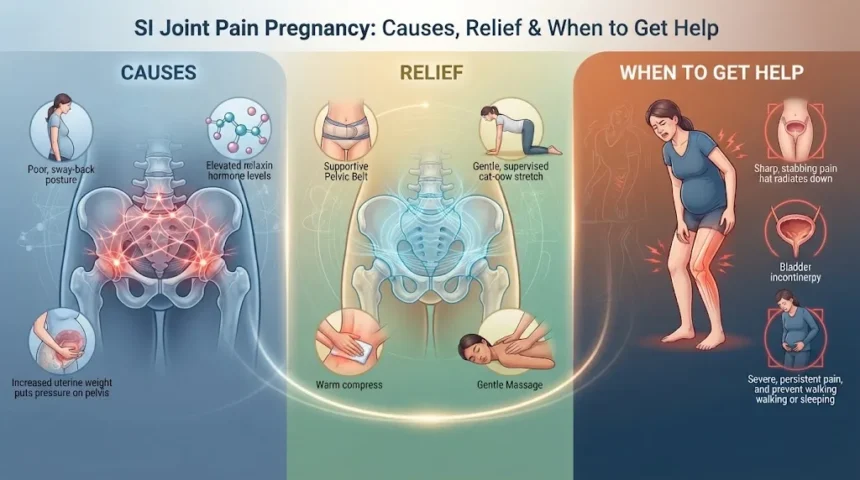
Pregnancy changes how load is distributed through the pelvis and lower back. As the uterus grows, your center of gravity gradually shifts, and muscles around the hips and trunk may work differently to keep you balanced. These changes can place additional demands on the sacroiliac region, particularly during walking, standing, lifting, and other weight-bearing activities.
Hormonal changes may also influence joint movement during pregnancy. Hormones involved in preparing the body for childbirth can affect ligaments throughout the pelvis, although this does not mean the SI joints become dangerously loose. Changes in joint support combined with increasing load may contribute to symptoms in people who are already sensitive to certain movements.
Previous lower-back pain, pelvic pain, physical work, prolonged standing, and significant changes in activity can also influence symptoms. There is rarely one single cause. SI joint pain during pregnancy is usually better understood as a combination of mechanical, muscular, and pregnancy-related changes rather than a sign that the pelvis has moved permanently out of place.
Common Symptoms of SI Joint Pain in Pregnancy
Pain is commonly felt near one or both dimples of the lower back, just above the buttocks. It may remain localized or spread toward the outer hip, buttock, groin, or upper thigh. Some people describe a deep ache, while others experience a sharp sensation during specific movements such as stepping out of a car or getting up from a chair.
Activities that place more weight through one leg can make symptoms worse. Walking, climbing stairs, putting on trousers while standing, or carrying something on one side may increase discomfort. Turning over in bed can also be painful because the pelvis rotates while the body changes position, especially later in pregnancy when movement becomes more physically demanding.
SI joint pain does not usually cause true numbness, significant weakness, or pain traveling all the way down the leg in a nerve-like pattern. Those symptoms may suggest another cause such as nerve irritation. If symptoms feel unusual, severe, or difficult to distinguish from other pregnancy-related pain, your maternity or healthcare team can help determine what is happening.
How to Relieve SI Joint Pain at Home
One of the most useful first steps is identifying movements that consistently trigger symptoms and temporarily modifying them. You may find shorter walks, smaller steps, or more frequent sitting breaks easier than pushing through long periods of activity. The goal is not complete rest but reducing repeated movements that significantly irritate the pelvis.
Heat may provide temporary relief when the lower back and buttock muscles feel tense. A comfortably warm pack can be used for short periods, but avoid excessive heat and follow pregnancy-specific guidance from your healthcare provider. Some people also prefer brief cold applications after an activity that clearly increases soreness, provided the skin is protected.
Pain medication during pregnancy should be discussed with your obstetric clinician, midwife, doctor, or pharmacist before use. Some medications that are commonly used outside pregnancy may not be appropriate during certain stages. Self-care works best when symptom relief is combined with movement adjustments and strengthening rather than relying only on medication.
Gentle Exercises for SI Joint Pain During Pregnancy
Pelvic tilts can help some people move the lower back and pelvis without placing heavy load through the SI joints. In a comfortable standing position against a wall or on hands and knees, gently move the pelvis through a small range. Keep the motion relaxed and stop if it produces sharp pain rather than trying to achieve a large movement.
Glute bridges may also help strengthen the hips if lying on your back is comfortable and appropriate for your stage of pregnancy. Later in pregnancy, prolonged flat-back exercise may not be recommended for everyone, so your prenatal clinician or physical therapist can suggest alternatives. Standing hip extensions or supported movements may provide similar strengthening without requiring a supine position.
Side-stepping with a light resistance band can strengthen the hip muscles that help control the pelvis during walking. Take small, controlled steps while keeping your knees and hips comfortable. Exercise should feel manageable rather than provocative, and a prenatal physical therapist can modify movements when symptoms are significant or your pregnancy requires additional precautions.
How Squat Strength May Support Pelvic Stability
Squatting uses the glutes, quadriceps, adductors, core, and other muscles that help control the pelvis and lower body. Appropriate squat variations can therefore be useful for maintaining strength during pregnancy when they are comfortable and medically suitable. Supported squats using a stable surface may feel easier than unsupported versions, particularly as balance changes later in pregnancy.
Understanding the muscles worked during squats can help explain why the movement is often included in lower-body strengthening programs. However, pregnancy is not the time to force a squat depth that causes pelvic, hip, or SI joint pain. A wider stance, reduced depth, or supported variation may feel more comfortable.
If squatting consistently worsens symptoms, replace it temporarily with another lower-body exercise rather than repeatedly pushing through pain. Sit-to-stands, supported mini squats, and gentle step-ups may provide useful alternatives. Strengthening is beneficial when it improves capacity without creating a lasting increase in pelvic pain afterward.
Sleeping With SI Joint Pain During Pregnancy
Side sleeping is common during pregnancy and can be made more comfortable with additional support. Placing a pillow between the knees can help keep the hips and pelvis in a more neutral position. Some people also benefit from supporting the abdomen with a small pillow so the growing belly does not pull the pelvis forward during the night.
A pillow behind the back can provide additional support and reduce the amount of twisting needed to stay comfortable. When turning in bed, try keeping the knees relatively close together and moving the shoulders and pelvis as one unit. Smaller, controlled movements can reduce the sudden rotational stress that often triggers SI joint pain at night.
Getting out of bed may also be easier if you first roll onto your side, bring the legs toward the edge, and use your arms to help push yourself upright. Avoid quickly twisting through the pelvis while the legs remain in another direction. These simple movement changes may reduce discomfort without requiring special equipment.
Everyday Movements That Can Aggravate SI Pain
Standing on one leg can increase pelvic discomfort because it places uneven load through the SI joints. Activities such as putting on shoes, stepping into trousers, or shaving one leg may feel easier when performed while sitting. Using both legs for support whenever practical can reduce unnecessary irritation during everyday tasks.
Carrying heavy bags or a child consistently on one hip may also increase asymmetrical loading. When possible, divide loads between both hands, use a backpack appropriately, or ask for help with heavier objects. Pregnancy already changes how your body manages load, so reducing avoidable one-sided stress can make daily movement more comfortable.
Stairs may become irritating because each step requires single-leg support. Take them slowly, use the railing, and limit unnecessary repeated trips when symptoms are active. You do not need to avoid stairs completely unless advised medically, but reducing frequency and moving with control can help manage a painful flare.
Can a Pregnancy Support Belt Help?
A maternity or pelvic support belt may help some people by providing gentle external support around the pelvis or lower abdomen. The effect varies, and a belt should not feel painfully tight or restrict normal breathing. Proper placement matters because different belts are designed for different types of pregnancy-related discomfort.
Support belts are best viewed as one tool rather than a complete solution. They may improve comfort during walking or standing, but they do not replace muscle strengthening or appropriate activity modification. Wearing one continuously without professional guidance is not necessarily better than using it during specific activities that typically provoke symptoms.
A prenatal physical therapist or maternity clinician can help you choose the right type and position. If a belt increases pressure, numbness, abdominal discomfort, or other unusual symptoms, stop using it and seek advice. Comfort and function should guide use rather than the assumption that tighter support provides greater benefit.
When to See a Physical Therapist
A physical therapist experienced in pregnancy-related pelvic pain can assess how you move, walk, stand, and perform everyday activities. They may check hip strength, trunk control, mobility, and which movements reproduce symptoms. Treatment often focuses on practical strategies that make daily activities easier rather than trying to manually “realign” the pelvis.
Your therapist may recommend individualized strengthening, mobility exercises, support belts, or changes to work and sleeping positions. They can also help you plan activity as pregnancy progresses and adjust exercises as your body changes. This can be especially useful when generic online exercises repeatedly increase pain or do not match your specific symptoms.
Consider seeking help when pain interferes with walking, sleep, work, or normal daily movement. Early support may make it easier to manage symptoms before activity becomes severely limited. Your obstetric or maternity team can often help you find a clinician familiar with prenatal musculoskeletal conditions.
When SI Joint Pain During Pregnancy Needs Urgent Help
Not every episode of lower-back or pelvic pain during pregnancy should be assumed to come from the SI joint. Contact your maternity or healthcare team promptly if pain is severe, suddenly different, or occurs with vaginal bleeding, fluid leakage, contractions, fever, or other pregnancy-related concerns. These symptoms require appropriate assessment rather than home exercise alone.
New weakness, significant numbness, loss of bladder or bowel control, or numbness around the groin or saddle area also requires urgent medical evaluation. These neurological symptoms are not typical of ordinary SI joint pain. Severe pain after a fall or accident should likewise be assessed, particularly if movement or weight-bearing becomes difficult.
Pain accompanied by burning urination, fever, flank pain, or feeling acutely unwell may have a cause unrelated to the musculoskeletal system. Pregnancy can make it especially important to distinguish ordinary mechanical pain from conditions requiring medical care. When you are unsure, contacting your prenatal care team is safer than assuming every new pain is normal.
Conclusion
SI joint pain during pregnancy commonly causes discomfort around the lower back, buttock, hip, or pelvis. Changes in body weight, posture, muscle demands, and pelvic loading can all contribute as pregnancy progresses. Activities such as walking, stairs, turning in bed, and standing on one leg may make symptoms more noticeable.
Relief often involves gentle activity modification, comfortable strengthening, supported sleeping positions, and reducing repeated one-sided movements. Exercises targeting the hips and trunk may improve pelvic control when performed at an appropriate level. Support belts and physical therapy can also be useful for some people, particularly when pain limits everyday activities.
Severe or unusual symptoms should not automatically be treated as SI joint pain. Contact your healthcare or maternity team for bleeding, fluid leakage, fever, contractions, neurological symptoms, major trauma, or rapidly worsening pain. When serious causes are excluded, a gradual and individualized approach can often make pregnancy-related pelvic discomfort much more manageable.
FAQs
Is SI joint pain common during pregnancy?
Yes. Pregnancy-related changes in pelvic loading, posture, muscle function, and body weight can make the sacroiliac region more sensitive. Symptoms may appear at different stages and vary considerably between individuals.
What does SI joint pain feel like in pregnancy?
It often feels like aching or sharp pain near one side of the lower back or upper buttock. Walking, stairs, turning in bed, and standing on one leg may make it worse.
Can I exercise with SI joint pain while pregnant?
Gentle, comfortable exercise is often appropriate, but the exact routine depends on your pregnancy and symptoms. Stop movements that cause significant pain and seek prenatal professional guidance when necessary.
Does SI joint pain go away after pregnancy?
Symptoms improve after delivery for many people as pregnancy-related loads and body changes settle. However, some people need additional rehabilitation if pain continues, especially when strength or movement limitations remain.
When should I call my doctor about pelvic pain in pregnancy?
Contact your healthcare team for severe or sudden pain, bleeding, fluid leakage, contractions, fever, neurological symptoms, or pain after significant trauma. Persistent pain that limits normal movement also deserves evaluation.