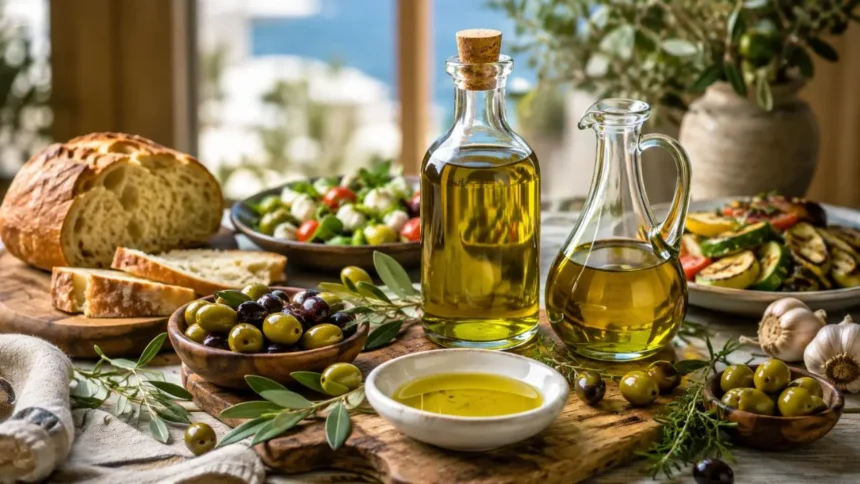
Olive Oil: Choose, Cook and Store It the Right Way
Olive oil is a liquid cooking fat made by extracting oil from olives, the fruit of the olive tree. It is widely used for frying, roasting, baking, dressings, marinades and finishing dishes. Its flavour can range from mild and buttery to grassy, peppery, fruity or pleasantly bitter.
The oil is especially associated with Mediterranean cooking, where it is used alongside vegetables, legumes, whole grains, nuts, fish and other minimally processed foods. Its health value comes mainly from its high proportion of unsaturated fat and, in extra virgin varieties, naturally occurring plant compounds called polyphenols.
Not every bottle has the same quality, flavour or intended use. Extra virgin olive oil is produced directly from olives using mechanical methods and must meet specific chemical and sensory standards. Products labelled refined olive oil, pure olive oil or olive-pomace oil undergo different processing and have different characteristics.
This guide explains the main olive oil benefits, nutrition facts, grades, cooking uses and storage requirements. It also explores how to choose the best olive oil, whether it is suitable for high-heat cooking, how much to use and which popular health claims deserve greater caution.
What Is Olive Oil?
Olive oil is produced by crushing olives and separating their oil from the fruit’s water and solid material. Traditional extraction used stone mills and presses, while modern producers commonly use mechanical crushers, mixers and centrifuges to complete the separation more efficiently.
Virgin olive oils are obtained through mechanical or physical processes without chemical refining. Temperature and handling must be controlled because excessive heat, oxygen, light and poor-quality fruit can reduce freshness, damage flavour and lower the concentration of sensitive aromatic and phenolic compounds.
The colour may range from golden yellow to deep green, depending on olive variety, ripeness and natural pigments. Colour alone does not prove quality, freshness or authenticity. A darker green oil is not automatically healthier or more genuinely extra virgin than a pale golden product.
The flavour of fresh olive oil may include notes of grass, herbs, tomato leaves, almonds, green fruit or ripe fruit. Mild bitterness and a peppery sensation can be natural characteristics of high-quality oil rather than signs that the product has spoiled.
Types of Olive Oil
Extra virgin olive oil is the highest recognised virgin grade. Under International Olive Council standards, it must be suitable for direct consumption, meet sensory requirements and have free acidity of no more than 0.8 grams per 100 grams, expressed as oleic acid.
Virgin olive oil is also produced mechanically and is suitable for direct consumption, but it allows a higher level of free acidity and limited sensory defects. Its maximum permitted free acidity under the IOC standard is 2 grams per 100 grams.
Refined olive oil is made by refining lower-grade virgin oil to remove undesirable odours, flavours and other characteristics. A retail bottle simply labelled “olive oil” often contains refined olive oil blended with a smaller amount of virgin or extra virgin oil to restore flavour.
Olive-pomace oil comes from the paste remaining after the initial mechanical extraction. The remaining oil is recovered and refined before being blended with suitable virgin oil. It is different from extra virgin olive oil and should be evaluated according to its own category rather than treated as an identical product.
Extra Virgin Olive Oil
Extra virgin olive oil, often shortened to EVOO, is extracted without chemical refining and must pass both laboratory and sensory assessments. This category is valued for its fresh aroma, distinctive taste and retention of naturally occurring minor compounds from the olive fruit.
The term “extra virgin” is a regulated quality classification rather than a marketing phrase describing colour or packaging. The oil must meet chemical limits and have no recognised sensory defects, such as rancidity, while demonstrating a detectable fruity characteristic.
Cold pressed olive oil is a related phrase commonly used on packaging. Modern oil is often centrifuged rather than physically pressed, so “cold extracted” may describe the process more accurately. The phrase does not eliminate the need to check the official grade, harvest information and producer.
Extra virgin oil is particularly useful in salad dressing, dips, pesto, soups, cooked vegetables and dishes where its flavour remains noticeable. It can also be used for cooking, although a delicate or expensive bottle may provide greater value when added near the end of preparation.
Olive Oil Nutrition
Olive oil is almost entirely fat and contains virtually no protein, carbohydrate, fibre or sodium in its plain form. One tablespoon provides approximately 119 calories and around 13.5 grams of total fat, according to USDA food-composition information.
Most of its fat is monounsaturated, particularly oleic acid. It also contains smaller quantities of polyunsaturated and saturated fats. Exact proportions vary according to the olive variety, environment, harvest timing and processing conditions.
Extra virgin olive oil contains minor plant compounds, including phenolic substances, as well as some vitamin E and vitamin K. These components may contribute to flavour, oxidative stability and biological effects, but their levels differ substantially between bottles.
Because the calories in olive oil are concentrated, pouring directly from a large bottle can add more energy than expected. Measuring with a teaspoon or tablespoon can help when a person needs closer control over portion size or total daily calorie intake.
Olive Oil Benefits for the Heart
Olive oil can support heart-conscious eating when it replaces foods higher in saturated or trans fat. The American Heart Association recommends choosing liquid, nontropical plant oils, including olive oil, in place of butter, lard and other fats with higher saturated-fat content.
The FDA has concluded that credible, although not conclusive, evidence supports a qualified claim that oleic-acid-rich edible oils may reduce coronary heart disease risk when they replace fats higher in saturated fat without increasing total calorie intake.
This replacement principle is important. Adding several tablespoons of olive oil to an unchanged diet is not equivalent to using it instead of butter, shortening or fatty sauces. The overall balance of foods and calories influences whether the substitution is beneficial.
A landmark randomised trial found fewer major cardiovascular events among high-risk adults assigned to a Mediterranean diet supplemented with extra virgin olive oil or nuts than among those advised to follow a reduced-fat diet. The result reflects a complete dietary pattern rather than one isolated ingredient.
Wider Olive Oil Benefits
Research links olive oil consumption with favourable health outcomes, particularly when it forms part of a Mediterranean-style diet. An umbrella review of existing meta-analyses found evidence across several outcomes, but the quality and strength were not equally convincing for every claimed benefit.
A 2024 meta-analysis of prospective studies reported associations between higher olive oil consumption and lower all-cause, cardiovascular and cancer mortality. Because these were observational data, they show relationships rather than proving that olive oil alone caused the lower risk.
Potential benefits are often connected with replacing saturated fats, improving the quality of the overall diet and consuming plant foods rich in fibre and micronutrients. Olive oil should not be viewed as a medicine that cancels the effects of smoking, inactivity, poor sleep or an unbalanced diet.
Claims that olive oil directly cures arthritis, prevents every cancer, cleanses the liver or reverses chronic disease go beyond established evidence. People managing diabetes, cardiovascular disease or another medical condition should continue prescribed care rather than replacing treatment with dietary oil.
Olive Oil and the Mediterranean Diet
The Mediterranean diet is a flexible eating pattern traditionally based on vegetables, fruits, legumes, whole grains, nuts, seeds and olive oil. It may also include fish, seafood, dairy, eggs and moderate portions of other animal foods, depending on culture and individual preference.
Olive oil contributes flavour that can make vegetables and legumes more enjoyable. It can be used to sauté onions, dress beans, roast vegetables and replace heavier sauces, helping create meals centred on minimally processed foods rather than simply adding fat to an existing dish.
Evidence supporting the Mediterranean diet is stronger than evidence for taking olive oil as an isolated supplement. Reviews and clinical trials associate greater adherence to the complete pattern with better cardiovascular outcomes, although findings for individual biomarkers can vary between studies.
Use the oil as part of a meal rather than treating it as a health shot. Combining measured olive oil with vegetables, beans, whole grains, herbs and lean proteins generally provides more nutritional value than swallowing oil without accompanying food.
Can You Cook With Olive Oil?
Yes, you can cook with olive oil. It works for sautéing, roasting, pan cooking, baking and many forms of shallow frying. Its suitability depends on the temperature, duration, oil quality and whether its flavour complements the food.
Olive oil is relatively rich in monounsaturated fat, which is more resistant to oxidation than highly polyunsaturated fats under many cooking conditions. Research comparing refined cooking oils has found refined olive oil to be relatively stable during repeated pan- and deep-frying experiments.
Extra virgin olive oil also contains antioxidant compounds that can contribute to oxidative stability, although heat gradually reduces some aromas and phenolic substances. Studies have shown that olive oils can perform effectively under frying conditions, but repeated overheating still causes deterioration.
Avoid heating any oil until it produces continuous smoke, harsh fumes or a burnt smell. Smoke indicates that the fat is breaking down rapidly. Discard badly overheated oil, ventilate the room and begin again at a lower temperature rather than continuing to cook with it.
Olive Oil for Cooking
For everyday sautéing and roasting, choose an olive oil that fits both your budget and flavour preference. A moderately priced extra virgin oil works well when you enjoy its taste, while a refined-and-virgin blend may be suitable when you want a milder flavour.
Use medium heat for garlic, onions, vegetables, eggs and similar foods. Start with a measured amount, allow the pan to warm gradually and add the ingredients before the oil overheats. A larger quantity is rarely necessary for ordinary sautéing.
Extra virgin olive oil can be used in baking as a replacement for part or all of the melted butter or another liquid oil in suitable recipes. Its flavour works particularly well in savoury bread, cakes containing citrus, brownies, muffins and Mediterranean-style pastries.
Deep-fat frying adds substantial calories regardless of the oil selected, and the American Heart Association does not recommend deep frying as a health-focused cooking method. Roasting, grilling, steaming and sautéing with measured oil are usually easier ways to manage overall fat intake.
Olive Oil for Salads and Finishing
Extra virgin olive oil is especially valuable in uncooked dishes because its aroma and taste remain fully noticeable. Use it in vinaigrettes, dips, hummus, tomato salads, grain bowls, cold pasta dishes and sauces made with fresh herbs.
A simple dressing can combine olive oil with lemon juice or vinegar, herbs, pepper and a limited amount of salt. The oil carries flavour across vegetables and helps fat-soluble compounds from foods become available during digestion.
Finishing oil is added after cooking rather than used as the main cooking fat. A small drizzle can improve soup, beans, grilled vegetables, fish, pasta or bread without requiring a large serving. Strong, peppery oils are particularly effective in this role.
Taste the oil before building the dish. Delicate oils work well with mild foods, while robust green oils can complement tomatoes, bitter greens, grilled meat and strong cheeses. Matching flavour intensity helps you use less while still producing a noticeable result.
Olive Oil vs Extra Virgin Olive Oil
The difference between olive oil and extra virgin olive oil mainly involves processing, sensory quality and flavour. Extra virgin oil is mechanically extracted and must meet the highest virgin-grade standards without recognised sensory defects.
A bottle labelled simply “olive oil” is commonly a blend of refined olive oil and virgin oil. Refining creates a more neutral product, while the added virgin oil supplies some colour and taste. Its flavour is usually milder than that of extra virgin oil.
Both products are rich in monounsaturated fat. Extra virgin varieties generally retain more of the original olive’s aromas and phenolic compounds because they have not undergone refining, although the exact content depends on freshness, cultivar and production.
Choose extra virgin oil when taste and minimal processing are priorities. Choose regular olive oil when you need a neutral flavour, a lower price or larger quantities for cooking. The most useful option is the one you can store properly and use before it becomes stale.
Olive Oil vs Other Cooking Oils
Olive oil, avocado oil, canola oil, sunflower oil and other liquid plant oils contain different proportions of fatty acids. The healthiest choice cannot be determined from one number, because cooking method, food pattern, flavour, price and replacement of saturated fat all matter.
Olive oil is particularly rich in monounsaturated fat and has extensive research connected with Mediterranean diets. Canola oil provides monounsaturated and polyunsaturated fats with a neutral flavour, while sunflower oils vary depending on whether they are traditional or high-oleic formulations.
Coconut oil and palm oil contain more saturated fat than olive oil. Health organisations generally recommend replacing fats high in saturated fat with monounsaturated or polyunsaturated plant oils to support healthier blood-cholesterol patterns.
You do not need to use only one cooking oil. Extra virgin olive oil can handle dressings, roasting and Mediterranean dishes, while another unsaturated oil may suit recipes requiring a neutral taste. Variety can support different cooking needs without treating one oil as universally superior.
How Much Olive Oil to Use
There is no universal tablespoon target that suits every person. Appropriate intake depends on total calorie needs, other dietary fats, health goals, cultural eating patterns and the amount already present in prepared food.
The FDA’s permitted qualified heart-health wording refers to about one and a half tablespoons of oleic-acid-rich oil per day when used to replace fats higher in saturated fat and without increasing total daily calories. This is not a requirement that everyone consume that exact amount.
A tablespoon contains roughly 119 calories, so several unmeasured pours can contribute a significant amount of energy. People trying to manage weight do not necessarily need to avoid olive oil, but measuring portions can make the diet more predictable.
Start with one or two teaspoons when sautéing vegetables or making a single salad serving, then add more only when needed. A spray bottle, teaspoon or measured pourer can distribute oil more evenly than tipping it freely from a wide bottle.
How to Choose the Best Olive Oil
Begin by choosing the correct grade for your purpose. Look for “extra virgin olive oil” when you want the strongest flavour and minimal processing. Choose a milder olive oil blend when neutral taste or a lower cooking cost matters more.
Look for a harvest date when it is available. UC Davis experts advise prioritising recent harvest information because a best-before date may be calculated differently between producers and does not always reveal when the olives were processed.
Select an opaque tin, dark-glass bottle or other package that protects the oil from light. Clear decorative bottles may look attractive, but prolonged light exposure can speed oxidation and reduce freshness, particularly when the bottle sits near a bright window.
Buy from a producer or retailer with good stock turnover, and choose a bottle size you can finish within a reasonable period. A large discounted container offers poor value when half of the oil becomes flat, stale or rancid before it is used.
Reading Olive Oil Labels
The label should clearly state the oil’s category rather than relying on vague words such as premium, light, smooth or natural. “Light olive oil” normally refers to a lighter flavour or colour, not fewer calories or less total fat.
A single-country statement indicates where the oil is associated with production or packaging, but wording should be read carefully. Some products contain oils sourced from more than one country and blended or bottled elsewhere.
Certification seals may provide additional assurance that an oil was tested under a recognised programme. They are not the only sign of quality, but they can be useful when the certification has transparent chemical, sensory and traceability standards.
Do not judge the oil entirely by acidity figures printed on the front. Free acidity is a laboratory quality measurement, not a sour taste, and very low acidity alone cannot prove freshness, good flavour or authenticity without other tests.
How to Store Olive Oil
Store olive oil away from heat, direct sunlight and air. A closed kitchen cupboard located away from the oven, hob, dishwasher and sunny window is normally better than an open shelf beside the cooking area.
Keep the cap firmly closed after each use. Oxygen enters the bottle whenever it is opened and gradually contributes to oxidation. A clean bottle with a well-fitting cap is preferable to a decorative pourer that leaves the oil continuously exposed.
UC Davis recommends protecting olive oil from light and heat and selecting relatively recent oil. Buying quantities that can be consumed while still fresh is more practical than trying to preserve a large open container for several years.
Refrigeration is usually unnecessary for an everyday bottle and may make some oils temporarily cloudy or partly solid. This change does not reliably prove purity, and the so-called refrigerator test cannot determine whether an oil is genuinely extra virgin.
How to Recognise Rancid Oil
Fresh olive oil may taste fruity, bitter, grassy or peppery. Rancid oil loses those lively qualities and may smell like crayons, old nuts, stale putty, wax, cardboard or cooking fat that has been stored too long.
A best-before date does not guarantee freshness after opening. Heat, sunlight, oxygen and storage time affect the rate of deterioration, so two bottles carrying the same date can taste very different when they have been handled differently.
Rancid oil is not improved by cooking, herbs or spices. Strong seasonings may cover the flavour, but they do not restore freshness or reverse oxidation. Discard an oil when its stale taste noticeably damages food.
Clean refillable bottles before adding fresh oil, and avoid repeatedly topping up old remnants. Mixing new oil with oxidised residue can affect flavour and makes it harder to track how long the complete bottle has been open.
Olive Oil for Skin
Olive oil can reduce immediate dryness by coating the skin and slowing moisture loss, which explains its traditional use in personal care. However, a kitchen oil is not automatically the best moisturiser for every face, body or skin condition.
Research on topical olive oil has produced mixed findings. One controlled study found that repeated olive oil application damaged the adult skin barrier and suggested it could worsen existing atopic dermatitis, demonstrating that “natural” does not always mean nonirritating.
Newer research continues to investigate how extra virgin olive oil compares with products such as petrolatum, but evidence is not strong enough to recommend it as a treatment for eczema, acne, infection or another diagnosed skin disorder.
People with sensitive, acne-prone or eczema-affected skin should choose fragrance-free products designed for the skin barrier and seek dermatological advice when symptoms persist. Patch-test any new product and stop using it if redness, burning, itching or bumps develop.
Olive Oil for Hair
Olive oil can coat dry hair, add temporary shine and reduce the rough feeling of damaged ends. A small amount may be used before shampooing or applied lightly to the ends, particularly on thick or tightly curled hair.
It does not have strong clinical evidence as a treatment that makes hair follicles grow faster or reverses hereditary hair loss. Reviews of traditional hair oils note that many growth claims are promoted without adequate peer-reviewed evidence.
Applying too much can leave fine hair heavy and difficult to wash. Oil on the scalp may also worsen buildup or irritation in some people, especially when mixed with fragranced essential oils or left on for extended periods.
Persistent hair loss, scalp pain, scaling, bald patches or broken hairs should be assessed by a dermatologist. Treating an underlying condition early is more useful than repeatedly covering the scalp with oil while the cause remains unidentified.
Risks and Side Effects
Olive oil is generally safe as a food for people who tolerate it, but it is calorie dense. Frequent large servings can make it harder to maintain an intended calorie intake, even when the fat itself is mainly unsaturated.
Some people may experience nausea, loose stools or digestive discomfort after swallowing a large quantity. Drinking shots of oil is unnecessary for most people and may be harder to tolerate than using a measured amount with food.
A true olive allergy is uncommon but possible. Stop consuming the product and seek urgent medical help for breathing difficulty, throat swelling, widespread hives, faintness or another sign of a serious allergic reaction.
Oil can become dangerously hot and cause severe burns or kitchen fires. Never pour water onto burning cooking oil. Turn off the heat when safe, cover the pan with a suitable lid and follow local fire-safety guidance rather than attempting to carry the pan.
Common Olive Oil Myths
The first myth is that olive oil cannot be used for cooking. Evidence shows that it can remain stable during common cooking methods when it is not repeatedly overheated, although some delicate aromas and polyphenols decline as temperature and cooking time increase.
The second myth is that green colour proves higher quality. Colour varies naturally with pigments, variety and ripeness, and professional sensory assessment is often performed in coloured glasses so appearance does not influence the taster.
The third myth is that extra virgin olive oil has fewer calories than refined olive oil. Both are essentially pure fat and provide similar calories per tablespoon. “Light” olive oil also does not normally mean reduced-calorie oil.
The fourth myth is that olive oil should be swallowed daily to detoxify the liver or digestive system. The body already removes and processes waste through the liver, kidneys, lungs and gastrointestinal tract, and there is no need to drink concentrated oil for cleansing.
Easy Ways to Use Olive Oil
Use a teaspoon to sauté garlic, onions or spices before adding vegetables, beans or tomatoes. The oil helps distribute aromatic flavours throughout a dish without requiring a deep layer in the pan.
Whisk it with vinegar, lemon juice, mustard and herbs for a quick dressing. This approach allows you to control the salt, sweetness and oil quantity more easily than many bottled dressings.
Brush a measured amount over vegetables before roasting rather than pouring freely. Tossing the vegetables thoroughly spreads a smaller quantity across a larger surface and helps seasonings adhere.
Finish soups, hummus, grilled fish, pasta or beans with a small drizzle of flavourful extra virgin oil. Using a strong oil at the table can create a satisfying taste with less quantity than using a mild oil unnoticed throughout cooking.
Conclusion: Make Olive Oil Part of the Meal
Olive oil is a versatile source of mostly unsaturated fat that can be used for cooking, dressings, baking and finishing food. Extra virgin olive oil provides the strongest connection with the original fruit because it is mechanically extracted and must meet strict quality standards.
Its clearest nutritional advantage appears when it replaces butter, lard, shortening and other fats higher in saturated fat. Research supporting cardiovascular benefits generally examines olive oil within a broader Mediterranean dietary pattern rather than as an isolated cure.
Choose a suitable grade, look for recent harvest information and buy a bottle size you can finish while fresh. Protect the oil from light, heat and air, and discard it when the aroma or flavour becomes noticeably rancid.
Most importantly, use olive oil to improve balanced meals rich in vegetables, legumes, whole grains and other nutritious foods. Measure portions when necessary and focus on the complete eating pattern instead of expecting one ingredient to produce every claimed health benefit.
Frequently Asked Questions
What is olive oil good for?
Olive oil is useful for sautéing, roasting, baking, salad dressing, marinades and finishing dishes. When it replaces fats higher in saturated fat, it can support a heart-conscious dietary pattern.
Is extra virgin olive oil better than regular olive oil?
Extra virgin oil is less processed and generally retains more flavour and phenolic compounds. Regular olive oil has a milder taste and can be a practical option for larger-volume cooking.
Can you cook with extra virgin olive oil?
Yes. Extra virgin olive oil can be used for sautéing, roasting and other normal cooking methods. Avoid repeatedly overheating it or allowing it to smoke heavily.
How many calories are in olive oil?
One tablespoon of olive oil contains approximately 119 calories and 13.5 grams of fat. Measure portions when calorie intake is an important consideration.
How long does olive oil last after opening?
Its usable life depends on freshness and storage, but quality gradually declines after exposure to air. Keep it tightly closed, away from heat and light, and use it while its aroma and flavour remain fresh.