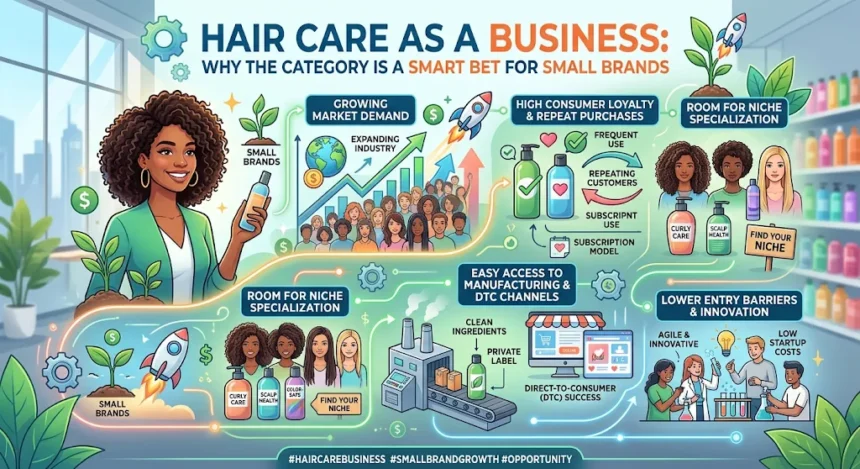
Quick answer: Hair care is a strong category for small brands because products are used several times a week, reordered within one to two months and easy to bundle into routines. Most new hair care brands launch with private label hair care products, ordered from around 500 units per product and delivered in six to ten weeks.
When entrepreneurs look at the beauty market, skincare usually gets the attention. Hair care deserves a closer look. Almost everyone washes their hair several times a week, products run out quickly, and customers are increasingly willing to pay more for formulas that suit their specific hair type. For a small business, that combination of steady demand and frequent reorders is hard to ignore.
The business case in three points
- High repeat purchase. A bottle of shampoo or conditioner is often finished within a month or two, so loyal customers come back regularly.
- Clear niches. Curly hair, colour-treated hair, scalp care, men’s grooming and natural formulas are all segments where specialised brands can win against mass-market names.
- Easy bundling. Shampoo, conditioner, mask and oil form a natural routine, which raises the average order value.
Who is building hair care brands
The new wave of hair care brands comes from many directions: hairdressers and barbers who want their own retail line, beauty creators with engaged audiences, e-commerce entrepreneurs looking for products with strong reorder rates, and existing skincare brands expanding their range. What they have in common is that very few of them manufacture anything themselves.
The private label route
Most new brands launch with private label hair care products. A specialist manufacturer supplies ready, tested formulas, and the brand chooses the products, scent and packaging and adds its own label. It removes the cost and time of developing formulas from scratch and lets the business focus on marketing and sales.
Minimum orders at many European manufacturers now start from around 500 units per product. Delivery usually takes six to ten weeks, so a brand can go from first samples to finished stock in a few months.
Building a profitable first range
Start with the products customers use most often and build around one clear hair type or problem:
- a shampoo and matching conditioner as the core
- one treatment product, such as a mask or hair oil, for a higher margin
- a styling or leave-in product once the core sells well
Keep the packaging consistent across the range. It lowers costs, simplifies production and makes the brand recognisable on a shelf or a product page.
Managing the risks
The biggest risks are ordering too much stock and getting compliance wrong. Order samples and test them on different hair types before committing. In the EU, every product needs a safety assessment and CPNP notification before sale. Manufacturers like Made By Nature Labs handle that paperwork and provide GMP certificates, which removes one of the biggest hurdles for a new brand.
Conclusion
Hair care combines frequent reorders, clear niches and simple bundling, which is exactly what a small brand needs to grow. With a focused first range and a reliable private label partner, it can be one of the most practical ways into the beauty business.
Key facts at a glance
- Why hair care: frequent use, fast reorders, clear niches and easy bundles.
- Core range: shampoo and conditioner, then a mask or oil, then styling.
- Growing niches: curly hair, scalp care, colour care, men’s grooming, natural formulas.
- Typical minimum order: from around 500 units per product.
- Typical lead time: six to ten weeks.
Frequently asked questions
Is hair care profitable for a small business?
It can be. Repeat purchases and bundles raise customer lifetime value, and own-brand products avoid price comparison with big brands. Margins depend mainly on packaging choices and marketing costs.
What is the difference between private label and custom hair care?
Private label uses ready, tested formulas with your branding and is fast to launch. Custom hair care means a chemist develops a formula for your brand, which takes longer and costs more.
How do I choose a hair care niche?
Look at your existing customers or audience and the hair problem they mention most, such as frizz, dryness, oily scalp or colour fading, then build the first range around solving it.
What are the main risks when starting a hair care brand?
Ordering too much stock, launching too many products, and skipping compliance. Testing samples, keeping the first range small and choosing a manufacturer that handles EU paperwork reduce all three.