Planks are one of the most widely used bodyweight exercises because they train several muscle groups at the same time without requiring equipment. Although they are often described as a core exercise, a properly performed plank also engages the shoulders, chest, back, glutes, hips, and legs. The exercise works mainly by asking your body to resist movement while maintaining a stable position.
The effectiveness of a plank depends heavily on form. Simply holding yourself off the floor does not guarantee that the right muscles are working efficiently. Good alignment, abdominal tension, glute engagement, shoulder stability, and controlled breathing all help distribute the effort across the body instead of placing unnecessary stress on the lower back or shoulders.
Understanding what muscles planks work can help you use the exercise more effectively in strength, mobility, or general fitness routines. Different plank variations can also shift more demand toward certain areas. This guide explains the main muscles involved, proper plank form, common mistakes, useful variations, and practical ways to include planks in your workouts.
What Muscles Do Planks Work?
Planks primarily target the muscles of the core, including the rectus abdominis, transverse abdominis, and obliques. These muscles work together to keep your spine and pelvis stable while gravity tries to pull your midsection toward the floor. Unlike crunches, planks challenge the core without requiring repeated bending of the spine.
The exercise also recruits muscles around the shoulders and upper body. Your deltoids, chest, serratus anterior, and parts of the upper back help support your body weight and maintain shoulder position. This is why a plank may feel demanding in the shoulders even when your main goal is abdominal training.
Your glutes, quadriceps, hip muscles, and even the muscles around the lower legs contribute as well. These areas help maintain a straight body line from the head to the heels. Because many muscles contract together, the plank functions as a full-body stabilization exercise rather than an isolated abdominal movement.
How the Core Muscles Work During a Plank
The transverse abdominis is a deep abdominal muscle that helps stabilize the trunk and control pressure around the midsection. During a plank, it works to prevent the abdomen from dropping toward the floor. Engaging this deep core muscle helps support a more stable position and reduces unnecessary movement through the lower back.
The rectus abdominis, often called the six-pack muscle, also contributes to spinal stability. Instead of shortening repeatedly as it does during some abdominal exercises, it contracts isometrically during a plank. This means the muscle produces tension while staying at approximately the same length throughout the hold.
The internal and external obliques help resist twisting and side bending. They become especially important when your body is challenged by uneven positions, such as lifting one arm or performing a side plank. Together, these core muscles create a stable trunk that allows the hips and shoulders to stay aligned.
Do Planks Work the Rectus Abdominis?
Yes, the rectus abdominis is active during a properly performed plank. Its main job is to help prevent excessive arching through the lower back while your body remains straight. Keeping the ribs controlled and gently drawing the pelvis into a neutral position can increase the feeling of abdominal engagement.
Many people expect to feel the same abdominal sensation they experience during crunches, but planks work differently. The rectus abdominis does not move through a large range of motion. Instead, it maintains tension to resist extension through the spine, which makes the exercise more about stability than repeated flexion.
If your lower back begins to sag, the abdominal muscles may not be maintaining enough tension. Shortening the hold and resetting your position is usually more useful than continuing with poor form. Quality matters more than simply trying to remain in the plank for the longest possible time.
Do Planks Work the Obliques?
The obliques are active during standard planks because they help maintain trunk stability and prevent unwanted rotation. Even though the movement appears completely still, small forces are constantly trying to shift your body out of alignment. Your obliques work with other core muscles to resist those changes.
Side plank variations place even greater demand on the obliques. When your body is supported on one arm and the side of one foot, the muscles along the side of the abdomen must work hard to keep the hips lifted. This makes side planks a useful option for training lateral core stability.
Oblique strength is useful for activities that involve turning, carrying, changing direction, or resisting rotation. Planks can contribute to this type of stability when performed with good control. More advanced anti-rotation exercises can also be added later if you want to challenge these muscles further.
Do Planks Work the Lower Back?
Planks also involve the muscles that support the lower back, including the erector spinae and deeper spinal stabilizers. These muscles help maintain a neutral spine while working together with the abdominal muscles. The goal is not to excessively arch the back but to create balanced tension around the entire trunk.
A properly performed plank should feel stable rather than painful in the lower back. If your hips drop too low, the lumbar spine may begin to extend excessively and increase discomfort. Tightening the glutes, bracing the core, and slightly adjusting the pelvis can help improve alignment.
People with existing back pain should not assume that planks are automatically appropriate. Some may tolerate modified planks well, while others may need different exercises or professional guidance. Pain during the movement is a reason to stop and reassess rather than simply trying to push through the hold.
How Planks Work the Shoulders
Your shoulders support a large portion of your body weight during a plank, especially in the high-plank position. The deltoids help stabilize the upper arms while smaller muscles around the shoulder joint maintain control. This is why shoulder endurance can sometimes limit plank duration before the core feels fully fatigued.
The serratus anterior also plays an important role by helping stabilize the shoulder blades against the rib cage. Actively pressing the floor away can increase serratus engagement and prevent the chest from collapsing between the shoulders. This creates a stronger and more stable upper-body position.
Keeping your shoulders positioned over your elbows or wrists also improves force distribution. If the arms are placed too far forward, the shoulders may experience unnecessary strain. Proper setup allows the shoulders, chest, and upper back to share the workload more efficiently.
How Planks Work the Chest and Upper Back
The pectoral muscles contribute to supporting the upper body during planks, particularly when your hands are placed on the floor. They help stabilize the shoulder joint and assist with maintaining pressure through the arms. The chest is not the primary target, but it still plays a supportive role throughout the exercise.
Upper-back muscles such as the trapezius and rhomboids also contribute to shoulder blade control. They work with the serratus anterior and shoulder muscles to keep the upper body stable. Maintaining this balance prevents the shoulder blades from collapsing inward or moving excessively during the hold.
Good upper-body stability makes it easier to maintain strong plank form for the entire body. If the shoulders and upper back become fatigued, posture may deteriorate quickly. Building strength in these areas can therefore improve both plank quality and overall upper-body control.
How Planks Work the Glutes
The gluteus maximus helps maintain hip extension and prevents the pelvis from dropping toward the floor. Squeezing the glutes gently during a plank can improve pelvic stability and reduce excessive arching in the lower back. This makes glute engagement an important part of correct technique.
The gluteus medius and smaller hip stabilizers also contribute, especially during side planks or single-leg variations. These muscles help control the pelvis and prevent the hips from rotating or shifting. Their involvement increases when the exercise becomes less symmetrical.
Strong glute engagement connects the upper and lower body into one stable line. If the glutes remain relaxed, the hips may sag or rise too high. Thinking about tightening the buttocks and pushing through the heels can help improve full-body tension during the exercise.
Do Planks Work the Legs?
The quadriceps work during planks by helping keep the knees straight and the legs active. Rather than allowing the lower body to relax, a strong plank requires tension from the thighs down to the feet. This creates better stability and makes the exercise feel more like a whole-body movement.
The hamstrings contribute to hip and pelvic control, while the calves help stabilize the ankles and support pressure through the toes. These muscles may not feel as fatigued as the core, but they still contribute to maintaining alignment. Keeping the legs active prevents the body from collapsing into a passive position.
Thinking about pressing the heels backward while tightening the thighs can increase lower-body engagement. This cue helps create length through the body while maintaining abdominal tension. The more effectively the entire body works together, the more stable and efficient the plank becomes.
How to Perform a Forearm Plank Correctly
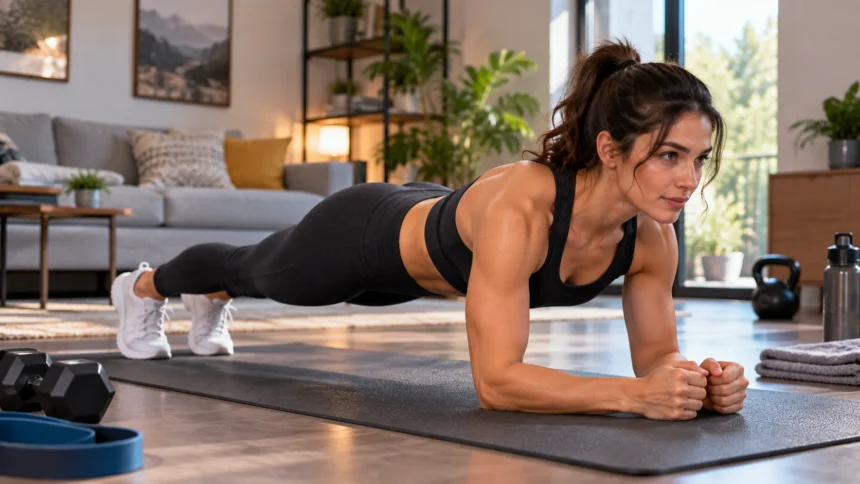
Start on the floor with your forearms down and elbows positioned directly beneath your shoulders. Extend your legs behind you and support your lower body on your toes. Keep your head in a neutral position so your neck follows the natural line of your spine.
Brace your abdominal muscles as though preparing for a light impact and gently tighten your glutes. Your body should form a straight line from the head through the shoulders, hips, knees, and heels. Avoid letting the hips drop toward the floor or rise excessively toward the ceiling.
Breathe steadily instead of holding your breath. Begin with a duration you can maintain with good form, such as 15 to 30 seconds, and stop when your alignment starts to break down. Short, controlled holds are generally more useful than long holds performed with poor posture.
Common Plank Form Mistakes to Avoid
One of the most common mistakes is allowing the hips to sag. This often places excessive stress on the lower back and reduces the amount of effective abdominal tension. Tightening the glutes and pulling the ribs slightly toward the pelvis can help correct the position.
Another common error is lifting the hips too high. This reduces the challenge on the core and turns the position into something closer to a downward angle. Aim for a straight body line rather than trying to make the exercise easier by shifting the hips upward.
People also frequently hold their breath, shrug the shoulders, or look too far forward. These habits can create unnecessary tension in the neck and upper body. Keep your gaze slightly ahead of your hands or forearms, maintain steady breathing, and press the floor away to keep the shoulders stable.
Best Plank Variations for Different Muscles
A high plank places slightly more demand on the wrists, shoulders, and chest because the arms remain straight. The core still works hard to resist spinal movement. This variation can also serve as the starting position for mountain climbers, shoulder taps, and other dynamic exercises.
Side planks emphasize the obliques, gluteus medius, and lateral hip stabilizers. Supporting your body on one side increases the challenge of preventing the pelvis from dropping. Beginners can modify the movement by keeping the lower knee on the floor while still training side-body stability.
Plank shoulder taps increase anti-rotation demands because you temporarily remove one hand from the floor. Single-leg planks similarly challenge the glutes and core by reducing the base of support. More complex variations should only be introduced after you can maintain strong alignment during a standard plank.
How Long Should You Hold a Plank?
There is no single ideal plank duration for everyone. Beginners may benefit from holding a good position for 10 to 30 seconds, while more experienced exercisers may comfortably maintain proper form for longer. The goal should be muscular control rather than chasing a specific number.
Once you can hold a standard plank easily for an extended period, increasing difficulty may be more useful than simply adding more time. Side planks, shoulder taps, weighted variations, or longer-lever positions can provide a stronger training stimulus. Progression should still happen gradually and without sacrificing technique.
You can perform several shorter sets instead of one very long hold. For example, three sets of 20 to 40 seconds may allow better form than one exhausting two-minute plank. Rest between sets and stop when you can no longer maintain a stable spine and pelvis.
How Planks Fit Into a Balanced Exercise Routine
Planks work well as part of a broader strength and mobility program rather than as the only core exercise you perform. Pair them with movements that train rotation, side bending control, hip strength, and spinal movement when appropriate. A varied routine usually provides more complete development than repeating one exercise every day.
Core training can also complement mobility work and daily movement habits. For example, people building a broader wellness routine may combine strength work with gentle stretching or other mobility exercises, including stretches for mobility when those movements suit their individual needs. The goal is to support overall movement quality rather than relying on one exercise for every problem.
Strength exercises such as squats, rows, presses, and lunges also train the core because the trunk must stabilize during movement. Planks can supplement these exercises by directly challenging anti-extension and anti-rotation control. Combining different movement patterns creates a more balanced and practical training program.
Conclusion
Planks work far more than the abdominal muscles alone. The rectus abdominis, transverse abdominis, obliques, lower back, shoulders, chest, upper back, glutes, hips, and legs all contribute to maintaining a stable position. This makes the plank a useful full-body stabilization exercise that requires coordinated muscle tension.
Proper form is more important than holding the position for as long as possible. Keep the shoulders aligned, brace the core, tighten the glutes, keep the legs active, and maintain a neutral spine. If your hips sag, your lower back hurts, or your shoulders collapse, shorten the hold and reset your technique.
Planks can be adapted to different ability levels through forearm, high-plank, side-plank, and dynamic variations. Use them as one part of a balanced strength routine rather than depending on them for all core training. With controlled technique and gradual progression, planks can help improve trunk stability, muscular endurance, and overall body control.
FAQs
What muscles do planks work the most?
Planks primarily work the core, including the transverse abdominis, rectus abdominis, and obliques. They also engage the shoulders, glutes, back, chest, hips, and legs to maintain full-body stability.
Do planks help strengthen the lower back?
Planks engage the muscles that support the lower back while also strengthening the abdominal and hip muscles. Good form is essential, because allowing the hips to sag may increase unwanted stress on the lumbar spine.
Can planks build visible abs?
Planks can strengthen and improve endurance in the abdominal muscles, but visible abs also depend on factors such as overall body composition. No single exercise can specifically remove fat from the abdominal area.
How long should a beginner hold a plank?
Beginners can start with approximately 10 to 30 seconds while maintaining good alignment. Several shorter sets are often more useful than one long hold that causes the hips, shoulders, or lower back to lose position.
Is it okay to do planks every day?
Some people can tolerate frequent plank training, but muscles still need appropriate recovery. Your ideal frequency depends on exercise intensity, overall training volume, fitness level, and whether you experience soreness or discomfort.