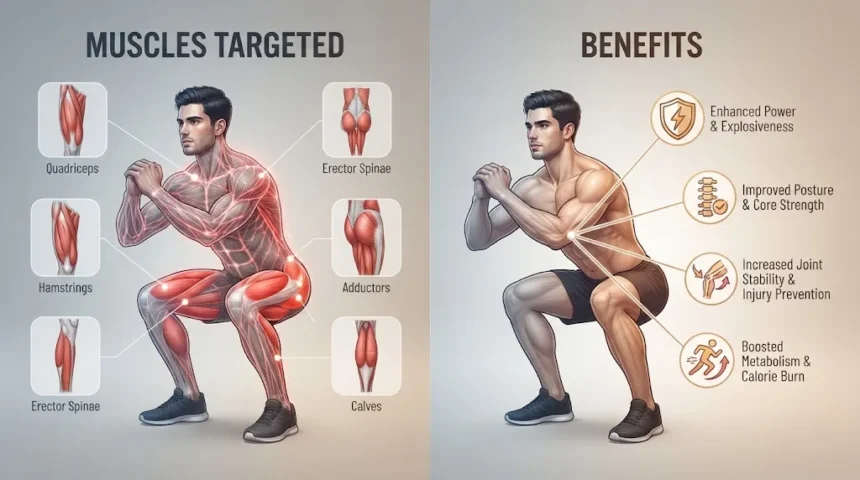
Squats are a compound lower-body exercise that trains several major muscle groups at the same time. The quadriceps, glutes, hamstrings, adductors, calves, and core all contribute to controlling the movement. Because several joints and muscles work together, squats can build strength that transfers well to everyday activities such as standing, climbing stairs, lifting, and getting up from a chair.
The amount each muscle contributes depends on your squat style, depth, stance, load, and individual body structure. A deeper squat may involve greater hip movement, while a more upright variation can place greater demand on the quadriceps. No single squat variation targets every muscle equally, which is why different squat styles can be useful within a balanced strength program.
Squats also require muscles around the trunk and hips to stabilize the body as you lower and stand back up. Even though the legs produce most of the visible movement, the abdominal and back muscles help maintain control. This combination makes squats valuable for strength, coordination, balance, and overall lower-body development.
Quadriceps During Squats
The quadriceps are four muscles located at the front of the thigh, and they play a major role during squatting. As you lower into the movement, the quadriceps control knee bending under load. When you stand back up, they help straighten the knees and produce much of the force needed to return to the starting position.
Squat variations that allow the knees to travel farther forward can increase the demand placed on the quadriceps. Front squats, heel-elevated squats, and some high-bar back squat styles often create a more upright torso and greater knee flexion. These changes can make the quads work harder compared with more hip-dominant squat variations.
Strong quadriceps support more than gym performance. They contribute to walking, running, climbing stairs, jumping, and controlling the body when lowering into a chair. Building quad strength through squats and other exercises can improve overall leg capacity, especially when resistance and training volume are increased gradually.
Glutes and Hip Muscles
The gluteus maximus is one of the primary muscles involved in squatting because it helps extend the hip as you stand. It becomes especially active when rising from deeper positions where the hips are more flexed. The gluteus medius and smaller hip muscles also help stabilize the pelvis and control the position of the thighs.
Squat depth can influence how much the glutes contribute. Deeper squats generally require more hip flexion, which increases the amount of work needed from the hip extensors during the upward phase. However, depth should be based on comfort, mobility, technique, and individual anatomy rather than forcing the hips into a painful range.
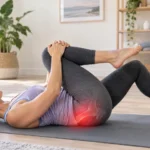
If deep squatting causes a repeated pinching sensation in the groin, reducing depth may be appropriate while you investigate the cause. People dealing with hip discomfort may also benefit from learning about hip impingement exercises before aggressively increasing squat depth. Strength should be built through a range the hip can tolerate comfortably.
Hamstrings and Adductors
The hamstrings contribute to hip extension and help stabilize the knee and pelvis during squats. However, they may not shorten and lengthen as dramatically as they do during exercises such as Romanian deadlifts because the hip and knee move together. Squats still involve the hamstrings, but they are not usually considered the most direct hamstring-building exercise.
The adductor magnus, located along the inner thigh, can contribute significantly during deeper squats. It helps extend the hip as you rise from the bottom position and works alongside the glutes. This is one reason squats can train more of the lower body than people sometimes expect from an exercise commonly described as mainly targeting the quadriceps.
A slightly wider stance may change how the hips and inner thighs contribute, although the effect varies from person to person. Stance width should feel natural rather than being chosen only to target one muscle. The best position allows you to maintain balance, control your knees, and squat through a comfortable range without sharp hip or knee pain.
Calves and Lower-Leg Muscles
The calf muscles help stabilize the ankle during squats and assist with keeping the body balanced as the knees and hips bend. The soleus is particularly involved because the knee remains flexed during much of the movement. The gastrocnemius also contributes to lower-leg stability, although squats do not train the calves as directly as calf raises.
Good ankle mobility allows the shins to move forward while the feet remain stable on the floor. If ankle motion is limited, the heels may rise or the torso may compensate by leaning farther forward. Heel elevation can sometimes make squatting more comfortable by reducing the amount of ankle dorsiflexion required.
Squats alone may not provide enough calf stimulus for people specifically trying to build lower-leg strength or muscle size. Direct calf exercises can complement squatting by training ankle plantar flexion through a larger range. A balanced lower-body program can therefore include squats for compound strength alongside targeted calf work.
Core Muscles During Squats
The abdominal muscles, obliques, spinal erectors, and deeper trunk muscles help stabilize the torso during squats. Their job is not necessarily to bend or twist the spine but to resist unwanted movement while force travels between the lower and upper body. This is especially important when holding a barbell, dumbbell, kettlebell, or other external load.
A strong brace helps maintain a stable trunk without requiring you to hold excessive tension for the entire workout. Before descending, create enough abdominal pressure to support the spine, then maintain control as you move. The amount of bracing required increases as the load becomes heavier or the squat variation becomes more demanding.
Squats can strengthen the core, but they do not replace every type of trunk exercise. Carries, planks, anti-rotation exercises, and controlled flexion or extension movements can provide additional training. Combining compound lifts with targeted core work can develop strength across a wider variety of positions and movement demands.
Benefits of Doing Squats
Squats are effective for developing lower-body strength because they train several major muscle groups within one movement. Progressive squat training can improve your ability to produce force through the knees and hips. This strength can support sports, resistance training, and daily tasks that involve lifting, standing, climbing, or lowering the body under control.
Squats can also help build muscle when performed with enough resistance and appropriate training volume. The quadriceps and glutes typically receive the greatest stimulus, while the adductors, hamstrings, calves, and core contribute to the movement. Different variations can shift emphasis and help prevent a strength program from becoming overly repetitive.
Another benefit is movement confidence. Practicing squatting can make activities such as sitting down, rising from the floor, or lifting objects feel more familiar and controlled. The exercise is also highly adaptable, allowing beginners to start with body-weight or supported variations before progressing to dumbbells, kettlebells, barbells, or machines.
How Squat Variations Change Muscle Emphasis
Back squats allow relatively heavy loading and train the entire lower body, but bar position can influence technique. High-bar squats often encourage a more upright torso, while low-bar squats generally involve more forward torso inclination. These differences can shift the relative demands between the knees, hips, quadriceps, and posterior chain.
Front squats place the load in front of the body, which usually requires a more upright torso. This position can increase quadriceps demand while still training the glutes and core. Goblet squats create a similar front-loaded pattern and are often easier for beginners because holding one weight in front can help with balance.
Split squats and Bulgarian split squats train one leg more independently and challenge hip stability. Sumo squats use a wider stance and may increase involvement of the adductors for some lifters. No variation is universally best, so exercise selection should reflect your goals, mobility, comfort, available equipment, and training experience.
How to Perform a Squat Correctly
Begin with your feet at a comfortable width and your toes pointing slightly outward if that feels natural. Keep your feet firmly in contact with the floor and create gentle tension through your trunk. Start the descent by bending the knees and hips together rather than forcing one joint to move before the other.
Lower yourself as far as you can while maintaining control and avoiding sharp pain. Your knees can move forward over the toes if that position is comfortable, and they should generally track in the same direction as your feet. Keep your balance over the middle of the foot rather than shifting excessively onto your toes or heels.
To stand, push through the floor and extend the hips and knees together. Avoid allowing the hips to shoot upward much faster than the chest if that causes you to lose your intended position. Finish standing tall without aggressively leaning backward or locking the knees harder than necessary at the top.
Common Squat Mistakes
One common mistake is choosing more weight than you can control. Excessive loading can shorten your range, reduce balance, and cause your technique to change significantly. Use resistance that allows consistent repetitions before increasing the load, especially if you are still learning how your stance and squat depth should feel.
Another mistake is forcing a stance or depth simply because someone else uses it. Hip anatomy, ankle mobility, limb length, and training goals all influence how a squat looks. One person’s narrow, deep squat may feel comfortable, while another person may need a wider stance or slightly reduced depth to move effectively.
Allowing the feet to lose contact with the floor can also make the movement less stable. Heels rising may suggest limited ankle mobility, unsuitable footwear, or a squat style that does not match your current movement capacity. Adjusting stance, using heel elevation, or improving ankle mobility may help rather than repeatedly forcing the same uncomfortable technique.
How to Progress Squats Safely
Beginners can start with body-weight squats, supported squats, or box squats while learning the movement. Once these become easy, holding a dumbbell or kettlebell can add resistance without making the setup overly complicated. Progress should happen gradually so muscles, joints, and connective tissues have time to adapt.
You can increase difficulty by adding weight, repetitions, sets, range of motion, or more challenging variations. Changing everything at the same time can increase fatigue faster than your body can handle. A simple approach is to progress one variable while keeping the others relatively stable for several workouts.
Pay attention to how you feel during and after training. Normal muscle fatigue is expected, but sharp hip, knee, or back pain should not be ignored. If discomfort continues despite reducing the load or modifying technique, professional assessment can help determine whether another issue is affecting your ability to squat comfortably.
Who Can Benefit From Squats?
Beginners can benefit because squats teach a fundamental movement pattern used throughout everyday life. Starting with a chair or supported squat can make the exercise approachable even when strength or confidence is limited. As control improves, resistance and depth can be increased gradually according to individual ability.
Athletes use squats to build lower-body strength for running, jumping, tackling, throwing, and changing direction. Squats do not perfectly reproduce every sport movement, but stronger legs and hips can provide a useful physical foundation. Athletes can then combine strength training with sprinting, jumping, and sport-specific drills.
Older adults may also benefit from appropriate squat variations because the movement resembles sitting down and standing up. Maintaining leg strength can support independence and everyday mobility. Exercise selection should still consider balance, joint comfort, medical conditions, and previous injuries, especially when someone is returning to strength training after a long period of inactivity.
Conclusion
Squats primarily work the quadriceps and glutes while also involving the hamstrings, adductors, calves, core, and other stabilizing muscles. Because several joints move together, squats provide a highly efficient way to train the lower body. The exact muscle emphasis changes with stance, depth, load, and squat variation.
Benefits include stronger legs, greater muscle development, improved movement control, and better capacity for everyday and athletic activities. Front squats, back squats, goblet squats, and split squats can all provide useful training when selected appropriately. No single variation is necessary for everyone, so comfort and individual goals should guide exercise choice.
Focus on consistent technique and gradual progression rather than forcing maximum depth or weight. Keep your feet stable, control the descent, and use a range of motion that feels manageable. When combined with other lower-body and core exercises, squats can become an effective foundation for long-term strength, performance, and functional fitness.
FAQs
What muscles do squats work the most?
Squats primarily target the quadriceps and gluteus maximus. The hamstrings, adductors, calves, abdominal muscles, and spinal stabilizers also contribute to controlling the movement and supporting the body under load.
Do squats work the hamstrings?
Yes, the hamstrings contribute to hip extension and knee stability during squats. However, exercises such as Romanian deadlifts and leg curls generally train the hamstrings through a more direct range of motion.
Are squats good for building glutes?
Yes. Squats can effectively train the glutes, particularly through comfortable deeper ranges that require greater hip flexion. Progressive resistance and sufficient training volume are important for building strength and muscle.
Do squats strengthen your core?
Yes. The core muscles stabilize the trunk and help transfer force during squats, especially when external resistance is used. Additional targeted core exercises can still complement squat training.
How deep should you squat?
Squat as deep as you can while maintaining control, balance, and comfort. Individual anatomy and mobility differ, so there is no single required depth that is appropriate for everyone.