Hip impingement, often called femoroacetabular impingement or FAI, occurs when the bones of the hip joint come into contact earlier than expected during certain movements. This can irritate tissues around the joint and cause pain, particularly with deep hip bending or rotation. Symptoms often develop gradually rather than beginning with one obvious injury.
The hip is a ball-and-socket joint formed by the top of the thigh bone and the pelvis. Differences in bone shape can reduce the available space during movements such as squatting, sitting deeply, or bringing the knee toward the chest. However, structural differences alone do not always cause pain, and many people have them without experiencing symptoms.
Exercise cannot change the shape of the bones, but it may improve strength, movement control, and tolerance around the hip. Many people can manage symptoms by modifying aggravating movements and gradually strengthening surrounding muscles. Persistent or severe pain should still be assessed professionally because other hip conditions can produce similar symptoms.
Common Causes of Hip Impingement
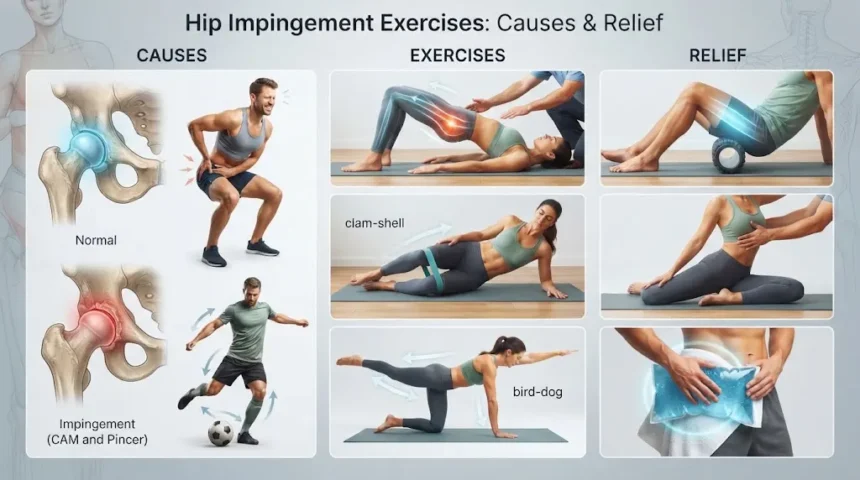
Femoroacetabular impingement is commonly described as cam, pincer, or combined impingement. Cam morphology involves extra bone around the top of the femur, while pincer morphology involves greater coverage from the hip socket. Some people have features of both types, although having these structural findings does not necessarily mean someone will develop pain.
Repetitive deep hip flexion can sometimes aggravate a sensitive joint. Activities such as deep squats, prolonged low sitting, cycling in a compressed position, martial arts, and certain sports repeatedly bring the hip into positions where symptoms may occur. The movement itself is not automatically harmful, but repeated exposure beyond your current tolerance may increase irritation.
Reduced hip strength and movement control may also influence how symptoms behave. Weakness around the glutes, trunk, or surrounding hip muscles can make certain activities more difficult to control. Previous injury, sudden training increases, and repeatedly forcing painful ranges may also contribute to irritation even when the underlying bone shape has been present for years.
Symptoms of Hip Impingement
Pain is commonly felt at the front of the hip or in the groin, especially during deep bending. Some people notice a pinching sensation when squatting, getting into a low car, tying shoes, or bringing the knee toward the chest. Pain may also appear after prolonged sitting or following activities that involve repeated hip flexion.
Stiffness can occur alongside pain, making it harder to rotate the hip or move comfortably through a deep range. Some people experience clicking, catching, or a feeling that the hip is temporarily blocked. Clicking by itself is not necessarily a sign of injury, but painful catching or loss of movement deserves more attention.
Symptoms can sometimes spread toward the outer hip, buttock, or upper thigh, making the source less obvious. Hip pain can also overlap with lower-back or pelvic problems. If pain includes significant weakness, numbness, severe night symptoms, or difficulty bearing weight, professional assessment can help rule out other causes.
How Exercise Can Help Hip Impingement
Exercise aims to improve the muscles and movement patterns surrounding the hip rather than forcing the joint through painful positions. Stronger glutes, hip abductors, and trunk muscles can help distribute force more effectively during walking, climbing stairs, lifting, and sports. Better strength may also make previously irritating activities easier to tolerate gradually.
Mobility work can be useful when nearby muscles feel stiff, but more flexibility is not always the goal. If a particular direction consistently produces a sharp pinch in the groin, repeatedly forcing that position may increase irritation. Exercise should focus on comfortable movement and functional range rather than trying to achieve maximum hip flexibility.
Progressive loading is especially important. Begin with exercises that feel manageable and gradually increase resistance, repetitions, or movement depth as symptoms improve. The goal is to expand what the hip can tolerate over time without repeatedly creating strong pain during or after training.
Glute Bridge for Hip Support
The glute bridge strengthens the buttock muscles while keeping the hip in a relatively controlled range. Lie on your back with your knees bent and feet flat on the floor. Gently tighten your abdominal muscles, press through your feet, and lift your hips until your body forms a comfortable line from the shoulders toward the knees.
Pause briefly at the top and squeeze the glutes without excessively arching the lower back. Lower your hips slowly and repeat while keeping the knees aligned with the feet. If you feel a sharp pinch at the front of the hip, reduce how high you lift rather than forcing the movement.
Start with two or three sets of comfortable repetitions and progress gradually. You can later add a resistance band around the thighs or use a single-leg variation if the basic bridge becomes easy. Smooth control is more important than lifting the hips as high as possible.
Clamshell Exercise
Clamshells target muscles around the outer hip that contribute to pelvic and leg control. Lie on your side with your hips and knees bent, keeping your feet together. Without rolling your pelvis backward, slowly lift the top knee while the feet remain touching, then lower it with control.
The movement does not need to be large. Stop when you feel the outer hip muscles working and before your pelvis begins rotating to create extra range. If you feel pressure or pinching at the front of the hip, adjust the hip angle slightly or reduce how far the knee opens.
A light resistance band around the thighs can make the exercise more challenging once body weight becomes easy. Clamshells are useful for developing hip control, but they should not be the only strengthening exercise in your routine. Combine them with bridges, standing exercises, and gradual weight-bearing movements for a more complete program.
Standing Hip Abduction
Standing hip abduction strengthens the gluteus medius and other muscles that help stabilize the pelvis. Stand near a wall or sturdy chair and lightly hold it for balance. Keep your trunk upright and move one leg slowly out to the side without leaning your body in the opposite direction.
Keep the toes mostly pointing forward and use a relatively small range at first. You should feel the muscles along the outside of the hip rather than a strong pinch in the groin. Return the leg slowly instead of allowing it to swing back under the body.
Progress the exercise by adding a loop band around the thighs or ankles. You can also perform controlled lateral band walks once basic standing abduction feels comfortable. These exercises may improve hip control during walking, stairs, running, and other activities where the pelvis needs to remain stable.
Hip Flexor Stretch
Tightness at the front of the hip can feel uncomfortable, but hip flexor stretching should be performed carefully when impingement symptoms are present. Begin in a half-kneeling position with one knee on the floor and the opposite foot in front. Keep your torso tall and gently shift the pelvis forward until you feel a mild stretch.
Avoid aggressively pushing the hip forward or arching the lower back. The stretch should feel along the front of the hip and thigh rather than as a sharp pinch inside the groin. If pinching occurs, reduce the range or stop the stretch because forcing the joint deeper may make symptoms worse.
Hold the stretch briefly while breathing naturally, then return to the starting position. One or two gentle repetitions per side may be enough initially. Stretching can reduce temporary muscle tightness, but strengthening and movement modification are usually more important for improving long-term tolerance.
Hip Rotation and Mobility Exercises
Controlled hip rotation can help maintain comfortable movement without forcing the joint into painful ranges. One option is a seated hip rotation drill where the knees gently move from side to side while the feet stay planted. Use a small range at first and avoid pushing into sharp groin pain.
Another option is gentle quadruped rocking. Start on your hands and knees, keep your back relatively neutral, and slowly shift your hips backward until you feel the first point of resistance. Stop before a strong pinch develops, then return forward and repeat with smooth, controlled movement.
Mobility exercises should make the hip feel easier to move rather than more irritated afterward. More range is not always better, especially when certain joint positions are naturally limited. Use mobility drills to explore comfortable movement and gradually expand tolerance rather than treating stiffness as something that must always be forced away.
Squat Modifications for Hip Impingement
Deep squats can provoke symptoms because they combine significant hip flexion with load. Instead of stopping squats completely, reduce the depth until you find a range that does not produce a strong pinch. A box or bench can provide a consistent target and make it easier to control how far you descend.
A slightly wider stance or small change in toe angle may also make squatting more comfortable for some people. Hip anatomy differs between individuals, so there is no single ideal squat stance for everyone. Experiment within a controlled range and choose the position that allows you to move without sharp pain or major compensation.
As symptoms improve, gradually increase squat depth or resistance. Do not rush back into deep, heavily loaded squats simply because a few sessions feel better. Strength and tolerance usually return more reliably when progression happens over several weeks rather than through sudden jumps in intensity.
Whole-Body Stability and Strength
Hip function is influenced by the rest of the body, including the trunk, knees, and ankles. Core exercises such as bird dogs, dead bugs, and carries can improve control during movements that transfer force through the pelvis. Better whole-body coordination may reduce unnecessary compensation when walking, lifting, running, or changing direction.
The same principle of controlled stability applies throughout the body. If you are building a broader strength routine, these shoulder stability exercises can complement lower-body work by improving control in another major joint region. A balanced program is often more useful than focusing exclusively on the painful area.
Lower-body strength should eventually include movements such as split squats, step-ups, bridges, and comfortable squat variations. Begin with ranges that do not provoke significant symptoms and progress gradually. A stronger hip generally tolerates everyday and athletic activity better than one that is protected from all loading for long periods.
Activities to Modify During a Flare-Up
Temporary activity modification can help when the hip is especially sensitive. Reduce movements that repeatedly produce a sharp groin pinch, such as deep squatting, very low sitting, or aggressive knee-to-chest positions. This does not mean avoiding movement entirely, because comfortable walking and light strengthening can help maintain function.
Cycling position may also need adjustment if deep hip flexion causes pain. Raising the seat slightly can reduce how much the hip bends at the top of each pedal stroke. Similarly, taking shorter steps or reducing hill intensity may help if running or walking uphill aggravates symptoms.
Return to more demanding activities gradually rather than testing the hip with maximum effort. Increase one factor at a time, such as depth, weight, distance, or speed. If symptoms become significantly worse for hours afterward or remain elevated the next day, the progression may have been too aggressive.
When to See a Healthcare Professional
Seek medical evaluation if hip pain is severe, follows significant trauma, or prevents you from bearing weight normally. A fall, collision, or sudden injury accompanied by major weakness or loss of movement can involve more than simple impingement. These situations deserve assessment rather than repeated attempts to stretch or exercise through the pain.
Persistent painful catching, locking, or significant loss of hip motion should also be evaluated. A physical therapist, sports medicine clinician, or other qualified healthcare professional can assess hip strength, movement, and possible involvement of the labrum or surrounding tissues. Imaging may be considered when the diagnosis remains uncertain or symptoms fail to improve.
Urgent assessment is appropriate for severe unexplained pain, fever, redness, or feeling significantly unwell. Progressive numbness, weakness, or bladder and bowel changes also require medical attention because these symptoms are not typical of simple hip impingement. The correct treatment depends on identifying the actual source of the symptoms.
Conclusion
Hip impingement can cause groin or front-of-hip pain during deep bending, squatting, sitting, or rotational movements. Structural differences in the hip may contribute, but they do not automatically mean someone will experience pain. Symptoms are often influenced by activity level, strength, movement tolerance, and how frequently irritating positions are repeated.
Exercises such as glute bridges, clamshells, standing hip abduction, gentle mobility drills, and modified squats can help improve strength and control. Stretching should remain comfortable and should not repeatedly create a sharp groin pinch. Progress exercises gradually so the joint and surrounding tissues have time to adapt.
If symptoms remain severe, cause locking, significantly limit walking, or do not improve with sensible activity changes, seek professional evaluation. Exercise can be an important part of managing hip impingement, but it should be matched to the underlying problem. A gradual combination of strength, mobility, and load management often provides the most practical path toward better movement.
FAQs
What exercises are best for hip impingement?
Glute bridges, clamshells, standing hip abduction, gentle mobility drills, and modified squats can be useful. Choose exercises that strengthen the hip without repeatedly creating a sharp pinching sensation in the groin.
Should I stretch a hip impingement?
Gentle stretching may help surrounding muscle tightness, but forcing the hip into painful flexion or rotation can worsen symptoms. Stretch only within a comfortable range and stop if sharp groin pain develops.
Can hip impingement improve without surgery?
Many people manage symptoms with activity modification, strengthening, mobility work, and gradual return to activity. Surgery may be considered in selected cases when significant symptoms persist despite appropriate conservative treatment.
Are squats bad for hip impingement?
Squats are not automatically harmful. Reducing depth, adjusting stance, or using a box can make them more comfortable while strength improves. Avoid repeatedly forcing a range that causes a strong pinch.
When should hip impingement pain be checked by a doctor?
Seek evaluation for severe pain, significant trauma, inability to bear weight, painful locking, progressive weakness, or symptoms that do not improve. Fever or serious neurological symptoms require more urgent medical attention.