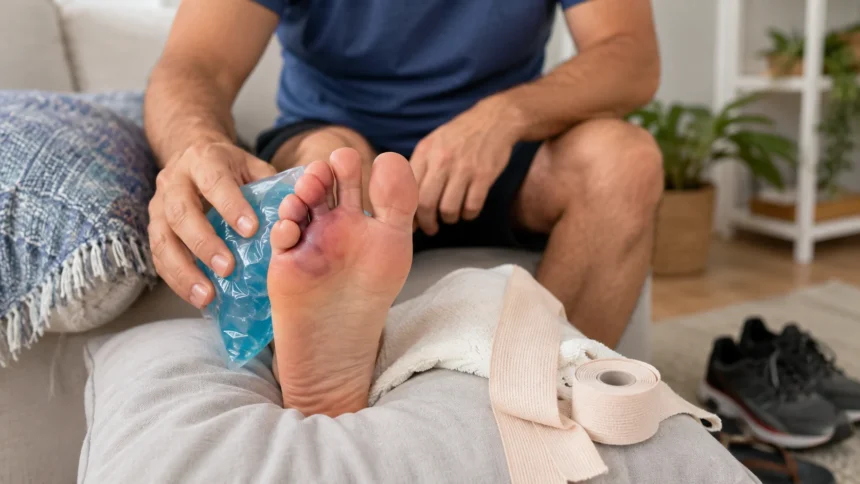
Sprained Toe: 7 Signs, Fast Relief & Recovery Tips
A sprained toe happens when one or more ligaments supporting a toe joint are stretched beyond their normal range or partially torn. It can happen after stubbing your toe, bending it backward, twisting it during sports, landing awkwardly, or catching the foot against an object. Pain, swelling, tenderness, and difficulty walking often follow soon afterward.
Most mild toe sprains can improve with protection, relative rest, cold therapy, elevation, supportive footwear, and a gradual return to normal movement. However, a sprain can feel surprisingly similar to a broken toe, so it is important to pay attention to deformity, severe pain, inability to bear weight, numbness, and other warning signs.
The big toe deserves particular attention because it plays a major role in balance and pushing the body forward while walking or running. A sprain involving the joint at the base of the big toe is often called turf toe, especially when the toe has been forcefully bent upward during sports or exercise.
If you are wondering whether you have a sprained toe, the following seven signs can help you recognize a possible ligament injury. You will also learn how to manage swelling, when buddy taping may help, how long recovery can take, and when symptoms deserve professional evaluation instead of home treatment.
What Is a Sprained Toe?
A sprain is an injury to a ligament, which is a strong band of connective tissue that joins one bone to another and helps stabilize a joint. When a toe is forced farther than its normal range, these ligaments can become overstretched or torn, producing pain around the affected joint.
Toe sprains range from mild to severe. A mild sprain may involve microscopic stretching of ligament fibers with limited swelling, while a more substantial injury can involve partial tearing, greater bruising, and difficulty using the toe normally. Complete ligament disruption is less common but can produce significant instability.
Any toe can be sprained, although the mechanism differs. Smaller toes are commonly injured by stubbing, twisting, or catching them against furniture, while the big toe is vulnerable when it is suddenly forced upward while the front of the foot remains planted.
A sprained toe is different from a strain because a strain affects muscle or tendon tissue rather than a ligament. It is also different from a fracture, although pain and swelling overlap enough that it can be difficult to tell the difference without an examination or imaging in more serious cases.
What Causes a Sprained Toe?
Stubbing the toe against furniture, a doorway, exercise equipment, or another hard object is a common cause. The impact can force the joint sideways or backward, stretching the supporting ligaments while also causing bruising and tenderness around the surrounding soft tissues.
Sports create another frequent mechanism. Running, football, soccer, basketball, martial arts, gymnastics, and other activities may force a toe into an unusual position when the foot lands, changes direction, or becomes caught against the ground.
The big toe can be injured when it bends upward too far while the ball of the foot stays planted. This type of injury is commonly associated with turf toe and can range from mild soreness to a significant ligament injury affecting walking and athletic performance.
Poorly fitting footwear can also contribute indirectly. Shoes that are too loose may allow excessive movement, while very tight or narrow shoes can place extra pressure on an already irritated toe. Uneven ground, barefoot activity, and sudden changes in training can increase the chance of accidental injury.
Sign 1: Pain Around the Toe Joint
Pain is usually the first noticeable sign of a sprained toe. It commonly develops around the joint rather than in the middle of the bone and may begin immediately after the toe is bent, twisted, or struck.
The discomfort may feel dull while resting but become sharper when you push off the foot, bend the toe, climb stairs, or wear shoes that press against the injured area. Big-toe sprains can be especially noticeable because the toe carries substantial force during normal walking.
Mild sprains may allow you to continue walking with only minor discomfort, while more significant injuries can make every step painful. Pain intensity alone cannot reliably distinguish a sprain from a fracture because broken toes can create similar symptoms.
Pay attention to how the injury happened and where the tenderness is strongest. Severe pain directly over a bone, pain that does not begin improving, or discomfort accompanied by obvious deformity should increase concern about a fracture or more serious joint injury.
Sign 2: Swelling Around the Injured Toe
Swelling commonly develops after a ligament injury because damaged tissues trigger an inflammatory response. The affected toe may become visibly larger than the matching toe on the opposite foot, and swelling may extend into the surrounding forefoot.
Swelling can appear within minutes or gradually increase during the first several hours. Shoes that felt comfortable before the injury may suddenly feel tight, particularly when the toe and neighboring tissues become puffy.
Keeping the foot elevated can help manage early swelling, while a wrapped cold pack can provide short periods of symptom relief. Avoid putting ice directly on bare skin, and do not assume that more frequent or prolonged icing will make the ligament heal immediately.
Large or rapidly increasing swelling deserves closer attention, especially when combined with severe pain, deformity, or difficulty walking. Significant swelling can occur with both sprains and fractures, so the appearance alone cannot establish the diagnosis.
Sign 3: Bruising or Discoloration
Bruising can develop when small blood vessels around the injured ligament and surrounding tissues are damaged. The skin may initially appear red before becoming purple, blue, green, or yellow as the bruise changes during healing.
Not every sprained toe develops obvious bruising. A mild ligament stretch may cause tenderness and swelling without much discoloration, while a more forceful injury can produce noticeable bruising around the joint and nearby foot.
Bruising also occurs frequently with fractures, so a dark-colored toe should not automatically be labeled a sprain. The combination of bruising, severe tenderness, deformity, and difficulty bearing weight should make you more cautious.
Take note of whether discoloration is gradually improving or continuing to spread along with worsening symptoms. Normal bruising often changes color and fades with time, whereas worsening pain or circulation changes need more urgent attention.
Sign 4: Pain When Bending the Toe
A sprained joint often becomes painful when moved because the damaged ligament is placed under tension. Bending the toe upward, downward, or sideways may recreate the pain you felt at the moment of injury.
Range of motion may also feel reduced because swelling physically limits movement. Your body may instinctively guard the joint, making you reluctant to move it even when the ligament itself has not been severely damaged.
Do not repeatedly force the toe through painful movements simply to “test” whether it is injured. Aggressive bending can irritate damaged tissues and provides little useful information when a fracture or significant sprain has not been ruled out.
As symptoms improve, comfortable movement can gradually return. A toe that remains extremely stiff, unstable, or painful after the initial swelling has settled may benefit from professional assessment to determine whether another injury is present.
Sign 5: Difficulty Walking Normally
Walking places repeated force through the toes, especially during the push-off phase of each step. A sprain can therefore cause limping, shorter steps, or a tendency to place more weight on the heel or outside of the foot.
Big-toe injuries often interfere with walking more noticeably because the big toe provides important leverage when the body moves forward. Even a moderate sprain can make running, climbing stairs, or walking quickly uncomfortable.
Changing your gait for too long can create secondary discomfort elsewhere in the foot, ankle, knee, or hip. Supportive footwear and temporary activity modification can help you move more naturally while the injury settles.
If you cannot bear weight at all or walking causes severe pain, do not simply push through it. Significant difficulty using the foot can occur with severe sprains, fractures, or other injuries that deserve medical evaluation.
Sign 6: Tenderness When You Touch the Toe
A sprained toe often feels tender around the injured joint when you gently press the surrounding tissues. The sore area may correspond closely with where the ligament was overstretched during the original injury.
Mild pressure may feel uncomfortable without producing intense pain. Severe point tenderness, particularly when it seems centered directly over a bone rather than the soft tissue around a joint, can raise concern about a possible fracture.
Do not repeatedly press hard on the injured area to determine how serious it is. Repeated poking can increase irritation without providing a reliable diagnosis and may make swelling or soreness feel worse.
Tenderness should gradually decrease as healing progresses. If the area becomes increasingly painful, hot, red, or swollen instead of improving, another problem may be present and professional evaluation may be appropriate.
Sign 7: Reduced Strength or Stability
A more significant sprain can make the toe feel weak or unstable when you try to push against the ground. You may notice that the joint does not feel as secure as it did before the injury, particularly during quick movements.
Weakness can also result from pain inhibition. When movement hurts, the body naturally reduces how strongly nearby muscles contract, making the toe feel weaker even when the supporting structures are not completely torn.
Instability is particularly important in a big-toe sprain because the joint needs to remain stable during walking, running, jumping, and changing direction. Athletes may notice difficulty accelerating or pushing off before everyday walking becomes severely limited.
Persistent instability or an inability to push off the foot normally can indicate a more substantial injury. Rather than immediately returning to sports, allow the toe to recover and consider assessment if normal strength and function do not return.
Sprained Toe vs Broken Toe: How Can You Tell?
A sprain damages ligaments, while a broken toe involves a fracture of one or more bones. Unfortunately, both injuries can cause pain, swelling, bruising, tenderness, and difficulty walking, making self-diagnosis difficult after a substantial impact.
A toe that appears crooked, rotated, unusually shortened, or obviously out of alignment is more concerning for a fracture or dislocation. Severe tenderness directly over the bone and an inability to comfortably bear weight are other reasons to seek evaluation.
A minor fracture may still look relatively normal, however, which means the absence of deformity does not guarantee that the toe is only sprained. Imaging such as an X-ray may sometimes be needed when the diagnosis will change treatment.
If the injury involves the big toe, medical assessment is particularly valuable when symptoms are significant because this joint contributes heavily to walking and balance. Persistent pain after several days also deserves attention even when the toe initially seemed mildly injured.
Sprained Toe vs Stubbed Toe
A stubbed toe describes how the injury occurred rather than the exact tissue that was damaged. Striking the front of your toe against a hard object can cause a simple bruise, a ligament sprain, nail injury, dislocation, or fracture.
A mild stub may hurt intensely for a few minutes and then settle relatively quickly. There may be temporary redness or tenderness without persistent swelling or difficulty walking once the initial pain fades.
When pain continues, swelling develops, bruising becomes prominent, or movement remains difficult, the impact may have caused more than a simple bump. A sprain is one possible result, especially if the joint was forced sideways or backward.
Treat the symptoms rather than assuming every stubbed toe is harmless. If the toe looks deformed, becomes numb, develops severe swelling, or remains difficult to use, consider a more significant injury and seek appropriate assessment.
What Is Turf Toe?
Turf toe is a sprain of the joint at the base of the big toe, generally caused when the big toe is forcefully bent upward. It frequently happens during sports when the front of the foot remains planted while the heel rises or another force pushes the toe backward.
Symptoms can include pain beneath or around the big-toe joint, swelling, reduced movement, and difficulty pushing off the foot. Mild turf toe may develop gradually, while a severe injury can cause immediate pain and substantial loss of function.
The injury gets its name from its association with athletes playing on artificial turf, although it can happen on many surfaces. Flexible footwear and repeated forceful push-off movements can increase stress around the joint.
Because the big toe is so important for walking and athletic performance, significant turf toe should not be treated casually. More severe injuries may require immobilization, rehabilitation, and a slower return to sport than a minor sprain of a smaller toe.
How to Get Fast Relief From a Sprained Toe
The quickest practical goal after a toe sprain is reducing unnecessary stress on the injured joint. Avoid running, jumping, or repeatedly bending the toe if those activities increase pain, but complete inactivity is not always necessary for a mild injury.
Apply a cold pack wrapped in a thin cloth for approximately 15 to 20 minutes at a time during the early stage when swelling is prominent. Leave enough time between sessions for the skin to return to normal temperature.
Elevating the foot above heart level when resting can also help manage swelling. Use pillows to support the lower leg comfortably rather than placing direct pressure on the painful toe.
“Fast relief” should not be confused with instant healing. Pain can improve before the ligament has fully recovered, so returning to sports or tight footwear too early can irritate the joint and extend the recovery process.
Should You Rest a Sprained Toe?
Relative rest is usually helpful during the first stage of a toe sprain. This means reducing movements that clearly worsen pain rather than spending days completely inactive when comfortable walking is still possible.
Running, jumping, kicking, and high-impact exercise may need to stop temporarily. If ordinary walking hurts, shorten the amount of time spent on your feet and choose activities that do not place substantial pressure through the injured toe.
As pain and swelling improve, gradually resume normal movement instead of waiting for the toe to feel absolutely perfect before using it. Gentle activity can help restore function once the acute irritation has settled.
The severity of the injury determines how much protection is needed. A mild sprain may tolerate ordinary walking quickly, while a more severe big-toe injury may require supportive footwear, a boot, or individualized rehabilitation.
How to Ice a Sprained Toe Safely
Cold therapy can temporarily reduce pain and help manage swelling during the first few days after injury. Place ice or a cold pack inside a towel rather than directly against the skin.
Apply the pack for around 15 to 20 minutes, then remove it and allow the skin to warm normally. Longer sessions are not necessarily more effective and can irritate or injure the skin.
You can repeat cold therapy several times throughout the day when swelling is prominent, particularly after activity. There is no need to wake repeatedly during the night simply to continue icing a mild toe injury.
People with circulation problems, reduced skin sensation, or certain cold-sensitive conditions may need different advice. If you cannot reliably feel temperature changes in your foot, ask an appropriate healthcare professional before using prolonged cold therapy.
Does Buddy Taping Help a Sprained Toe?
Buddy taping involves loosely securing an injured smaller toe to the neighboring toe so the uninjured toe provides additional stability. It can sometimes reduce unwanted movement and make walking more comfortable during recovery.
Place a small piece of gauze or soft padding between the toes before applying tape to reduce rubbing and moisture. The tape should be secure without being tight enough to cause numbness, color changes, throbbing, or increased swelling.
Buddy taping is not appropriate for every toe injury. A badly deformed toe, suspected significant fracture, circulation problem, severe injury, or major big-toe sprain should be evaluated rather than automatically taped at home.
Check the skin regularly and remove or replace the tape if it becomes wet or irritating. If buddy taping increases pain rather than improving comfort, stop using it and reassess whether professional advice is needed.
What Shoes Are Best for a Sprained Toe?
Choose footwear with enough room around the toes so the upper portion of the shoe does not press directly against swelling. Narrow, pointed shoes can increase pain and should generally be avoided while the injury remains tender.
A supportive shoe with a relatively firm sole can reduce excessive bending through the toe during walking. This can be especially useful when push-off movements are painful because the shoe absorbs some of the motion that would otherwise occur through the injured joint.
Very flexible shoes may feel comfortable initially but allow substantial bending at the forefoot. Whether that is helpful depends on the exact injury, so choose whichever option lets you walk with the least pain and most natural gait.
Avoid high heels during recovery because they shift body weight toward the front of the foot and can increase pressure through the toes. Return to your usual footwear gradually once swelling and walking discomfort have substantially improved.
Can You Walk on a Sprained Toe?
Many people with a mild toe sprain can continue walking as tolerated. The key is whether you can walk reasonably normally without producing significant pain or making symptoms noticeably worse afterward.
If you begin limping heavily, walking long distances is probably placing too much demand on the injured joint. Reduce activity and use supportive footwear until you can move with a more natural stride.
A severe sprain may require greater protection. In some situations, a clinician may recommend a stiff-soled shoe, walking boot, crutches, or another method of temporarily reducing load.
Do not use your ability to walk as proof that the toe is not fractured. Some people can still bear weight with a minor fracture, so worsening pain, significant bruising, and severe point tenderness still deserve attention.
Pain Relief for a Sprained Toe
Over-the-counter pain medicine may help some people manage discomfort during the first few days. Acetaminophen can provide pain relief, while nonsteroidal anti-inflammatory medicines such as ibuprofen may help with pain and swelling when they are appropriate for the individual.
Medication safety depends on your health history, other medicines, age, pregnancy status, allergies, and conditions affecting the stomach, kidneys, heart, or bleeding risk. Follow package directions and ask a pharmacist or clinician when you are unsure.
Topical pain-relieving products may also be an option for some people depending on the injury and local recommendations. Avoid applying products to broken skin, open wounds, or areas where the nail has been significantly damaged unless directed appropriately.
Pain medicine should make recovery more comfortable rather than enable you to ignore the injury. If medication is the only reason you can continue running or playing sports, the toe probably needs more recovery time.
Should You Stretch a Sprained Toe?
Aggressive stretching is usually unnecessary during the painful early stage. Forcing an injured ligament farther into the movement that caused the sprain can increase discomfort and potentially irritate healing tissue.
Once swelling and acute pain begin settling, gentle range-of-motion exercises may help restore normal movement. Slowly bend and straighten the toe only within a comfortable range rather than pushing until you feel a strong stretch.
The big toe needs adequate mobility for normal walking, so gradually restoring movement can become important after a turf-toe-type injury. More severe cases may benefit from exercises prescribed by a physical therapist or sports medicine professional.
Use pain as a guide rather than a challenge. Mild stiffness is expected during recovery, but sharp pain, worsening swelling, or a feeling of instability indicates that you should reduce the movement and allow more healing.
How Long Does a Sprained Toe Take to Heal?
A mild toe sprain may feel considerably better within several days, although tenderness can remain longer. The ligament still needs time to repair even when ordinary walking becomes comfortable relatively quickly.
Moderate sprains can take several weeks to recover fully, particularly when the injury involves the big toe or when work and daily activities repeatedly load the affected joint.
More severe ligament injuries may take considerably longer and can require structured rehabilitation. Athletes should restore pain-free movement, strength, balance, and push-off ability before returning to explosive sports.
Recovery should be measured by function as well as time. If the toe remains swollen, painful, weak, or unstable after the period you expected it to heal, assessment can help identify an overlooked fracture, significant ligament injury, or another cause of persistent pain.
How to Speed Up Sprained Toe Recovery Safely
Protect the toe early instead of repeatedly testing it with painful activities. Every time you run, jump, or forcefully push off before the ligament can tolerate the load, you risk keeping the area irritated.
Control swelling with sensible elevation and short cold-pack sessions when useful. Wear shoes that accommodate the swollen toe and reduce excessive bending instead of forcing the foot into narrow footwear.
Gradually restore normal walking and toe movement as symptoms settle. Sudden transitions from several days of rest directly into intense sport can overload tissue that has not yet regained its normal strength.
Finally, give yourself permission to adjust your recovery plan according to symptoms. Returning slightly later with normal function is generally preferable to returning early, aggravating the injury, and extending the overall healing process.
When Can You Exercise Again?
You can usually begin increasing activity when ordinary walking is comfortable, swelling has substantially decreased, and moving the toe no longer produces sharp pain. These functional signs are more useful than choosing an arbitrary number of days.
Start with lower-impact activities that do not heavily load the injured toe. Cycling or other exercises may be possible depending on footwear and symptoms, while sprinting, jumping, and rapid direction changes should generally return later.
Before resuming running, make sure you can walk briskly and push off the injured foot without significant discomfort. Athletes should also test sport-specific movements gradually rather than returning immediately to full competition.
If pain becomes stronger during activity or the toe is noticeably more swollen later that day or the following morning, reduce the workload. That response suggests the tissue was not ready for the amount of stress you introduced.
Can You Play Sports With a Sprained Toe?
A very mild sprain may allow a quick return to activity, but playing through significant pain can interfere with normal mechanics and increase stress elsewhere in the foot and lower leg.
Sports involving sprinting, jumping, kicking, or rapid direction changes place considerable demand through the toes. The big toe is particularly important during acceleration because it helps provide leverage as the foot pushes away from the ground.
Some athletes use taping, stiff inserts, or supportive footwear during the return-to-play process, but these tools do not make an incompletely healed ligament instantly safe. Protection should complement recovery rather than replace it.
Return when movement is comfortable, strength has returned, and sport-specific actions can be performed without substantial pain or instability. Significant turf toe injuries may require a more structured return supervised by a qualified clinician.
Common Mistakes That Delay Toe Sprain Recovery
Continuing high-impact exercise because the injury “is only a toe” is one of the most common mistakes. Small joints can still experience substantial force, and repeatedly aggravating the ligament can extend soreness.
Another mistake is taping the toe too tightly. Buddy tape should provide gentle support, not cut off circulation. Numbness, increasing pain, cold skin, or changes in toe color mean the tape needs to be removed immediately.
Wearing narrow shoes is another easy way to maintain irritation. Swelling needs space, and repeated rubbing against footwear can make an otherwise straightforward injury uncomfortable every time you walk.
Finally, do not assume every swollen toe is a sprain. Ignoring severe pain, obvious deformity, persistent symptoms, or inability to bear weight can delay diagnosis of a fracture or more significant soft-tissue injury.
When Should You See a Doctor for a Sprained Toe?
Seek prompt medical assessment when the toe looks crooked, points at an unusual angle, becomes numb, feels cold, or develops major color changes. These findings can indicate a fracture, dislocation, or circulation problem rather than a simple sprain.
Severe pain, inability to bear weight, or substantial swelling also deserves attention. The same force capable of tearing a ligament can fracture a bone, so the mechanism and severity matter.
Big-toe injuries warrant a lower threshold for evaluation because of the joint’s importance during walking and balance. A significant turf toe injury that is not managed appropriately can continue affecting push-off and athletic performance.
Even apparently mild injuries should be reassessed if they fail to improve. Pain that remains significant after several days, repeatedly worsens, or continues limiting normal walking may justify examination and possibly imaging.
How to Prevent Another Sprained Toe
Wear shoes that fit securely and provide enough space for your toes. Footwear that is excessively loose can allow the foot to slide, while narrow shoes can place unnecessary pressure on the front of the foot.
Warm up before sports that involve sprinting, jumping, or rapid changes of direction. Gradually exposing the feet and lower legs to movement can prepare muscles and joints for higher forces.
Increase training volume progressively rather than suddenly doubling running distance or introducing large amounts of jumping. Fatigue can reduce movement control and make awkward landings more likely.
Finally, allow a previous injury to recover before returning fully to demanding activity. Restoring movement, strength, and stability reduces the chance of repeatedly stressing a toe joint that has not regained normal function.
Final Thoughts on Sprained Toe Recovery
A sprained toe usually causes pain, swelling, tenderness, bruising, painful movement, difficulty walking, or reduced stability after the joint has been bent or twisted beyond its normal range. Mild injuries often respond well to simple self-care and temporary activity modification.
Early relief can include relative rest, cold therapy, elevation, supportive footwear, and carefully applied buddy taping when appropriate. The goal is to protect the ligament while keeping the rest of your body moving comfortably rather than forcing the toe through pain.
Recovery can take anywhere from days to several weeks depending on the severity and which toe is affected. Big-toe sprains and substantial ligament injuries generally deserve more caution because they can interfere significantly with push-off and balance.
Most importantly, watch for signs that the injury may be more than a sprain. A crooked toe, severe pain, numbness, major swelling, inability to bear weight, or symptoms that fail to improve should prompt medical evaluation rather than repeated attempts to treat the problem at home.
Frequently Asked Questions
How do I know if my toe is sprained?
A sprained toe commonly causes joint pain, swelling, tenderness, bruising, and discomfort when bending or walking. A fracture can cause similar symptoms, so severe or persistent injuries may need medical assessment.
What is the fastest way to heal a sprained toe?
Protect the toe from painful activity, use short cold-pack sessions for swelling, elevate the foot, and wear comfortable supportive shoes. Recovery still takes time because damaged ligaments need to heal.
Should I buddy tape a sprained toe?
Buddy taping can support some mild injuries to smaller toes. Avoid taping a badly deformed toe or significant big-toe injury without assessment, and never tape tightly enough to affect circulation.
Can you walk with a sprained toe?
Many people can walk with a mild sprain as long as pain remains manageable and they are not limping heavily. Severe pain or inability to bear weight should be professionally evaluated.
How long does a sprained toe take to heal?
Mild sprains may improve noticeably within days, while moderate injuries can take several weeks. Severe ligament injuries, especially involving the big toe, may require a longer rehabilitation period.