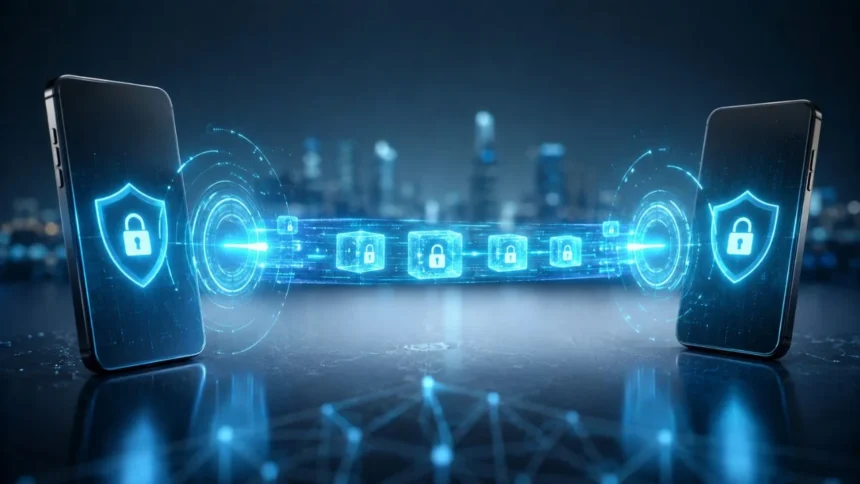
End-to-End Encrypted Meaning: A Simple Guide
End-to-end encrypted means that information is converted into an unreadable form on the sender’s device and can be unlocked only on the intended recipient’s device. While the information travels across the internet, servers and network providers carry the encrypted data without needing to read its original contents. This protection is commonly used for private messages, calls, photographs, videos, documents, passwords, and stored files. It is often shortened to end-to-end encryption or E2EE.
Imagine placing a message inside a locked box that only the recipient can open. Delivery workers can see the box, move it between locations, and confirm that it reached its destination, but they do not have the key needed to read what is inside. End-to-end encryption creates a similar type of protection digitally. The important difference is that complex mathematical keys replace the physical lock and key.
End-to-end encryption provides stronger privacy than ordinary encryption in transit because the service provider should not hold the keys needed to decrypt the protected content. This means a messaging company can deliver a private conversation without storing a readable copy on its servers. However, the protection applies primarily to the encrypted content rather than everything connected with the communication. Details such as account information, timing, device data, or recipients may still be processed.
Understanding the meaning of end-to-end encrypted helps people make better decisions about messaging apps, backups, business communications, and cloud storage. The term sounds technical, but its main purpose is simple: keeping readable information limited to the people or devices at the ends of a communication. This guide explains how E2EE works, what it protects, what it cannot prevent, and how to use encrypted services safely.
What Does End-to-End Encrypted Mean?
When a conversation is end-to-end encrypted, a readable message exists on the sender’s device before it is protected. The application then uses cryptographic keys to transform that message into ciphertext, which looks like meaningless digital information. The ciphertext travels through servers and internet connections until it reaches the recipient. The recipient’s device uses the correct key to turn it back into readable text.
The “ends” in end-to-end encryption are the devices or authorized accounts participating in the communication. One end may be your smartphone, while the other could be a friend’s smartphone, tablet, or properly linked computer. Encryption begins before the information leaves the sending endpoint and remains active until it reaches an authorized receiving endpoint. Intermediary systems should not receive the decryption key.
This design is different from a service that encrypts information only while it moves between your device and the company’s server. In that arrangement, the company may decrypt the information on its system and encrypt it again before sending it onward. The data is protected from ordinary interception during transmission, but the provider may still be technically capable of accessing the contents. End-to-end encryption removes that central access under its intended design.
The phrase does not mean that the entire application, device, account, or communication process is automatically private. An encrypted service may still collect account details, delivery information, contacts, usage records, and other metadata. Someone with access to an unlocked phone may also read messages after they have been decrypted. E2EE protects content during transmission and storage only where the service specifically supports it.
How End-to-End Encryption Works
End-to-end encryption relies on cryptographic algorithms and encryption keys. An encryption key is a long digital value used to transform readable information into protected ciphertext or return that ciphertext to its readable form. Secure systems generate keys through mathematical processes that make them extremely difficult to guess. Users normally do not need to see or manually manage these keys during everyday messaging.
When you send an encrypted message, the application prepares the information on your device and protects it before uploading it to the service. The company’s server receives the encrypted version and routes it toward the intended recipient. Because the server does not possess the correct private key, it cannot simply open the message and read its contents. The recipient’s authorized device completes the decryption process.
Modern encrypted messaging systems may create new keys frequently rather than using one permanent key for every conversation. Regular key changes can limit how much information would be exposed if one key were somehow compromised. Some systems also provide forward secrecy, which helps protect previous messages when a current key is stolen. These features operate in the background without requiring users to understand the underlying mathematics.
The process happens quickly enough that an encrypted conversation feels similar to an ordinary chat. Users type a message, tap send, and see it arrive on another device within seconds. The encryption and decryption steps are completed automatically by the application. This allows strong message security to become part of normal communication instead of a complicated process reserved only for cybersecurity experts.
A Simple Example of End-to-End Encryption
Suppose Sarah sends Ali a private message using an end-to-end encrypted messaging app. Sarah’s phone changes the readable sentence into encrypted data before it leaves the device. That protected data passes through Sarah’s internet provider, the messaging company’s servers, and Ali’s internet connection. None of those intermediaries should have the key required to turn it back into readable content.
When the protected message reaches Ali’s authorized phone, his device uses the appropriate cryptographic key to decrypt it. Ali then sees the original sentence inside the messaging application. The process is automatic, so neither Sarah nor Ali needs to enter a special encryption code for every message. To them, the conversation works like an ordinary chat despite the security operations happening underneath.
Someone monitoring the network might see that data is moving between devices and servers. However, the intercepted content should appear as unreadable ciphertext rather than Sarah’s original words. The observer may still learn some surrounding information, such as when the connection occurred or how much data was transferred. This surrounding data is one reason encryption should not be confused with complete anonymity.
If someone steals Ali’s unlocked phone, the situation changes because the message has already reached an authorized endpoint. The thief may be able to open the app and read the decrypted conversation directly. End-to-end encryption cannot protect a message from someone who controls the device displaying it. Strong screen locks, software updates, remote-wipe features, and account security remain essential.
End-to-End Encryption vs Encryption in Transit
Encryption in transit protects information while it moves between a device and a server. Websites commonly use Transport Layer Security to secure data sent between a browser and a website. This protection helps stop someone on the same network from casually reading login details, payment information, or page activity. The padlock icon in a browser usually indicates a protected connection rather than end-to-end encryption.
With transport encryption, the service receiving the data may still be able to decrypt and process it. For example, an ordinary email provider may protect a message while it travels to its servers but store or scan the readable content afterward. The connection is secure against interception, yet the provider remains one of the trusted points. This is sometimes described as client-to-server encryption.
End-to-end encryption limits trust more narrowly because the intended participants hold the keys needed to access the protected content. The server routes or stores ciphertext but should not receive a readable copy. This design reduces the possible impact of a server breach because stolen encrypted content remains difficult to use without the keys. It also limits the provider’s ability to recover or inspect protected information.
Both forms of encryption are valuable, but they solve different problems. Transport encryption protects the path between a user and a service, while E2EE protects content throughout its journey between authorized endpoints. A service may use both protections at the same time. Users should look beyond general claims such as “secure” or “encrypted” and check whether the feature is specifically described as end-to-end encrypted.
End-to-End Encryption vs Encryption at Rest
Encryption at rest protects information while it is stored on a device, hard drive, database, or cloud server. If someone steals an encrypted laptop or accesses a protected storage system, the stored files may remain unreadable without the correct key. Full-disk encryption is a familiar example because it protects data saved on a computer or smartphone. Many cloud providers also encrypt stored customer information.
The main question is who controls the encryption keys. A cloud service may encrypt files at rest while keeping the keys in its own systems. This arrangement protects data from certain types of theft, but the provider may still be able to decrypt it for account recovery, service operation, or legal compliance. The phrase “encrypted at rest” therefore does not automatically mean “end-to-end encrypted.”
End-to-end encrypted storage keeps the decryption keys with the user’s trusted devices or account-controlled recovery method. The cloud provider can store and synchronize the encrypted files without holding an ordinary way to read them. This offers stronger protection against server breaches and unauthorized internal access. It can also make account recovery more difficult when the user loses all trusted devices and recovery information.
A secure service may combine encryption in transit, encryption at rest, and end-to-end encryption. Each layer addresses a different risk within the data journey. The exact protection can also vary between features in the same application. Messages may be end-to-end encrypted, for example, while profile information, cloud backups, public posts, or business records use a different security model.
What Information Does End-to-End Encryption Protect?
End-to-end encryption can protect the contents of private text messages from interception while they travel between authorized devices. The service provider may handle delivery without receiving a readable version of the conversation. This is particularly valuable when people discuss personal, financial, professional, medical, or family matters. A server breach should not automatically expose the protected message history in readable form.
The same technology can protect voice calls and video calls when the application applies E2EE to those features. Audio and video are encrypted before transmission and decrypted on the participating devices. Network operators may detect that a call is occurring, but they should not be able to listen to the protected conversation. Call quality and connection management may still require the service to process technical information.
Photos, videos, voice notes, documents, stickers, and other attachments can also receive end-to-end encryption. The application encrypts each file before it is uploaded and sends the necessary key information securely to the intended recipient. The provider may temporarily store the encrypted attachment for delivery without being able to display its original contents. Protection depends on the specific application and feature being used.
Some cloud storage, password managers, note-taking tools, and backup services also offer end-to-end encrypted data. In these cases, files are encrypted on an authorized device before being stored remotely. Only trusted devices or users with the correct recovery information can unlock them. Users should confirm which categories are covered because a provider may protect certain files with E2EE while handling other account data differently.
What End-to-End Encryption Does Not Protect
End-to-end encryption does not prevent the person receiving a message from copying, forwarding, photographing, or sharing it. Once content appears on an authorized screen, the recipient can usually preserve it in another form. Disappearing-message settings may reduce how long information remains visible, but they cannot guarantee that no copy exists. Senders must still consider whether they trust the people receiving sensitive information.
E2EE cannot secure a phone or computer that has been infected with spyware or other malicious software. Malware operating at an endpoint may capture text before encryption or read it after decryption. It may also record the screen, monitor keyboard input, activate the microphone, or steal stored files. Keeping devices updated and installing software only from trusted sources remains essential.
The technology does not automatically hide metadata. A provider may know when an account was created, when a connection occurred, which device was used, or where an approximate connection originated. Depending on the service design, it may also process information about participants, group membership, delivery status, or interaction frequency. Some privacy-focused platforms attempt to minimize metadata, but E2EE alone does not guarantee this.
End-to-end encryption also does not identify whether the person at the other end is trustworthy. A scammer can use an encrypted messaging service just as an ordinary user can. Encryption keeps the conversation private from intermediaries, but it does not make the claims within that conversation truthful. Users should remain cautious about payment requests, investment offers, verification codes, suspicious links, and urgent demands.
Can Messaging Companies Read End-to-End Encrypted Messages?
Under a properly implemented end-to-end encrypted design, the messaging provider does not hold the keys needed to read protected message content. Its servers can receive, store temporarily, and deliver encrypted information without seeing the original text. This is one of the defining differences between E2EE and ordinary server-controlled encryption. The provider should see ciphertext rather than the readable conversation.
However, not every feature inside an encrypted application necessarily receives the same protection. Public posts, channels, business tools, cloud backups, artificial intelligence features, or reported messages may follow different rules. A user may deliberately send information to a service-operated feature, making that content available for processing. Privacy should therefore be evaluated feature by feature rather than only by the application’s overall reputation.
When a user reports abuse, the app may allow selected messages or surrounding information to be submitted for review. This does not necessarily mean the provider was reading the entire encrypted conversation beforehand. Instead, the reporting user’s device may send a copy of the chosen content. Users should review the reporting process and privacy explanation for the particular service they use.
A company may also collect information that is not part of the encrypted message itself. Account numbers, profile details, device information, delivery records, and service interactions may remain available. This is why “the provider cannot read your messages” is not the same as “the provider collects no information about you.” Both statements describe different parts of digital privacy.
What Is Metadata in Encrypted Communication?
Metadata is information about a communication rather than the readable contents of the communication itself. It can include the time a message was sent, the devices involved, the size of an attachment, delivery status, and technical connection details. An envelope provides a useful comparison: the letter is the content, while the addresses and postal markings are metadata. Delivery often requires some surrounding information.
Metadata can reveal meaningful patterns even when the conversation remains unreadable. Frequent communication between two accounts may suggest a relationship, while regular activity at particular times may reveal routines. Location-related connection information can provide additional context. A single record may appear harmless, but many records combined over time can create a detailed behavioral picture.
Different encrypted services collect and retain different amounts of metadata. Some platforms design their systems to know as little as possible about contacts, groups, senders, and communication history. Others retain more operational data for security, spam prevention, analytics, synchronization, advertising, or legal obligations. Users should read the privacy policy instead of assuming that all E2EE apps handle metadata identically.
Reducing metadata exposure can involve choosing privacy-focused services, limiting unnecessary profile information, disabling contact uploads, and reviewing linked devices. A virtual private network may hide an internet address from some network observers, but it does not make an account anonymous to the messaging service. Privacy depends on the combined design of encryption, account systems, metadata handling, device security, and user behavior.
Are WhatsApp, Signal, and Google Messages End-to-End Encrypted?
Signal applies end-to-end encryption to its private messages and calls by default. Users do not need to activate a special private mode before starting an eligible conversation. Signal also emphasizes reducing the amount of user information retained by its service. Device security and recipient behavior can still affect privacy after protected content reaches an authorized endpoint.
WhatsApp states that personal messages and calls are end-to-end encrypted. The app also offers an optional form of end-to-end encrypted cloud backup, which requires separate backup protection and recovery information. Users should distinguish between live conversations, backups, business interactions, channels, and other features. Each feature may have its own privacy and data-processing conditions.
Google Messages provides end-to-end encryption for eligible conversations when participants use supported Google Messages RCS chats. Ordinary SMS and MMS messages do not receive the same E2EE protection. A lock indicator can help users determine whether encryption is active for a particular conversation. Changes in messaging service, connectivity, device, or chat eligibility may affect how a message is delivered.
Other applications may offer E2EE for selected chats, calls, files, or storage categories rather than enabling it everywhere. Some services require users to start a secret conversation or activate an additional setting. Others encrypt only one-to-one chats and not all group features. Check the conversation information, security indicators, official documentation, and backup settings before sending sensitive material.
Are SMS and Ordinary Text Messages End-to-End Encrypted?
Traditional SMS messages are not normally end-to-end encrypted. Mobile networks route and process them using systems created before modern private messaging applications became common. Network providers may need access to technical information and message handling systems to complete delivery. Someone should not treat an ordinary SMS conversation as having the same privacy protections as an E2EE chat.
MMS messages, which can carry pictures and other media, also lack modern end-to-end encryption under their traditional design. They may be protected during certain parts of transmission, but the sender and recipient do not exclusively control the decryption keys. This makes SMS and MMS unsuitable for highly sensitive information. Verification codes should also be kept private even when received through ordinary text messaging.
RCS adds richer features such as typing indicators, read receipts, improved media, and internet-based delivery. However, encryption depends on the applications, participants, networks, and implementation involved. A conversation labeled as RCS should not automatically be assumed to have E2EE in every cross-platform situation. Users should look for a clear lock symbol or an explicit security notice inside the conversation.
When encrypted delivery becomes unavailable, some applications may offer to send a message as SMS instead. This fallback can improve reliability but reduce privacy. Read the warning before accepting the change, particularly when sending confidential information. Waiting for the encrypted service to reconnect may be safer than allowing a sensitive message to travel through an unencrypted fallback method.
Why Encrypted Backups Matter
A messaging app can protect live conversations with E2EE while saving backups under a different security system. If the cloud provider holds the backup decryption key, the stored message history may be accessible even though the original transmission was protected. Attackers often target backups because they can contain years of conversations, photographs, documents, and contact information. Users should examine backup protection separately.
An end-to-end encrypted backup is protected before it is uploaded to cloud storage. The provider storing the backup should not hold the ordinary key needed to read its contents. Restoring the information requires an authorized device, password, encryption key, or another approved recovery method. This creates stronger privacy but places more responsibility on the account owner.
Losing the recovery password or encryption key may make an E2EE backup permanently inaccessible. The provider cannot simply reset access when it never possessed the decryption key. Users should store recovery information in a reputable password manager or another secure location. Keeping the only copy on the device being backed up creates an avoidable risk.
Review whether backup encryption is enabled automatically or must be turned on manually. Check which content is included, where it is stored, and whether linked accounts have strong authentication. Delete old unprotected backups when appropriate after confirming that a secure replacement exists. A private conversation is only as secure as every readable copy created throughout its life cycle.
How Security Codes Verify an Encrypted Conversation
Some encrypted messaging apps provide a security number, QR code, fingerprint, or verification code for each conversation. This code represents cryptographic information connected with the participants’ devices or identity keys. Comparing codes helps confirm that the conversation is secured directly between the intended endpoints. It provides additional protection against someone secretly inserting another system into the connection.
Users can compare the code in person, scan a QR code from the other person’s device, or verify the number through another trusted communication method. The codes should match when both people are viewing the correct conversation and devices. This process is particularly valuable for journalists, business leaders, activists, security professionals, and anyone discussing highly sensitive information.
A security code may change when someone installs the application again, replaces a phone, resets an account, or adds a new device. A change is not automatic proof of an attack because ordinary device updates can cause it. However, users handling confidential information should verify the new code before continuing. Unexpected changes deserve more attention when combined with suspicious account behavior.
Verification confirms the cryptographic connection, but it does not guarantee that the other person’s device is free from malware. It also cannot prevent the recipient from sharing the conversation. The feature answers a narrower question: whether the encryption keys match the intended endpoints. Device security, personal trust, and safe communication practices remain separate responsibilities.
Can End-to-End Encryption Be Hacked?
Strong modern encryption is designed to make direct decryption without the correct key extremely difficult. Attackers therefore often avoid trying to break the cryptographic algorithm itself. Instead, they target easier weaknesses such as stolen phones, weak screen locks, malicious software, account recovery systems, cloud backups, and human mistakes. The security of E2EE depends on the complete environment surrounding it.
A phishing attack may trick someone into revealing an account code or linking an unauthorized device. Once the attacker becomes an accepted endpoint, the app may deliver readable messages to that device. The encryption has not necessarily been mathematically broken; the attacker has abused account access. Users should reject unexpected pairing requests and review linked devices regularly.
Software vulnerabilities can also weaken an encrypted application or operating system. A flaw may allow attackers to access stored messages, activate device features, or bypass normal security controls. Installing updates promptly reduces exposure because updates often contain important security fixes. Unsupported phones and outdated applications create unnecessary risk even when the messaging protocol itself remains strong.
Physical access remains another serious threat. A weak PIN, unattended unlocked phone, visible notifications, or unprotected computer can expose private conversations directly. Use a strong device passcode, biometric lock, automatic screen locking, and encrypted storage. Disable sensitive notification previews and enable remote location or deletion features when the device supports them.
How to Use End-to-End Encrypted Apps Safely
Begin by choosing a reputable service that clearly explains which features use end-to-end encryption. Confirm that encryption is active by checking the conversation details, lock symbol, or security information. Do not assume every chat is protected simply because the application supports E2EE somewhere. Group conversations, business messages, backups, and fallback delivery may follow different rules.
Protect the account with a strong, unique password or PIN and enable multifactor authentication where available. Never provide registration codes, backup keys, recovery passwords, or device-linking approvals to another person. Customer support representatives should not need your secret verification code. Unexpected requests for these details are common signs of account takeover attempts.
Review linked computers, tablets, browsers, and companion devices regularly. Remove any session you do not recognize or no longer use. A forgotten linked device may continue displaying messages even after your primary phone is secure. Log out before selling, repairing, lending, or disposing of a device that has access to private conversations.
Keep the operating system and messaging application updated, and download software only through trusted stores or official providers. Use a screen lock, hide sensitive notification previews, and avoid leaving devices unattended. Consider disappearing messages for conversations that do not need permanent storage. Remember that recipients can still save content before it disappears.
Benefits of End-to-End Encryption
The main benefit of E2EE is greater confidentiality for personal communication. Private conversations remain protected from ordinary network interception and should not be readable on the service provider’s servers. This helps people communicate about family matters, finances, health, employment, and personal concerns. Privacy becomes part of the service design rather than depending only on company promises.
End-to-end encryption can also reduce the damage caused by a cloud or server breach. Attackers who steal properly encrypted content still need the decryption keys held by authorized endpoints. Although account records and metadata may remain exposed, readable conversations can receive an important additional layer of protection. This makes centralized data stores less valuable as sources of message content.
Businesses can use encrypted communication to protect internal discussions, customer details, intellectual property, contracts, and operational information. E2EE does not replace access controls, employee training, record retention, or compliance requirements. However, it reduces unnecessary exposure while information moves between authorized participants. Organizations should choose approved tools rather than allowing sensitive work through personal applications without oversight.
Encryption also supports freedom of expression, journalism, legal confidentiality, and personal safety. People may need to communicate without exposing sensitive discussions to criminals, hostile networks, abusive individuals, or unauthorized insiders. The same protection benefits ordinary users completing everyday tasks. Digital privacy is not limited to people who believe they have something unusual to hide.
Limitations and Trade-Offs of End-to-End Encryption
Strong privacy can make account recovery more challenging. When a provider does not hold the decryption keys, it may be unable to restore encrypted information after all trusted devices and recovery methods are lost. Users must protect recovery codes, backup passwords, and authorized devices carefully. Greater control over data brings greater responsibility for maintaining access.
E2EE can limit server-side features that depend on reading message contents. A service may find it more difficult to provide cloud search, automatic organization, content analysis, moderation, or account restoration without changing its privacy design. Some platforms perform selected processing on the user’s device instead. Users should understand when optional intelligent features send information outside an encrypted conversation.
Encryption cannot stop harmful people from communicating privately or sending scams, harassment, and illegal material. Service providers may use reports, account behavior, public information, rate limits, and other signals to respond to abuse. The challenge is addressing harmful conduct without creating general access to every private conversation. This remains an important technical and policy debate.
Compatibility can create another limitation. Encryption may work only when every participant uses supported software, activates the correct feature, or remains connected through an eligible service. A message may lose protection when it falls back to SMS or enters an external business system. Users should verify the actual delivery method rather than relying only on the name of the application.
Final Thoughts on End-to-End Encrypted Meaning
End-to-end encrypted means that readable information is protected on the sender’s device and can be decrypted only by an intended recipient or authorized device. Servers and network providers help deliver the data without receiving the ordinary keys needed to read its contents. This creates stronger privacy than encryption that ends at the service provider’s server. It is especially useful for private messages, calls, files, and backups.
The protection is powerful but limited to the information and features covered by the encrypted system. Metadata, profile details, public content, reported messages, and some backups may follow different rules. The recipient can also copy or share anything visible on their device. Users should never interpret an E2EE label as a promise of complete anonymity or protection from every digital threat.
Device security remains just as important as message encryption. Malware, stolen phones, weak passcodes, unauthorized linked devices, and phishing attacks can expose content at an endpoint. Keep software updated, use strong account protection, and review connected devices regularly. Encryption works best when the devices holding the keys are also properly secured.
Before sending sensitive information, confirm that the particular conversation and backup method are end-to-end encrypted. Look for a security indicator, review the app’s official explanation, and verify security codes when the situation requires stronger assurance. E2EE is not a magical privacy shield, but it is one of the most valuable technologies available for protecting modern digital communication.
Frequently Asked Questions
What does end-to-end encrypted mean on WhatsApp?
It means personal messages and calls are protected between participating devices so WhatsApp should not be able to read or listen to their contents. Backups and other features should be checked separately.
Can anyone see an end-to-end encrypted message?
The intended participants can read it on their authorized devices. Someone controlling an unlocked device, receiving a forwarded copy, or viewing a screenshot may also see the content.
Can police read end-to-end encrypted messages?
The service provider may not have readable message content to provide under a properly implemented E2EE system. However, authorities may obtain metadata, device data, reported content, or messages directly from an accessible endpoint.
Are end-to-end encrypted messages completely safe?
They are strongly protected during transmission, but no system removes every risk. Malware, phishing, stolen devices, insecure backups, and untrustworthy recipients can still expose information.
Does end-to-end encryption hide my phone number?
Not necessarily. E2EE protects message content, but the app may still process your phone number, account details, device information, contacts, or other metadata.