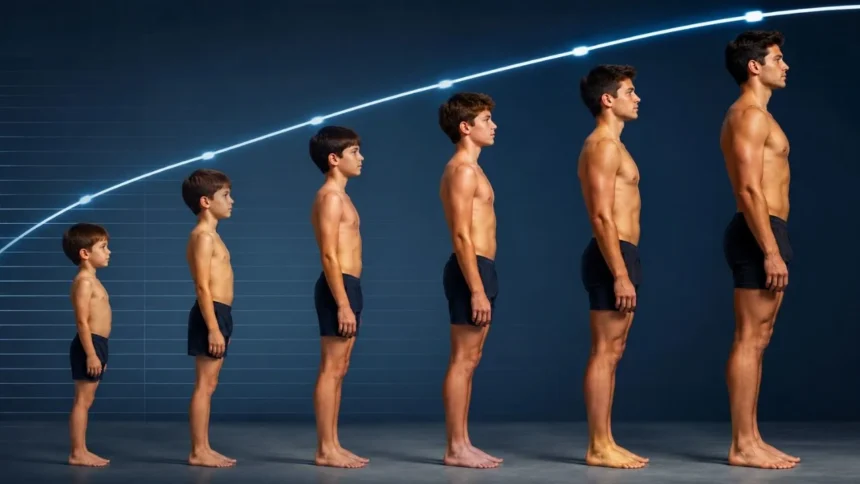
Penis growth usually stops near the end of puberty. For most people born with a penis, adult genital development is largely complete by around age 17 or 18. However, puberty follows an individual schedule, so some people finish earlier while later developers may notice small changes into their early 20s.
Most penis growth does not happen at one steady rate. It normally occurs in stages after the testicles begin to enlarge, with length often developing before width. Growth may speed up for a period, slow down and then continue as the rest of the body progresses through puberty.
Genetics, hormones and the timing of puberty have the greatest influence on final penis size. Exercise, masturbation, sexual activity and ordinary lifestyle choices do not determine how large it becomes. Advertised pills, creams and stretching programmes cannot restart natural puberty-related growth after development is complete.
It is also important to remember that penis size varies widely and does not determine masculinity, fertility or the ability to have a satisfying relationship. Concern is worth discussing with a healthcare professional when puberty has not started by the expected age, development suddenly stops or there are symptoms such as pain, swelling or a significant new change.
At What Age Does Penis Growth Usually Stop?
Most penis growth is completed by the end of puberty, commonly between ages 17 and 18. This is a general range rather than a strict deadline. Someone who begins puberty early may reach adult genital size sooner, while someone who starts later may continue developing for several additional years.
Puberty usually begins between ages 9 and 14 in people assigned male at birth. The complete process often lasts around three to five years. Penis growth generally begins after testicular enlargement and continues alongside changes in height, muscle mass, body hair and voice.
Some reliable health guidance notes that genital development may be complete as early as age 13 or as late as age 18. Other guidance acknowledges that the penis and testicles may continue changing until approximately age 21. These differences reflect normal variation rather than disagreement about one exact finishing age.
A birthday cannot confirm whether growth has ended. The more useful question is whether the full process of puberty appears complete. A healthcare professional can assess pubertal development when someone is unsure or concerned about the timing of physical changes.
How Does the Penis Grow During Puberty?
Puberty begins when the brain sends hormonal signals to the testicles. The testicles then produce more testosterone, which supports genital development, body-hair growth, voice changes, muscle development and the adolescent growth spurt. These changes happen gradually rather than overnight.
The first visible genital change is normally enlargement of the testicles and scrotum. Penis lengthening usually begins after that initial stage. Width or girth commonly develops later, although every person may notice the sequence and timing somewhat differently.
Growth may appear uneven during adolescence. A person may become taller before noticing much genital development, or genital changes may occur before the largest height increase. Comparing one feature with friends of the same age is therefore not a reliable way to judge whether puberty is normal.
By the later stages of puberty, the genitals have generally reached adult development. Facial hair may continue becoming thicker, and muscle distribution may keep changing afterwards. These later changes do not necessarily mean that substantial additional penis growth will occur.
What Are the Main Stages of Male Puberty?
Healthcare professionals often describe puberty using Tanner stages. Tanner stage one represents childhood development before visible puberty begins. Tanner stage two usually starts with enlargement of the testicles and changes in the skin of the scrotum.
During Tanner stage three, penis length begins increasing more noticeably. Pubic hair becomes darker and thicker, and the person may experience faster height growth. Voice changes, acne and stronger body odour may also become more noticeable during this period.
Tanner stage four includes further development in penis length and width. The scrotum and testicles continue maturing, while facial and body hair become more established. Growth in height may begin slowing after reaching its fastest point.
Tanner stage five represents adult physical maturity. The genitals have generally reached their adult size and shape, although minor natural changes can continue. A clinician uses the complete pattern of development rather than age alone when determining a person’s pubertal stage.
How Long Does Penis Growth Take?
The main period of penis growth usually lasts several years. It begins after the first signs of puberty and continues as the body moves through later developmental stages. The process is gradual and may not be noticeable from one month to the next.
Puberty commonly takes around three and a half to five years to complete. Someone who starts at age 10 may finish considerably earlier than someone who starts at age 14. Both timelines may fall within healthy development when the changes follow a normal sequence.
Growth is not necessarily continuous throughout that period. A person may notice a faster change over one year and little visible difference during the next. Hormones, genetic timing and the person’s overall stage of puberty influence the rate.
Measuring repeatedly over short periods is unlikely to provide useful information. Natural temperature changes and measurement differences can create the appearance of growth or shrinkage. Development is better assessed over time and in the context of all puberty changes.
How Can You Tell Whether Puberty Is Finished?
Puberty may be approaching completion when height growth has slowed significantly and the body has developed more adult proportions. The shoulders may be broader, the voice is usually permanently deeper and facial or body hair may be more established. Genital development is generally mature by this stage.
Another sign is that changes have become less noticeable over an extended period. Earlier puberty often brings rapid developments in height, genitals, hair and skin. Later stages tend to involve smaller adjustments rather than dramatic physical changes.
Finishing puberty does not mean that the body will never change again. Muscle mass, body composition, hair growth and sexual function can continue changing throughout adulthood. Weight, health, medications and ageing can also affect how the genital area looks.
The only reliable way to evaluate incomplete or delayed puberty is through a healthcare assessment. A doctor can review growth history, examine physical development and order hormone or other tests when necessary. Online comparisons cannot provide the same individual context.
What Determines Final Penis Size?
Genetics is one of the strongest influences on adult penis size. Genes affect overall physical development, including height, body proportions and how tissues respond to hormones. This is why normal penis size varies greatly between individuals.
Hormones are also essential during fetal development and puberty. Testosterone and related hormones support genital growth during adolescence. A medical condition that significantly reduces hormone production or response may affect development, although such conditions are not the explanation for ordinary size variation.
General nutrition and health support normal puberty. Severe malnutrition or a chronic untreated illness can interfere with growth and development. Eating additional protein, taking vitamins or following a special diet will not make the penis grow beyond its genetically determined size when nutrition is already adequate.
Ethnicity, height and foot size cannot accurately predict an individual’s penis size. Population averages do not determine what any one person will look like. Normal development includes many combinations of body height, genital size and other physical features.
Does Height Predict Penis Size?
Height does not reliably predict penis size. A tall person may have a smaller, average or larger penis, and the same range exists among shorter people. Both traits involve genetics, but they do not develop in a fixed proportion.
The adolescent height spurt and genital development may happen at different points in puberty. Someone may grow taller first and experience more genital development later. Another person may notice these changes in the opposite order.
Shoe size, hand size and facial features are also unreliable predictors. Popular claims about these body parts are usually based on stereotypes rather than a method that can accurately estimate one person’s anatomy.
Focusing heavily on comparisons can increase anxiety without providing useful health information. A clinician is interested in whether development is medically normal, not whether body parts match a particular ratio. Function, comfort and overall health matter more than matching an assumed proportion.
Does Body Weight Affect How Large the Penis Looks?
Body weight does not usually change the actual length of a fully developed penis. However, additional fat around the lower abdomen and pubic area can cover part of the shaft. This may make the visible portion appear shorter even when its underlying size has not changed.
Weight loss can reveal more of the existing shaft in some adults, but it does not create new penile tissue. The amount of visible change varies according to where a person stores body fat and their individual anatomy.
A buried or concealed penis is a medical condition in which the penis is partly hidden by surrounding tissue or skin. It can occur in children or adults and may sometimes cause hygiene, urination or comfort problems. It should be evaluated medically rather than treated through unverified enlargement methods.
Healthy weight management can support general cardiovascular and sexual health. It should not be pursued through extreme dieting solely to change genital appearance. Sustainable habits are safer and more beneficial than rapid weight-loss promises.
Do Flaccid and Erect Size Change Differently?
The flaccid penis naturally changes size throughout the day. Cold temperature, stress, physical activity and nervous-system responses can make it temporarily retract. Warmth and relaxation may make it hang lower or appear fuller.
Flaccid appearance does not reliably predict erect size. Some penises increase considerably during erection, while others show a smaller proportional change. Both patterns are normal and are sometimes informally described as “growers” and “showers.”
During puberty, both flaccid and erect dimensions can develop as genital tissues mature. The person may not notice the changes equally because the resting size varies so much with temperature and other temporary conditions.
Comparisons based on changing-room appearance or non-standard photographs are particularly misleading. A single flaccid observation provides little information about adult development, erectile function or sexual health.
Does Masturbation Affect Penis Growth?
Masturbation does not stop penis growth, reduce final size or interfere with puberty. It also does not cause the penis to grow larger. Genital development is controlled mainly by genetics, hormones and normal physical maturation.
Masturbation is a common behaviour during adolescence and adulthood. It may temporarily change blood flow and create an erection, but this is not permanent tissue growth. The penis returns to its usual resting state afterwards.
Frequent masturbation does not use up testosterone or prevent the body from developing normally. Claims that avoiding ejaculation produces greater genital growth are not supported by medical evidence.
The behaviour becomes a concern only when it causes injury, interferes with responsibilities or feels difficult to control. Pain, bleeding, persistent swelling or damaged skin should be allowed to heal and may require medical attention.
Does Sexual Activity Affect Penis Growth?
Having sex does not make the penis larger, and not having sex does not stop development. Natural penis growth follows puberty whether or not a person is sexually active. Sexual experience and physical size are separate issues.
Erections increase blood flow temporarily but do not extend the pubertal growth period. Repeated sexual activity cannot train the penis to remain permanently longer or thicker after the erection ends.
Sexual activity also does not prove that puberty is complete. A person may be capable of erections and ejaculation before all physical development has finished. Reproductive changes and body growth occur across several stages.
Any sexual activity should involve legal age requirements, mutual consent, respect and appropriate protection from pregnancy and sexually transmitted infections. Questions about sexual health are best discussed with a qualified healthcare professional or trusted health service.
Can Exercise Make the Penis Grow?
General exercise can support cardiovascular health, body confidence and erectile function, but it does not permanently increase penis size. Stronger blood flow may improve erection quality in someone with a health-related problem, which can make erections appear fuller without changing anatomy.
No gym exercise targets the penis in the same way that resistance training builds skeletal muscle. The penis contains specialised erectile tissue rather than the type of muscle that grows through weightlifting.
Pelvic-floor exercises may help some adults improve urinary control or erectile function. They are used for function, not natural enlargement. Performing them excessively or incorrectly can also create pelvic tension.
“Jelqing” and other aggressive manual exercises are not proven ways to create safe permanent growth. Pulling, squeezing or bending the penis can cause bruising, pain, scarring or damage to blood vessels and erectile tissue.
Can Food or Supplements Increase Penis Growth?
No particular food can increase penis size beyond normal development. A balanced diet supports overall puberty by providing energy, protein, vitamins and minerals. Once nutritional needs are met, eating more of one food will not create additional genital growth.
Products advertised as male-enhancement pills often contain herbs, stimulants or undeclared ingredients. They have not been shown to restart natural penis growth after puberty. Some may interact with medicines or create cardiovascular and other health risks.
Protein powder, zinc, vitamin D and other supplements do not enlarge a normally developing penis. A diagnosed nutritional deficiency should be treated appropriately, but taking excessive nutrients does not push growth beyond the body’s genetic plan.
Teenagers should never take testosterone boosters, bodybuilding hormones or online sexual-enhancement products. These substances can disrupt natural hormone production and may affect the liver, heart, fertility, mood and testicles.
Can Testosterone Make the Penis Grow?
Testosterone supports penis growth during normal puberty. If a child or adolescent has a medically diagnosed hormone deficiency, treatment from a specialist may help the body progress through puberty. The timing and dosage require careful medical supervision.
Taking testosterone when hormone levels are already normal will not reliably increase adult penis size. After genital development is complete, additional testosterone does not restart the normal growth process.
Unsupervised testosterone can reduce the body’s own hormone production. It may shrink the testicles, lower sperm production, cause acne, alter mood and create other serious side effects. Products obtained without medical monitoring can also be contaminated or incorrectly dosed.
Anyone concerned about delayed puberty should see a GP, paediatrician or endocrinologist rather than using hormone products independently. Blood tests and a physical assessment can determine whether hormone treatment is actually needed.
Do Penis Enlargement Pills or Creams Work?
Pills, creams, oils and patches sold for permanent enlargement have not been proven to increase penis size. Many advertisements rely on testimonials, manipulated images or temporary erection effects rather than reliable clinical evidence.
A cream may make the skin feel warm or increase temporary blood flow, but this does not create permanent tissue growth. Some products can cause irritation, burns or allergic reactions on sensitive genital skin.
Supplements may contain ingredients that affect blood pressure, heart rate or erections. An erection that appears firmer is not evidence of permanent enlargement. Undeclared prescription-drug ingredients can create additional risks.
Do not use a product simply because it is described as natural. Natural substances can still cause side effects and medicine interactions. A healthcare professional can address concerns about size or erectile function without relying on unregulated promises.
Do Penis Pumps Increase Size Permanently?
A vacuum pump draws blood into the penis and can create a temporary erection. Medical vacuum devices may be prescribed for erectile dysfunction. Their purpose is to support an erection, not to permanently enlarge a normally functioning penis.
The penis may look temporarily fuller after using a pump because of increased blood and mild swelling. This effect fades. Excessive pressure or prolonged use can cause bruising, pain, numbness and broken blood vessels.
Pumps advertised for permanent enlargement should be approached cautiously. Using a medically designed device according to professional instructions is different from using an unregulated high-pressure product purchased online.
Anyone considering a pump for erectile difficulties should speak with a clinician, particularly when taking blood-thinning medicines or living with a bleeding disorder. The underlying cause of erection changes may also need treatment.
Can Stretching Devices Make the Penis Longer?
Penile traction devices apply gentle tension for extended periods. Some medical evidence suggests that carefully supervised traction may produce modest changes in selected adults, particularly for certain conditions such as penile curvature. Results require consistent long-term use and are not guaranteed.
This is different from natural puberty-related growth. A traction device does not reopen puberty or change genetics. Products vary in design, safety and the evidence supporting them.
Improper use can cause pain, numbness, skin injury or circulation problems. Teenagers should not use traction devices to influence normal development. Puberty should be allowed to progress without unapproved mechanical intervention.
An adult considering traction should first consult a urologist. A specialist can determine whether the concern is based on a medical condition, distorted body perception or a realistic treatment goal.
Is Penis Enlargement Surgery Safe?
Cosmetic penis-enlargement surgery is not a routine solution for ordinary size concerns. Procedures may attempt to change visible flaccid length or girth, but results and patient satisfaction vary. Surgery does not always improve functional erect length.
Possible complications include infection, scarring, pain, changes in shape, reduced sensation and erectile dysfunction. A person may require additional surgery to correct a poor result, and the final appearance may not match expectations.
Reconstructive surgery can be medically appropriate for congenital conditions, major injury or other recognised health needs. That is different from elective enlargement in someone with normal anatomy.
Anyone considering a procedure should consult a qualified urologist rather than a commercial clinic making guaranteed promises. Psychological support may also be useful when body-image distress continues despite reassurance about normal anatomy.
Does Penis Size Affect Fertility?
Penis size does not usually determine fertility. Fertility depends more heavily on sperm production, sperm quality, hormone function and whether sperm can reach the reproductive tract.
A normally functioning penis of almost any common size can allow ejaculation and sexual activity. Testicular health is more directly connected with sperm production than penile length or width.
Certain rare developmental or hormonal conditions can affect both genital development and fertility. In those cases, the underlying condition matters rather than size alone. A medical evaluation can identify whether broader reproductive development is involved.
Adults who have been trying to achieve pregnancy without success should seek fertility guidance based on the recommended timeframe for their situation. A semen analysis and medical history provide more useful information than measuring penis size.
What Is Considered Normal Development?
Normal development covers a broad range of sizes, shapes and timelines. One testicle may hang lower, the penis may lean slightly and skin colour can differ from the surrounding body. These differences are often ordinary anatomical variation.
Penis size during the middle of puberty cannot reliably predict final adult size. A person developing later than friends may continue changing after others appear physically mature. Early development also does not guarantee a larger final size.
Images online can create unrealistic expectations. Pornography may feature people selected for unusual physical characteristics, while camera angles, editing and temporary erection-enhancing methods can distort appearance.
A medical definition of abnormality is based on standard clinical measurement and overall development, not personal comparison. A clinician can assess genuine concerns privately and respectfully.
When Should Delayed Puberty Be Checked?
A boy or person assigned male at birth should be assessed when the testicles have not started enlarging by about age 14. Testicular development is normally the earliest clear sign of puberty, so clinicians use it rather than penis size alone.
Evaluation may also be helpful when puberty begins but makes little progress over several years. Slow height growth, lack of genital development or an absence of other expected changes may require investigation.
Delayed puberty is often caused by a harmless family pattern known as constitutional delay. A parent or close relative may also have matured later. Other possible causes include chronic illness, undernutrition or problems involving the testicles, pituitary gland or hypothalamus.
A healthcare professional may review growth charts, family history and physical development. Blood tests, bone-age imaging or specialist referral may be recommended when the cause is uncertain.
When Is Puberty Considered Too Early?
Puberty signs before age nine in a boy or person assigned male at birth are generally considered unusually early. These signs may include enlargement of the testicles and penis, rapid height growth, pubic hair, facial hair or a deepening voice.
Early development does not always indicate a serious problem, but it should be medically assessed. Hormonal conditions can cause the body to begin puberty before the expected age.
Untreated early puberty may initially make a child taller than peers but can cause the growth plates to mature too quickly. This may reduce final adult height in some cases.
Parents or caregivers should seek paediatric advice rather than waiting to see whether the changes stop. Timely evaluation can identify whether monitoring or treatment is appropriate.
When Should You See a Doctor About the Penis?
Arrange a non-urgent medical appointment when genital growth seems absent during puberty, the development pattern appears delayed or worry about size is causing ongoing distress. A doctor can assess the complete puberty pattern rather than relying on one measurement.
Seek medical advice for a new hard lump, persistent swelling, discharge, sores, difficulty urinating or pain that does not improve. A significant new curve that causes painful erections or functional problems should also be examined.
Sudden severe testicular pain is an emergency because it may be caused by testicular torsion. Prompt treatment is needed to protect the affected testicle. Do not wait for the pain to pass or rely on online advice.
A healthcare professional has heard questions about genital development many times. The conversation is private and medical rather than judgmental. Seeking reassurance from a qualified person is safer than using unverified enlargement products.
How to Manage Anxiety About Penis Size
Concern about penis size is common, particularly during adolescence when bodies develop at different rates. Anxiety often comes from comparison rather than a medical problem. Friends, pornography and social media do not provide a representative view of normal anatomy.
Try to focus on what the body can do rather than matching one physical ideal. Healthy relationships depend on communication, respect, trust and mutual comfort. Penis size is not a measure of personal worth or maturity.
Repeated measuring, checking and comparing can make anxiety stronger. It may provide brief reassurance but encourage the mind to return to the same concern. Reducing checking and avoiding misleading enlargement content can be helpful.
Speak with a doctor or mental health professional when the concern consumes significant time, affects relationships or leads to risky treatments. Body-image distress is real and deserves support even when the body is medically normal.
Final Verdict
The penis usually stops growing near the end of puberty. Most people reach adult genital development by around 17 or 18, although some finish earlier and later developers may continue changing into their early 20s.
Growth begins after the testicles start enlarging and normally occurs over several years. Length often increases before width, and development may happen in uneven stages rather than at a constant rate.
Genetics, hormones and puberty timing determine final size. Masturbation, sexual activity, exercise and ordinary foods do not make the penis permanently larger or smaller. Pills, creams and aggressive enlargement methods may be ineffective or harmful.
Medical advice is recommended when puberty has not begun by around age 14, starts before age nine or is accompanied by pain, swelling or another concerning symptom. For most people, differences in size and development timing are normal parts of human variation.
Frequently Asked Questions
Does the penis stop growing at 16?
It may still be developing at 16 because many people have not completed puberty at that age. Adult size is commonly reached around 17 or 18, but timing varies.
Can the penis grow after age 18?
Small changes may continue after 18 in someone who started or completed puberty later. Significant natural growth is unlikely once puberty is fully complete.
Does masturbation stop penis growth?
No. Masturbation does not stop puberty, reduce testosterone or affect final penis size. Growth is mainly controlled by genetics and hormones.
Can testosterone increase penis size after puberty?
Testosterone treatment may support development when a young person has a diagnosed hormone deficiency. It does not reliably enlarge a normally developed adult penis.
When should delayed penis growth be checked?
See a healthcare professional when the testicles have not begun enlarging by around age 14 or puberty starts but does not progress. Testicular development is the main early sign doctors assess.