What Are the Trapezius Muscles?
The trapezius, commonly called the traps, is a large muscle covering much of the upper back, neck, and shoulders. It extends from the base of the skull down toward the middle of the spine and outward toward the shoulder blades. Because of its size and location, the trapezius contributes to many upper-body movements and postural positions.
The muscle is generally divided into upper, middle, and lower sections. The upper traps help elevate and rotate the shoulder blades, while the middle fibers assist with pulling them toward the spine. The lower fibers help control downward movement and rotation, making balanced trap exercises important for overall shoulder function.
Training the traps is not only about developing larger shoulders. Strong trapezius muscles can support upper-back stability, shoulder blade control, lifting movements, and everyday tasks such as carrying objects. A balanced program should therefore work different parts of the trapezius instead of relying only on heavy shrugs.
Benefits of Trap Exercises
Trap exercises can help strengthen the muscles responsible for controlling the shoulder blades and supporting the upper back. This strength is useful during pulling, carrying, overhead movements, and many daily activities. Well-conditioned traps may also help you maintain better control when handling loads instead of allowing the shoulders to move unpredictably.
Training the middle and lower traps can improve scapular control during rows, presses, and other upper-body exercises. These muscles help position the shoulder blades as the arms move. Better control may make exercises feel smoother and allow surrounding muscles to work more effectively without depending excessively on one area.
Trap training can also contribute to a stronger-looking upper back and shoulders. For people training for muscle growth, developing all regions of the trapezius creates more balanced upper-body proportions. However, appearance should not come at the expense of technique, because using excessive weight often shifts attention away from controlled muscular work.
How to Perform Dumbbell Shrugs Correctly
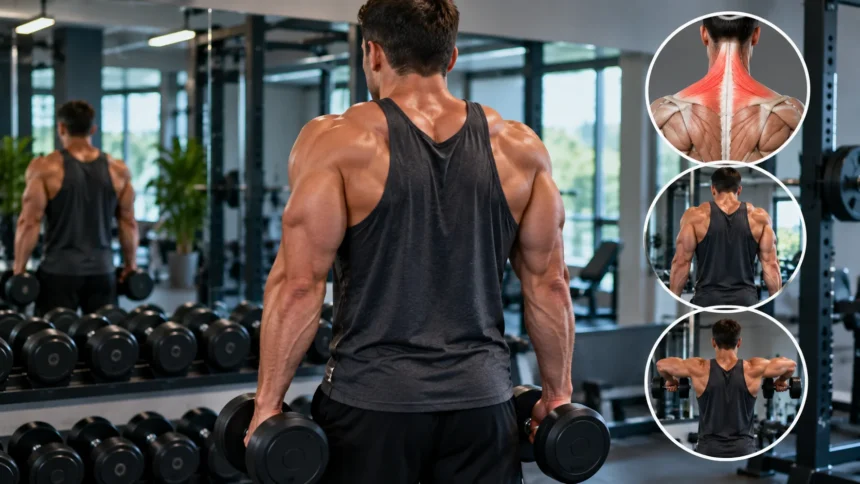
Dumbbell shrugs are one of the simplest exercises for targeting the upper traps. Stand tall with a dumbbell in each hand and allow your arms to hang naturally at your sides. Keep your head neutral, tighten your midsection gently, and raise your shoulders upward toward your ears without bending your elbows significantly.
Pause briefly at the top and focus on contracting your upper traps rather than rotating your shoulders. Lower the dumbbells slowly until your shoulders return to their natural position. Avoid dropping the weights quickly, because the lowering phase provides useful muscular tension and helps you maintain control throughout each repetition.
Choose a weight that allows approximately eight to 15 controlled repetitions without changing your posture. If you have to bounce, lean backward, or use your legs to move the dumbbells, the load is probably too heavy. Progress gradually by adding repetitions or small amounts of resistance while maintaining the same movement quality.
Barbell Shrugs for Building Upper Trap Strength
Barbell shrugs allow you to train the upper traps with relatively heavy resistance while keeping the movement straightforward. Hold a barbell in front of your thighs with your hands slightly wider than shoulder width. Stand tall and lift your shoulders upward while keeping your elbows straight and your torso stable.
Avoid rolling your shoulders forward or backward during the exercise. The traps primarily need to elevate the shoulder blades, so large circular movements usually add unnecessary motion without improving the exercise. Lift the shoulders vertically, pause briefly at the top, and lower the bar under control before beginning the next repetition.
Heavy barbell shrugs can be useful, but weight should not become the only measure of progress. A lighter load performed through a controlled range may challenge the traps more effectively than a much heavier bar moved with momentum. Straps may help grip during advanced training, but beginners should first develop solid technique.
Face Pulls for Upper-Back and Trap Control
Face pulls train the upper back, rear shoulders, and portions of the trapezius while encouraging controlled shoulder blade movement. Attach a rope to a cable machine at approximately face height. Hold the rope with both hands, step backward, and begin with your arms extended while maintaining a stable torso.
Pull the rope toward your face while separating your hands slightly and drawing your shoulder blades back. Keep your elbows high but comfortable rather than forcing them excessively upward. Pause briefly when your hands reach either side of your face, then slowly extend your arms again without allowing the weight stack to pull you forward.
Use moderate resistance because face pulls are more effective when movement stays smooth and controlled. If the weight causes you to lean backward or turn the exercise into a full-body pull, reduce the load. Sets of roughly 10 to 15 repetitions often work well for building control and muscular endurance.
Rows for Middle Trap Development
Rowing exercises are excellent for working the middle traps because they involve pulling the shoulder blades toward each other. Seated cable rows, chest-supported dumbbell rows, and machine rows can all be useful options. The key is maintaining good upper-back control instead of simply moving the weight from one point to another.
During a row, begin by allowing your arms to extend while keeping your spine controlled. Pull the handles or weights toward your torso and gently draw the shoulder blades back. Avoid aggressively squeezing them together or pushing your chest forward, because excessive movement can reduce control and place unnecessary stress on other areas.
Choose a resistance that allows you to feel your upper-back muscles working while maintaining a steady tempo. Pull smoothly, pause briefly, and return the weight slowly. If your shoulders repeatedly shrug toward your ears during the exercise, lower the weight and focus on keeping the upper traps from dominating the movement.
Prone Y Raises for Lower Trap Strength
Prone Y raises are a useful exercise for targeting the lower trapezius and improving shoulder blade control. Lie face down on a bench or stable surface and extend your arms overhead at an angle so your body forms a Y shape. Keep your thumbs pointing upward and your neck relaxed throughout the movement.
Raise your arms slightly while gently drawing the shoulder blades downward and inward. The movement does not need to be large because the goal is to activate the lower traps rather than lift the arms as high as possible. Pause briefly before lowering your arms slowly back toward the starting position.
Use very light dumbbells or begin with no additional weight. The lower traps usually respond better to controlled movement than heavy resistance in this exercise. If you feel mostly neck tension or find yourself shrugging during each repetition, reduce the range and concentrate on moving the shoulder blades more deliberately.
Farmer’s Carries for Trap and Grip Strength
Farmer’s carries train the traps while also challenging grip strength, core stability, and overall posture. Hold a heavy dumbbell or kettlebell in each hand and stand tall with your shoulders naturally positioned. Walk forward at a controlled pace while keeping your torso upright and avoiding unnecessary side-to-side movement.
Your traps work to stabilize the shoulder girdle while you carry the weights. Resist the temptation to shrug your shoulders upward throughout the walk, because the goal is stable positioning rather than holding an exaggerated contraction. Keep your head neutral and take smooth, controlled steps until you complete the desired distance.
Start with manageable loads and shorter distances before progressing to heavier weights. Farmer’s carries can be surprisingly demanding even though the movement appears simple. Good posture should remain consistent throughout the entire set, so end the carry when your grip or body position begins to deteriorate significantly.
Common Trap Exercise Mistakes
Using too much weight is one of the most common mistakes during trap exercises. Heavy loads can encourage bouncing, shortened ranges of motion, and excessive involvement from other muscles. Instead of focusing only on the number on the bar or dumbbell, choose resistance that allows you to control both the lifting and lowering portions.
Another mistake is training only the upper traps. Shrugs are useful, but the trapezius also includes middle and lower fibers that contribute to shoulder blade control. Rows, face pulls, Y raises, and other pulling movements can create a more balanced program than performing several different shrug variations in every workout.
Poor neck position can also create unnecessary tension. Avoid repeatedly pushing your head forward, looking sharply upward, or twisting your neck while lifting. Keep your gaze neutral and allow your shoulders to move independently of your head so the traps can work without creating avoidable strain around the cervical spine.
How Often Should You Train Your Traps?
Many people can train their traps two or three times per week depending on the rest of their program. Trap muscles already work during rows, deadlifts, carries, and several shoulder exercises, so direct training may not be necessary every day. Consider your total weekly workload rather than counting only exercises specifically labeled for the traps.
Beginners may start with a few sets of shrugs and one or two upper-back exercises each week. As strength and recovery improve, additional sets or exercises can be introduced gradually. More training does not always produce faster progress, especially if soreness or fatigue begins affecting other pulling and shoulder movements.
Allow enough recovery between demanding sessions. Mild muscular soreness can occur after a new workout, but persistent pain or declining performance may indicate that your workload is too high. Consistent training with manageable volume usually produces better long-term results than repeatedly exhausting the same muscles without adequate recovery.
Balance Trap Training With Full-Body Exercise
Strong traps are useful, but they should be developed as part of a balanced strength program. Include exercises for the chest, shoulders, arms, core, hips, and legs rather than concentrating only on the upper back. Balanced training can improve overall movement quality while preventing one muscle group from receiving disproportionate attention.
Lower-body strength and hip stability are important parts of full-body training as well. Exercises such as the monster walk can complement upper-body workouts by strengthening muscles around the hips and glutes. Combining upper- and lower-body exercises creates a more complete routine than training traps in isolation.
You do not need to perform every exercise during one workout. Split movements across the week based on your schedule and recovery ability. A program containing rows, carries, shrugs, lower-body strength work, pressing exercises, and mobility can provide a balanced approach while still giving the traps enough training stimulus.
How to Progress Trap Exercises Safely
Progressive overload helps the traps become stronger over time, but progression should be gradual. You can add a small amount of weight, perform more repetitions, increase the number of sets, or improve movement control. Changing one variable at a time makes it easier to track progress without suddenly overwhelming the muscles.
Improving technique can also be a form of progression. A slower lowering phase, stronger pause, or cleaner range of motion may make an exercise more challenging without adding weight. This is particularly valuable for trap exercises because heavy loads can easily encourage momentum and reduce the amount of controlled muscular work.
Keep a simple record of your exercises, sets, repetitions, and resistance. If you can consistently complete the top end of your repetition range with good form, consider a small increase in resistance. Avoid making large jumps simply because one workout felt easy, since strength usually develops more reliably through steady progression.
When Trap Pain Needs More Attention
Normal training fatigue usually feels like general muscular soreness or heaviness that improves with rest. Sharp pain, burning, numbness, or tingling is different and should not simply be treated as normal workout discomfort. Stop the exercise if symptoms suddenly appear or become noticeably worse during a particular movement.
Pain traveling from the neck into the arm may involve structures other than the trapezius muscle. Persistent weakness, loss of grip strength, or significant limitations in neck movement also deserve professional attention. Continuing heavy shrugs or rows without understanding these symptoms may aggravate an underlying problem.
Seek timely medical advice after a significant injury or when pain occurs with severe headache, dizziness, major swelling, or other concerning symptoms. Trap exercises are designed to strengthen healthy muscles, not diagnose or treat unexplained medical conditions. When symptoms do not behave like ordinary exercise soreness, proper assessment is the safer approach.
Conclusion
Trap exercises can strengthen the upper, middle, and lower portions of the trapezius while supporting shoulder blade control and upper-back stability. Shrugs, rows, face pulls, Y raises, and farmer’s carries each challenge the muscle differently. A balanced routine usually provides better results than relying on one movement alone.
Good technique should always come before heavy resistance. Keep your neck neutral, control each repetition, avoid unnecessary shoulder rolling, and choose weights you can manage without momentum. Gradual progression allows you to build strength and muscle while reducing the likelihood that poor form becomes part of your training habits.
Remember that your traps work alongside many other muscles throughout the body. Combine trap exercises with pressing, pulling, core, lower-body, and mobility work for a complete program. Consistency, appropriate recovery, and steady progression are more important than trying to lift the heaviest weight possible during every workout.
FAQs
What are the best exercises for traps?
Shrugs, rows, face pulls, farmer’s carries, and prone Y raises are useful trap exercises. Combining several movements helps train the upper, middle, and lower portions of the trapezius more evenly.
How many times a week should I train traps?
Many people can train the traps around two or three times weekly, depending on overall workout volume. Remember that rows, deadlifts, and carries may already provide considerable trap work.
Do shrugs build big traps?
Shrugs can effectively target the upper traps when performed with appropriate resistance and controlled form. Muscle growth also depends on total training volume, progressive overload, recovery, nutrition, and individual response.
Should you roll your shoulders during shrugs?
Usually, no. Simple upward shoulder elevation is enough to train the upper traps. Rolling the shoulders adds unnecessary movement and generally does not provide an important advantage over controlled vertical shrugs.
Why do my traps hurt after working out?
Temporary soreness may occur when your traps experience a new or demanding workload. Sharp pain, numbness, tingling, significant weakness, or symptoms that continue worsening should not be treated as ordinary muscle soreness.