Your abdominal muscles work throughout the day to support posture, stabilize the spine, transfer force, and control movement between your upper and lower body. After intense workouts, prolonged sitting, or repetitive bending, the muscles around your abdomen may feel tight or stiff. Gentle ab stretches can help restore comfortable movement when they are performed with appropriate technique.
Stretching your abs does not mean aggressively bending backward or forcing your spine into an uncomfortable position. Effective abdominal mobility usually involves controlled extension, breathing, and gradual movement through a pain-free range. The goal is to create a gentle lengthening sensation across the front of the torso while keeping your lower back comfortable.
A balanced mobility routine can include stretches for the rectus abdominis, obliques, hip flexors, and surrounding trunk muscles. Different positions work better for different people depending on mobility, training experience, and existing discomfort. This guide explains useful ab stretches, their benefits, proper form, common mistakes, and practical mobility tips.
Why Stretch Your Abdominal Muscles?
Your abdominal muscles repeatedly contract during exercises such as crunches, planks, sit-ups, hanging leg raises, and compound lifting movements. After challenging training, they may temporarily feel tight or fatigued. Gentle stretching can provide a comfortable way to move the trunk in the opposite direction and restore a sense of mobility.
Ab stretching may also feel useful after long periods of sitting. Sitting often keeps the hips and trunk in a relatively flexed position, particularly when posture becomes slouched. Moving gently into extension can help break up prolonged positioning and encourage the torso, chest, and hips to move through a broader range.
Stretching should still be viewed as one part of overall mobility rather than a complete solution for every type of stiffness. Strength, breathing, movement habits, and hip mobility also affect how your trunk feels. Combining gentle stretches with regular activity usually provides a more practical approach than relying on one stretch alone.
Understanding the Main Abdominal Muscles
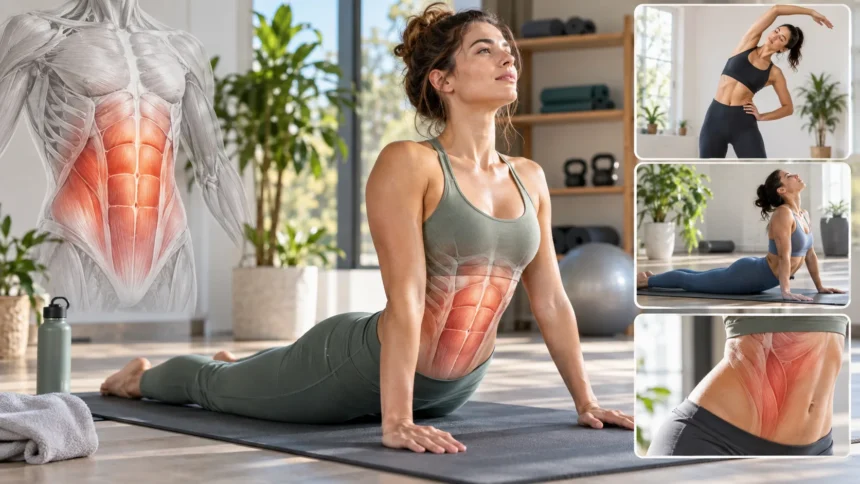
The rectus abdominis runs vertically along the front of the abdomen and is often associated with the visible “six-pack” appearance. Its major functions include flexing the trunk and helping stabilize the pelvis. Movements involving controlled backward extension can create a stretch across this area when performed comfortably.
The internal and external obliques sit along the sides of the abdomen. These muscles help rotate and side-bend the trunk while contributing to core stability. Side stretches and gentle rotation can target these areas differently from traditional forward-facing abdominal stretches.
The deeper transverse abdominis also contributes to trunk stability and abdominal pressure control. It is not usually stretched in isolation in the same way as superficial muscles. A complete mobility routine therefore focuses more on comfortable movement of the trunk, ribs, spine, and hips rather than trying to isolate every abdominal layer.
Cobra Stretch for the Abs
The cobra stretch is one of the most familiar movements for lengthening the front of the torso. Lie face down with your hands near your shoulders and your elbows close to your sides. Press gently through your hands while lifting your chest, keeping your pelvis in contact with the floor if that position feels comfortable.
You do not need to straighten your elbows completely. A smaller lift can provide enough abdominal stretch without creating excessive pressure through the lower back. Keep your shoulders relaxed away from your ears and think about lifting the chest forward and upward instead of simply bending as far backward as possible.
Hold the position for several comfortable breaths and then lower yourself slowly. You should feel mild lengthening through the abdomen rather than sharp pain, pinching, or strong compression in the lumbar spine. If the stretch feels uncomfortable, reduce the range or switch to a gentler variation such as sphinx pose.
Sphinx Pose for Gentle Abdominal Mobility
Sphinx pose provides a milder alternative to cobra and can be useful for people who find stronger spinal extension uncomfortable. Lie on your stomach and place your forearms on the floor with your elbows approximately beneath your shoulders. Gently lift your chest while keeping your forearms and pelvis supported.
Allow the front of the abdomen to lengthen gradually as you breathe. Avoid pushing aggressively through the arms or tightening the glutes excessively to force additional extension. The position should feel supported and relaxed enough that you can breathe comfortably through the abdomen and lower ribs.
Sphinx pose is particularly useful during warm-ups, cooldowns, or mobility sessions because the intensity is easy to control. You can move your elbows slightly farther forward to reduce the extension if needed. Comfortable breathing should remain your guide throughout the stretch rather than trying to achieve a particular visual position.
Standing Abdominal Stretch
A standing abdominal stretch can be convenient because it requires no floor space or equipment. Stand upright with your feet about hip-width apart and gently reach both arms overhead. Lift through the chest and allow a small backward movement through the upper body without aggressively pushing your hips forward.
Keep the movement smooth and controlled. Your glutes and abdominal muscles can remain lightly engaged so your lower back does not collapse into excessive extension. Think about creating length from your hips through your ribs and fingertips rather than trying to bend as far backward as possible.
This stretch can be useful during breaks from desk work or after sitting for an extended period. It also allows you to transition easily into side bends for the obliques. If you experience dizziness, balance problems, or back discomfort, keep the movement smaller or perform a supported version near a wall.
Side-Bending Stretch for the Obliques
Side bending can gently lengthen the oblique muscles along the sides of your torso. Stand with your feet comfortably apart, raise one arm overhead, and slowly lean toward the opposite side. Keep both feet grounded and avoid twisting your chest forward while you move into the stretch.
You may feel the stretch from the side of your ribs toward your waist or hip. Breathe normally and avoid pulling aggressively with the overhead arm. A small, controlled side bend is often enough to create a useful stretch without placing unnecessary pressure through the spine.
Repeat the movement on both sides because flexibility and comfort may differ from one direction to the other. If one side feels significantly tighter, do not force it to match the opposite side immediately. Gradual mobility work is usually more effective than using excessive pressure to chase symmetry.
Kneeling Ab and Hip Flexor Stretch
The abdominal muscles and hip flexors often work together during movement, making a kneeling stretch useful for addressing the front of the hips and trunk. Begin in a half-kneeling position with one knee on the floor and the opposite foot in front. Gently tuck the pelvis and shift forward slightly.
Once you feel a comfortable stretch through the front of the hip, raise the arm on the kneeling side overhead. A small side bend away from the kneeling leg can increase the sensation through the hip flexors and side of the abdomen. Keep the movement controlled rather than arching aggressively through your lower back.
Use padding under the knee if the floor feels uncomfortable. The position should create a gradual stretch rather than pressure through the kneecap or sharp discomfort in the hip. Switch sides and compare how each side feels, adjusting your stance as needed to maintain balance and comfortable breathing.
Supine Abdominal Stretch
A supine stretch provides another option for people who prefer lying on their back. Lie comfortably with your legs extended and reach your arms overhead along the floor. Imagine creating length from your fingertips through your ribs, abdomen, hips, and toes without forcing your spine into an extreme position.
Take slow breaths and allow the rib cage and abdomen to expand naturally. The stretch may feel subtle, particularly compared with cobra or standing extension, but subtle stretching can still be useful. This position is often comfortable after exercise because it encourages full-body lengthening without requiring significant spinal movement.
You can also slightly bend the knees if keeping the legs straight causes tension through your lower back. Mobility exercises should be adjusted to your body rather than performed according to rigid rules. Comfort, breathing, and control are more important than matching a specific position perfectly.
Benefits of Regular Ab Stretching
One potential benefit of abdominal stretching is improved comfort when moving the trunk into extension or rotation. People who spend significant time sitting or performing flexion-based exercises may appreciate movements that encourage the torso to explore different positions. Maintaining varied movement can help keep everyday activities feeling less restricted.
Stretching can also support cooldown routines after core training. Moving gently through comfortable ranges may help you transition from intense exercise into a more relaxed state. Slow breathing during stretches can further encourage relaxation and help you become more aware of tension around the abdomen, ribs, shoulders, and hips.
Mobility work may also complement sports and strength training that require efficient movement through the trunk. However, stretching alone does not automatically improve performance or prevent every injury. Strength, coordination, conditioning, recovery, and appropriate training progression remain equally important parts of a well-rounded exercise program.
How Long Should You Hold Ab Stretches?
For general mobility, many people find that holding a gentle stretch for roughly 20 to 30 seconds feels comfortable. You can repeat the position several times if needed, especially when the first repetition feels stiff. Longer holds are not automatically better if your form begins to deteriorate or discomfort develops.
Dynamic mobility can also be useful before exercise. Instead of holding cobra or standing extension for a long period, move slowly in and out of a comfortable range several times. This approach can prepare the trunk for activity without requiring prolonged static positions before your workout begins.
After training, you may prefer slower static stretches combined with relaxed breathing. The exact timing depends on your goals and how your body responds. Rather than obsessing over seconds, prioritize steady breathing, comfortable tension, and enough control that you can leave the stretch without feeling irritated or strained.
Common Ab Stretching Mistakes
One common mistake is forcing excessive lower-back extension. People sometimes believe a deeper backward bend automatically creates a better abdominal stretch. In reality, pushing beyond your available mobility may create compression or irritation through the lumbar spine without providing meaningful additional benefit to the abdominal muscles.
Holding your breath is another mistake. Comfortable breathing helps you stay relaxed and provides useful feedback about whether the position is too intense. If you cannot breathe naturally in a stretch, reduce the range until you can maintain slow inhalations and exhalations without feeling pressure or strain.
People may also stretch aggressively when they mistake pain for normal muscle tightness. Sharp abdominal pain, sudden back pain, or unexplained symptoms should not be treated by forcing additional mobility. Stretching is most appropriate when it produces mild muscular tension that settles quickly after you leave the position.
Mobility Tips for Better Results
Start mobility sessions gradually instead of moving immediately into your deepest available stretch. A few gentle trunk rotations, shoulder movements, or walking steps can help your body transition into movement. Warm tissues often feel more comfortable than stretching aggressively after remaining completely still for a long time.
Combine abdominal mobility with movement for the hips, upper back, and shoulders. These areas influence how easily your trunk can extend, rotate, and side-bend. If your hips or ankles are painful, your movement patterns may change elsewhere; conditions such as gout in the ankle can also require appropriate medical management rather than trying to compensate through stretching.
Consistency matters more than occasional intense mobility sessions. Performing a few comfortable stretches several times per week can be easier to maintain than completing one long routine occasionally. Pay attention to which movements leave you feeling freer and which repeatedly create discomfort, then adjust your routine accordingly.
When Abdominal Pain Should Not Be Stretched
Normal muscle tightness after exercise usually feels different from sudden or severe abdominal pain. Sharp pain, unexplained tenderness, significant swelling, vomiting, fever, or pain that becomes progressively worse should not be treated simply by stretching. These symptoms can have causes unrelated to muscle stiffness and may require medical assessment.
You should also be cautious after recent abdominal surgery, injury, pregnancy-related complications, or diagnosed abdominal conditions. Certain extension positions may not be appropriate during every stage of recovery. A healthcare professional or physical therapist can help determine which forms of movement are suitable for your circumstances.
Stop stretching if a movement causes severe pain, dizziness, numbness, or symptoms that continue after the stretch ends. Mobility exercises should generally leave you feeling the same or better rather than noticeably worse. When you are unsure whether discomfort is muscular, getting an appropriate evaluation is safer than repeatedly stretching through pain.
Conclusion
Ab stretches can be a useful addition to mobility routines, particularly after core workouts or long periods of sitting. Cobra, sphinx pose, standing extensions, side bends, kneeling stretches, and gentle supine positions offer different ways to lengthen the front and sides of the torso. No single movement is necessary for everyone.
Proper form is more important than achieving an extreme range of motion. Move slowly, breathe comfortably, and stop before the stretch becomes painful or creates strong pressure in your lower back. Combining abdominal stretching with hip, shoulder, and thoracic mobility can create a more balanced approach to trunk movement.
Stretching should help you explore comfortable movement rather than force your body into positions it cannot control. Practice consistently, adjust each exercise to your mobility, and pay attention to how you feel afterward. Persistent or unexplained abdominal pain should be evaluated rather than treated as ordinary muscle tightness.
FAQs
What is the best stretch for tight abs?
Cobra or sphinx pose can gently stretch the front abdominal muscles. Sphinx is usually milder, while cobra creates greater extension, so choose the variation that allows comfortable breathing without lower-back pain.
How often should I stretch my abs?
You can perform gentle abdominal mobility several times per week or after workouts when it feels comfortable. Frequency matters less than using good form and avoiding aggressive stretching through pain.
Can ab stretches help after a core workout?
Gentle stretching may help you move comfortably after core training and can be included in a cooldown. However, stretching does not eliminate all post-workout soreness or replace appropriate recovery.
Why does my lower back hurt when stretching my abs?
You may be moving into more spinal extension than your body comfortably tolerates. Reduce the range, try sphinx instead of cobra, and stop if pain remains sharp or persistent.
Should I stretch my abs if they are sore?
Gentle movement may feel comfortable with normal post-exercise soreness, but avoid aggressive stretching. Severe, unusual, or worsening abdominal pain should not be assumed to be ordinary muscle soreness.