Electrons Meaning: Charge, Role & Simple Explanation
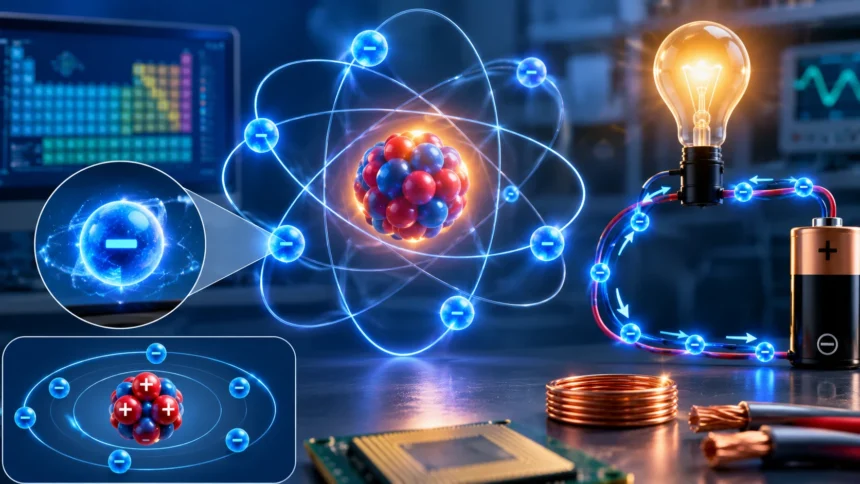
Electrons are tiny subatomic particles found in atoms, and they play a central role in electricity, chemistry, electronics, and the physical properties of matter. Although electrons are far too small to see directly with ordinary microscopes, their behavior influences nearly everything around us, from the bonds holding molecules together to the electric current powering a smartphone. Each electron carries a negative electric charge and has an extremely small mass compared with protons and neutrons. In a neutral atom, the number of electrons normally matches the number of positively charged protons in the nucleus. When electrons are gained, lost, shared, or moved, important physical and chemical changes can occur. Understanding the meaning of electrons therefore provides a foundation for learning about atoms, electrical charge, chemical bonding, electricity, magnetism, and modern technology.
What Are Electrons?
Electrons are subatomic particles that carry a negative electric charge and are fundamental components of atoms. An atom usually contains a central nucleus made of positively charged protons and electrically neutral neutrons, while electrons occupy regions around that nucleus. Electrons are dramatically lighter than protons and neutrons, so most of an atom’s mass is concentrated in its nucleus. Despite their tiny mass, electrons strongly influence how atoms interact with one another. Their arrangement helps determine an element’s chemical properties, bonding behavior, and electrical characteristics. In simple terms, electrons are among the particles that make ordinary matter behave the way it does.
The negative charge of an electron is one of its defining characteristics. Electric charge comes in positive and negative forms, and opposite charges attract while like charges repel. Because protons have positive charge, electrons are electrically attracted to the positively charged atomic nucleus. However, electrons should not be imagined simply as miniature planets traveling around the nucleus in fixed circular paths. Modern physics describes them using quantum mechanics, which represents their possible locations and energies in terms of probability distributions. These regions are often called orbitals. Simple diagrams using shells remain useful for introductory learning, but they are simplified representations rather than literal pictures of electron motion.
Electrons belong to a family of fundamental particles known as leptons. Unlike protons and neutrons, which contain smaller constituents called quarks, an electron is currently treated in standard particle physics as an elementary particle without known internal structure. This makes the electron especially important in the study of fundamental physics. Its properties are extraordinarily consistent, with every electron observed having the same electric charge and rest mass. Whether an electron is associated with a hydrogen atom, traveling through a metal, or produced during a physical process, it has the same basic characteristics. This uniformity is one reason scientists can describe electrical and chemical behavior using precise physical laws.
Although electrons are associated with atoms, they are not always permanently bound to one particular atom. In metals, some electrons can move relatively freely through the material, allowing electrical current to flow. During chemical reactions, atoms can also gain, lose, or share electrons. When an atom loses or gains electrons, it becomes an electrically charged ion. In molecules, electrons may be shared between atoms to form covalent bonds or transferred in ways that contribute to ionic bonding. These changes involve mainly electrons rather than atomic nuclei. This is why electrons are central to chemistry even though they account for only a tiny fraction of an atom’s total mass.
Electrons are also responsible for many everyday phenomena that people experience without thinking about atomic physics. Static electricity can develop when electrons are transferred between materials, leaving one object with an excess of electrons and another with a shortage. Electrical circuits rely on the movement or coordinated behavior of charge carriers, often electrons in metallic conductors. Light emitted by atoms can result from changes in electron energy states. Chemical reactions depend heavily on how outer electrons interact between atoms. Even the fact that solid objects do not simply pass through one another is connected to electromagnetic interactions and quantum behavior involving electrons. These tiny particles therefore have enormous practical importance.
What Is the Charge of an Electron?
An electron carries a negative electric charge. In introductory science, its charge is commonly represented as −1 when charge is measured relative to the elementary charge. A proton carries an equal amount of positive charge, represented as +1, while a neutron has no net electric charge. Because the electron and proton charges have equal magnitude but opposite signs, an atom containing the same number of electrons and protons is electrically neutral overall. If that balance changes, the atom develops a net charge. This simple relationship between electrons and protons explains the basic idea behind ions, static electricity, and many electrical interactions.
In standard physical units, the magnitude of the elementary electric charge is approximately 1.602 × 10⁻¹⁹ coulomb. Therefore, the electric charge of a single electron is approximately −1.602 × 10⁻¹⁹ coulomb. This number is extremely small because a coulomb represents a very large quantity of elementary charges. Everyday electrical currents involve enormous numbers of charged particles rather than just one electron. Scientists use the elementary charge as a convenient fundamental unit when discussing individual particles. Students do not always need to memorize the full numerical value immediately, but understanding the negative sign is essential. The sign tells us how electrons interact electrically with protons, other electrons, and electric fields.
Two electrons repel each other because they carry charges with the same sign. By contrast, an electron and a proton attract each other because their charges are opposite. These interactions are manifestations of the electromagnetic force, one of the fundamental interactions in nature. At the scale of atoms and molecules, electromagnetic forces are enormously important because they influence atomic structure, chemical bonding, electricity, magnetism, and the behavior of materials. The electrical attraction between negative electrons and positive nuclei helps keep atoms together. At the same time, quantum mechanical principles determine the specific ways electrons can be arranged. Atomic structure therefore emerges from a combination of electromagnetic interaction and quantum behavior.
An object can become negatively charged when it gains more electrons than are needed to balance its positive charges. Conversely, an object can become positively charged when it loses electrons. This does not usually mean that protons physically move from one ordinary object to another, because protons are bound inside atomic nuclei. In many common situations, the transferable particles are electrons. Rubbing certain materials together can encourage electrons to move from one surface to another, producing static charge. A small shock after walking across a carpet can occur when accumulated charge suddenly moves between your body and another object. This familiar experience is an everyday demonstration of electron transfer.
The negative sign assigned to electron charge is partly the result of historical convention. Scientists established positive and negative labels for electrical charge before the electron itself was discovered. Later research showed that electrons carried the type of charge already labeled negative. The labels could theoretically have been chosen the other way around, but once the convention became established it remained part of physics and electrical engineering. What matters physically is that there are two opposite types of electric charge and that electrons carry one of them. Understanding this point helps avoid the mistaken idea that negative charge somehow means an electron is harmful or deficient. It simply describes its electrical property.
Where Are Electrons Found in an Atom?
Electrons are found in regions surrounding an atom’s nucleus rather than inside the nucleus itself. The nucleus contains protons and, in most atoms, neutrons, while electrons occupy quantum states extending around it. Older diagrams often show electrons moving around the nucleus on neat circular paths similar to planets orbiting the Sun. That model can help beginners understand energy levels, but it is not an accurate description of modern atomic physics. Electrons behave according to quantum mechanics and do not have simple, precisely defined classical paths around the nucleus. Instead, scientists describe the probability of finding an electron in different regions of space.
These probability regions are called atomic orbitals. An orbital is a mathematical description associated with an electron’s quantum state and the likelihood of detecting it in different locations around the nucleus. Orbitals have characteristic shapes and energy levels, and different kinds are commonly labeled using terms such as s, p, d, and f. Beginners often first encounter the simpler concept of electron shells, which group states according to their principal energy level. Both ideas help organize electron structure, but orbitals provide the more detailed quantum description. The arrangement of electrons among these states determines many of an atom’s chemical and physical properties.
Electrons closer to the nucleus are generally associated with lower-energy states, while electrons in higher-energy states are often distributed farther from the nucleus. The attraction between negatively charged electrons and the positively charged nucleus contributes to this structure. However, electrons cannot simply occupy any energy they choose. Atomic energy levels are quantized, meaning only certain energy states are allowed. An electron can move to a higher energy state when it absorbs an appropriate amount of energy. It can later return to a lower state and release energy, sometimes in the form of a photon of light. This process helps explain atomic emission spectra and many light-producing technologies.
The electrons involved most directly in chemical bonding are usually the outermost electrons, often called valence electrons. Their arrangement strongly influences whether an atom tends to gain electrons, lose them, or share them with another atom. Elements located in the same group of the periodic table often have similar chemical properties partly because they have related valence-electron arrangements. Noble gases, for example, are comparatively unreactive because their outer electron configurations are especially stable. Alkali metals behave very differently because they have an outer electron that can be removed relatively easily. Understanding electron arrangement therefore provides a powerful explanation for patterns seen throughout the periodic table.
It is important to recognize that an electron cloud is not a physical cloud made of material surrounding the nucleus. The phrase is a visual way of describing probability distributions associated with electrons. Areas drawn as denser portions of an electron cloud represent regions where an electron is more likely to be detected. This quantum description can feel unfamiliar because everyday objects usually have clearly defined positions. At atomic scales, however, particles such as electrons are governed by quantum principles that differ from ordinary classical experience. Students do not need advanced mathematics to understand the key idea. Electrons occupy allowed quantum states around nuclei rather than traveling on simple miniature tracks.
What Role Do Electrons Play in Atoms?
Electrons determine much of an atom’s chemical behavior because interactions between atoms occur primarily through their outer electrons. When atoms approach one another, their nuclei generally remain intact during ordinary chemical reactions. Instead, electrons may be shared, transferred, rearranged, or influenced by neighboring atoms. These electron interactions create chemical bonds and allow atoms to form molecules and compounds. Water, oxygen, proteins, plastics, minerals, and countless other substances exist because atoms interact through electrons. The number and arrangement of electrons therefore help determine which substances can form and how stable they will be. Chemistry is, to a large extent, the study of how electrons behave within and between atoms.
An atom’s electron configuration describes how its electrons are distributed among available energy levels and orbitals. This arrangement is closely linked to the position of an element on the periodic table. Elements with similar outer-electron configurations often show similar chemical behavior. For example, elements in certain groups may readily lose an electron, while others have a strong tendency to gain one. The periodic table is therefore more than a list of atomic numbers. Its structure reflects repeating patterns in electron configuration. Once students understand the role of electrons, many trends involving reactivity, bonding, and elemental properties become easier to interpret instead of appearing as unrelated facts to memorize.
Electrons also help determine the size of atoms. The atomic nucleus is incredibly small compared with the overall region occupied by the electron distribution. As the number of protons and electrons changes across the periodic table, the balance between nuclear attraction and electron structure influences atomic radius. Additional electron shells generally increase the spatial extent of atoms, while stronger nuclear attraction can pull electron distributions inward under certain circumstances. These effects create predictable trends across periods and groups. Atomic size then influences bonding distances and chemical interactions. The dimensions of matter at the atomic level are therefore strongly connected to the quantum behavior of electrons surrounding nuclei.
Magnetic properties can also depend on electron behavior. Electrons possess an intrinsic quantum property called spin, and their orbital behavior also contributes to magnetic effects. When electron magnetic contributions cancel in particular arrangements, a material may respond differently to magnetic fields than one containing unpaired electrons. In certain materials, interactions between large numbers of electron magnetic moments can create strong magnetism. This is part of the reason materials such as iron can exhibit familiar magnetic behavior. The full physics can become advanced, but the fundamental message is simple: electrons are deeply involved in magnetism as well as electricity and chemistry. Their properties shape how materials respond to electromagnetic fields.
Electrons also allow atoms to interact with electromagnetic radiation such as visible light. When electrons absorb suitable amounts of energy, they may transition to higher-energy states. When they return to lower-energy states, energy can be released. The exact allowed energy differences depend on the atom or molecule, which is why different materials absorb and emit different wavelengths. Scientists use these spectral patterns to identify elements in laboratories, stars, and distant astronomical objects. Electronics, lasers, lighting, and spectroscopy all involve electron behavior in various forms. The role of electrons therefore extends from the smallest atomic interactions to technologies used for communication, medicine, manufacturing, and scientific discovery.
How Electrons Create Chemical Bonds
Chemical bonding occurs largely because atoms interact through their electrons, especially their valence electrons. Atoms can sometimes become more energetically stable by sharing or transferring electrons with other atoms. These interactions create the bonds that hold molecules and compounds together. Different types of bonding arise depending on the elements involved and how their electrons behave. The three categories commonly introduced in basic chemistry are covalent, ionic, and metallic bonding. Each involves electrons in a different way, although real chemical bonding can be more nuanced than these simplified labels suggest. Understanding these basic models nevertheless provides a useful foundation for explaining the structures and properties of ordinary substances.
Covalent bonds form when atoms share electron density. A simple example is a hydrogen molecule, where two hydrogen atoms interact in a way that allows electrons to be associated with both nuclei. Water also contains covalent bonds between oxygen and hydrogen atoms. Shared electrons help bind the atoms into a stable molecular structure. Different atoms attract shared electrons with different strengths, which can make some covalent bonds polar. The distribution of electron density within a molecule influences properties such as molecular shape, solubility, boiling point, and chemical reactivity. Many biological molecules, including proteins, carbohydrates, and DNA, depend extensively on covalent bonding.
Ionic bonding is commonly explained as involving electron transfer followed by electrical attraction between oppositely charged ions. An atom that loses one or more electrons becomes positively charged, while an atom that gains electrons becomes negatively charged. These oppositely charged ions attract one another and can form an ionic solid. Table salt provides a familiar example involving sodium and chloride ions. The actual structure is an extended crystal lattice rather than isolated pairs of atoms. Electrical forces between many ions contribute to the stability of the crystal. The behavior of electrons is therefore responsible for creating the charged particles that make ionic bonding possible.
Metallic bonding behaves differently because some electrons in metals are not confined to individual atom-to-atom bonds in the same way as in many molecular substances. Instead, electrons can be delocalized across the metallic structure, contributing to properties such as electrical conductivity and thermal conductivity. This electron behavior also helps explain why many metals can be shaped without immediately shattering. When metallic atoms shift positions, the bonding can remain effective because the electron distribution is not limited to one rigid directional connection. This simplified model is often described as positive metal ions surrounded by a sea of mobile electrons. More advanced solid-state physics provides a deeper explanation using quantum energy bands.
Chemical reactions occur when existing electron arrangements change and new arrangements form. Bonds may break, new bonds may develop, and electron density can shift between atoms. Importantly, ordinary chemical reactions do not usually create or destroy atomic nuclei. The identities of the elements remain the same while their electrons are reorganized into different compounds or molecules. This distinction separates chemistry from nuclear reactions, which involve changes within atomic nuclei. Burning fuel, digesting food, rusting iron, and charging a battery all involve electron behavior in different ways. By following where electrons move or how they are shared, chemists can understand and predict a wide range of reactions.
How Do Electrons Produce Electricity?
Electricity is closely associated with electric charge, and electrons are important charge carriers in many familiar electrical systems. In a metal wire, some electrons can respond to an applied electric field and contribute to an electric current. It is tempting to imagine individual electrons racing from a power station directly into a household appliance, but the real behavior is more subtle. Electrons within the conductor respond collectively to electric fields, while electrical energy can be transmitted through the circuit much faster than the average drift of an individual electron. The simplified idea of moving electrons remains useful for introductory learning. It helps explain why a complete conducting path is necessary for many circuits to operate.
Electric current describes the rate at which electric charge passes through a region. In metallic conductors, electrons are usually the relevant mobile charge carriers. Conventional current, however, is defined as flowing in the direction positive charge would move, which is opposite to the average motion of electrons in a simple metallic conductor. This convention was established historically before scientists understood electrons in their modern form. Engineers continue using conventional current because electrical laws work consistently with that definition. Beginners sometimes find the opposite directions confusing, but there is no contradiction. Electron flow describes the motion of negative charge, while conventional current uses a standardized positive direction.
Voltage is related to electric potential difference and provides a way of describing the energy change available per unit charge between two points. When a voltage source such as a battery is connected in an appropriate circuit, an electric field influences charges within the conductor. Electrons respond to this field, allowing current to flow when the path is complete. Resistance describes how strongly a material or component opposes current under particular conditions. These concepts work together in basic circuit analysis. Electrons are essential to the microscopic explanation, but circuit diagrams often focus on voltage, current, and resistance because these quantities are easier to measure and use in engineering calculations.
Conductors allow electric charge to move relatively easily, while insulators strongly restrict such movement under ordinary conditions. Metals such as copper are good electrical conductors because of their electronic structure. Materials such as rubber, glass, and many plastics have electrons that are less able to move freely through the material under normal voltages. Semiconductors occupy an especially important middle ground because their electrical behavior can be carefully controlled. Silicon is the best-known semiconductor used in electronic devices. By modifying semiconductor materials and applying electric fields, engineers can control how charge moves through tiny components. This ability forms the foundation of modern computers and digital electronics.
Electricity is not produced only through metallic electron flow. Different physical systems can contain different types of mobile charge carriers. In electrolytes, for example, positive and negative ions can move and carry current. Semiconductor devices involve electrons as well as electron vacancies described as holes. Plasmas contain charged particles that can respond strongly to electric and magnetic fields. Even so, electrons remain central to understanding electricity because their charge, mobility, and interactions determine the behavior of many common materials and devices. From household wiring to microscopic transistors, controlling electrical charge is one of the most useful applications of electron physics.
Electrons in Modern Technology
Modern electronics depend on the controlled behavior of electrons within semiconductor materials. Devices called transistors can act as switches or amplifying elements, allowing electrical signals to be controlled with extraordinary precision. Integrated circuits contain enormous numbers of transistors packed onto extremely small pieces of semiconductor material. When these components switch between electrical states, computers can represent and process digital information. Every calculation performed by a laptop, smartphone, or server ultimately depends on physical processes occurring inside electronic hardware. Software may feel completely abstract, but it runs on machines whose operations are based on charge and quantum behavior. Electrons therefore form a physical foundation beneath the digital world.
Computer memory also relies on controlled electrical states. Different memory technologies store information using particular physical arrangements of charge, voltage, magnetic state, or related electronic properties. The details vary between technologies such as dynamic memory, flash storage, and other semiconductor systems. What they share is the ability to represent information using reliable microscopic physical states. Digital data is commonly represented logically as zeros and ones, but those symbols ultimately correspond to measurable conditions inside hardware. Engineers design circuits so these states can be written, stored, read, and changed with extremely low error rates. Electron behavior is therefore directly connected to how computers remember information.
Displays also involve electrons and electronic states in different ways. Light-emitting diodes produce light when charge carriers recombine in semiconductor materials and release energy as photons. Modern screens contain huge numbers of controllable light-producing or light-modulating elements that create images by adjusting color and brightness. Touchscreens rely on electrical sensing methods to detect where a finger changes the local electrical environment. Cameras reverse part of this relationship by using light to create electrical signals within image sensors. In each case, devices translate between electrical behavior and information humans can see or interact with. Modern consumer technology is therefore full of practical applications of electron physics.
Solar panels provide another important example. When suitable semiconductor materials absorb light, energy from incoming photons can create mobile charge carriers. The internal structure of the solar cell helps separate those charges and produce an electrical current through an external circuit. This process converts part of the Sun’s electromagnetic energy directly into electrical energy without requiring rotating mechanical machinery. Battery systems then often store electrical energy through chemical reactions involving electron transfer. During discharge, those reactions can drive electrons through an external circuit and power a device. Renewable energy and energy storage technologies therefore rely heavily on controlling electrons through materials and chemical processes.
Communication systems also depend on electronic behavior. Smartphones convert voices, images, and digital information into electrical and electromagnetic signals that can be transmitted and processed. Radio transmitters create rapidly changing electrical currents that generate electromagnetic waves, while receiving circuits convert incoming signals into useful electronic information. Fiber-optic communication uses light to transmit information, but electronic devices generate, detect, process, and route those optical signals. Data centers contain vast networks of processors, storage devices, and communication equipment built from electronic components. Whether someone streams a video, sends an email, or makes an online payment, electron behavior is involved at multiple stages behind the scenes.
Electrons, Ions, Protons, and Neutrons
Electrons are easier to understand when compared with the other familiar subatomic particles found in atoms. Protons carry positive electric charge, electrons carry negative electric charge, and neutrons carry no net electric charge. Protons and neutrons are found inside the atomic nucleus, while electrons occupy quantum states surrounding it. Protons and neutrons are also much heavier than electrons. Because of this difference, almost all of an atom’s mass comes from its nucleus even though the electron distribution occupies most of the atom’s volume. These three particle types provide the basic introductory picture of atomic structure, although modern particle physics reveals additional fundamental particles and interactions.
The number of protons determines which chemical element an atom is. Every hydrogen atom has one proton, every carbon atom has six, and every oxygen atom has eight. Changing the number of protons changes the element itself. By contrast, changing the number of electrons changes the atom’s electrical charge without normally changing its elemental identity. A sodium atom that loses one electron is still sodium, but it becomes a positively charged sodium ion. This distinction is fundamental to chemistry. Protons establish elemental identity, while electrons largely determine charge and chemical interaction under ordinary conditions.
Neutrons influence atomic mass and nuclear stability but do not directly determine electrical charge. Atoms of the same element can contain different numbers of neutrons, creating isotopes. Carbon-12 and carbon-14, for example, both contain six protons but differ in neutron number. Their electron arrangements can be similar when the atoms are electrically neutral, so they share many chemical characteristics. However, their nuclei have different masses and nuclear properties. Some isotopes are stable, while others are radioactive. This demonstrates why atomic behavior must be considered on both nuclear and electronic levels. Electrons dominate ordinary chemistry, while protons and neutrons are central to nuclear structure.
An ion forms when the balance between protons and electrons changes. If an atom loses electrons, it has more positive proton charge than negative electron charge and becomes a positive ion, called a cation. If an atom gains electrons, it develops a net negative charge and becomes an anion. Ions are extremely important in chemistry, biology, batteries, electrical conduction in solutions, and many industrial processes. Sodium, potassium, calcium, chloride, and other ions help support biological functions in the human body. Their behavior ultimately depends on differences in electron number. The concept of ions therefore provides a direct practical link between electron charge and everyday chemical systems.
It is also important not to confuse an electron with an atom itself. An atom is an organized system containing a nucleus and an electron structure, while an electron is one fundamental particle that participates in that system. Similarly, electricity is not simply a substance made entirely of loose electrons. Electrical phenomena involve electric fields, charge distributions, currents, energy transfer, and the behavior of materials. Simplified explanations are useful for beginners, but accurate understanding improves when these distinctions are maintained. Electrons are remarkably important, yet they operate as part of broader physical systems governed by electromagnetic and quantum principles.
FAQs About Electrons
What is an electron in simple words?
An electron is a tiny subatomic particle with a negative electric charge that is found in quantum states around an atom’s nucleus. Electrons are especially important because they influence electricity, chemical bonding, magnetism, and how atoms interact.
Are electrons positive or negative?
Electrons have a negative electric charge, while protons have an equal-magnitude positive charge. A neutral atom normally contains equal numbers of protons and electrons, causing their charges to balance overall.
Where are electrons located?
Electrons occupy quantum states in regions surrounding an atomic nucleus rather than moving along fixed circular tracks. These regions can be described using electron clouds and atomic orbitals that represent the probability of detecting an electron in different locations.
What happens when an atom loses an electron?
When a neutral atom loses one or more electrons, it develops more positive charge than negative charge and becomes a positively charged ion called a cation. The atom normally remains the same chemical element because its number of protons has not changed.
Why are electrons important?
Electrons are important because they control much of chemical bonding, electrical conductivity, atomic interactions, and the behavior of electronic materials. Technologies including computers, batteries, solar panels, communication equipment, and semiconductor devices all depend on understanding and controlling electron behavior.