RTU Meaning: Remote Terminal Unit Explained
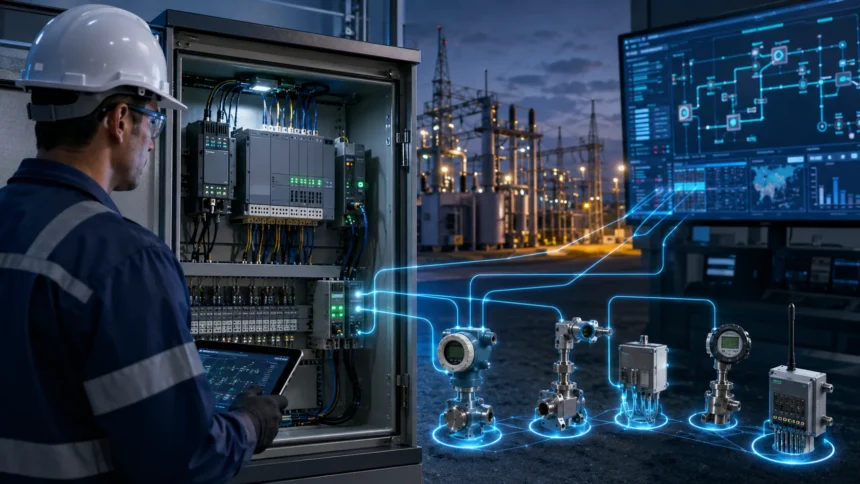
An RTU, or Remote Terminal Unit, is an industrial control device used to collect information from equipment in the field and communicate that information to a central monitoring or control system. RTUs are strongly associated with SCADA systems, where equipment may be spread across pipelines, substations, water networks, renewable-energy sites, factories, and other geographically dispersed locations. An RTU can receive signals from sensors, process the information locally, store operational data, and send measurements or alarms back to operators. Many units can also issue commands to pumps, valves, switches, motors, and other field equipment. This combination of monitoring, communication, and control makes RTUs an important part of modern operational technology.
Remote terminal units were originally valued because industrial operators needed dependable ways to monitor equipment located many kilometers from a control room. Running dedicated communication cables to every remote asset was often impractical, so RTUs were designed to work with radio, telephone, satellite, and other long-distance communication technologies. Modern RTUs now support Ethernet, cellular networks, industrial protocols, IP communications, wireless links, and increasingly sophisticated local processing. NIST describes an RTU as a field computer commonly used to communicate with remote equipment, including situations where radio communication is required. Their role has therefore expanded from simple telemetry devices into capable edge controllers that can perform meaningful automation at remote sites.
Understanding the RTU meaning requires looking at how the device fits into the wider industrial automation environment. An RTU usually sits between field instruments and a supervisory system, translating physical measurements into digital information that operators can monitor remotely. It may also translate control commands from the SCADA system into physical actions at the site. This guide explains what an RTU is, how a Remote Terminal Unit works, its main hardware components, communication protocols, RTU vs. PLC differences, common applications, and cybersecurity considerations. It also examines how smart RTUs are evolving through edge computing, data logging, advanced control, and secure remote management. The result is a practical introduction for readers without requiring deep automation knowledge.
What Is an RTU?
A Remote Terminal Unit is a specialized industrial computer designed to monitor and control equipment at a remote or distributed location. It gathers signals from field devices such as pressure transmitters, flow meters, temperature sensors, level sensors, electrical meters, and switches. The RTU converts those signals into digital information that can be processed locally or sent to a central SCADA server. It may also receive instructions from the control center and use its outputs to operate equipment such as valves, pumps, relays, and circuit breakers. NIST describes RTUs as data-acquisition and control devices used at remote field locations within SCADA environments. This field-to-control-center connection is the core purpose of an RTU.
The word remote is significant because RTUs are commonly installed where equipment is far from operators or difficult to reach regularly. A pipeline company might place RTUs at pumping stations hundreds of kilometers apart, while an electrical utility can deploy them across substations throughout a large service region. Water utilities may use RTUs at reservoirs, pumping stations, wells, and wastewater facilities. Because these locations can be exposed to heat, cold, dust, moisture, electrical interference, and unreliable communications, industrial RTUs are generally designed for much tougher environments than normal office computers. Many models also emphasize low power consumption because remote installations may depend on batteries, solar panels, or limited local electrical supplies.
An RTU does more than simply forward sensor readings. Modern devices can process data, perform calculations, compare measurements against configured limits, generate alarms, execute control logic, and store information when communications are temporarily unavailable. The unit can continue carrying out certain local functions even if its connection to the central control system is interrupted. Schneider Electric describes current Smart RTUs as combining traditional RTU monitoring and communication with PLC-style processing and data-logging capabilities. This local intelligence is particularly valuable for remote infrastructure because important equipment may still need to operate safely when network connectivity becomes slow, intermittent, or unavailable.
RTUs contain both hardware and software. Hardware may include a processor, memory, power supply, communication interfaces, input/output modules, and connections for field equipment. Software or firmware determines how the unit collects signals, processes data, communicates, handles alarms, performs calculations, and responds to commands. Engineers configure the RTU according to the process being monitored, meaning two identical units could perform completely different tasks depending on their programming and connected equipment. The device is therefore not a sensor itself. Instead, it acts as the intelligent intermediary that collects information from multiple instruments, applies logic where required, and communicates useful operational information to higher-level control systems.
RTU capabilities vary substantially between products. A small unit may monitor only a handful of signals at a remote water tank, while a modular system can handle hundreds of input and output points at a complex industrial site. Some RTUs primarily perform telemetry, whereas advanced models provide substantial local automation, flow measurement, data logging, communications, and cybersecurity functionality. Emerson’s current RTU portfolio, for example, includes scalable platforms designed for remote oil, gas, water, and wastewater operations, with modular I/O and programmable control capabilities. Therefore, the term RTU describes a category of industrial controller rather than one fixed device configuration or level of processing power.
How Does an RTU Work in a SCADA System?
An RTU normally works as part of a Supervisory Control and Data Acquisition system, better known as SCADA. The SCADA system provides centralized visibility and supervisory control, while RTUs or PLCs are positioned at distributed field locations close to the physical process. Sensors measure real conditions such as temperature, voltage, flow, pressure, tank level, or equipment status and send electrical or digital signals to the RTU. The RTU reads those inputs and converts them into values that its software can understand. It can then timestamp, store, calculate, or evaluate those measurements before sending relevant information toward the SCADA control center. Operators see the resulting information through human-machine interfaces and monitoring applications.
Communication works in both directions. The RTU reports field data to the supervisory system, but the SCADA server can also send approved commands back to the RTU. For example, an operator might remotely instruct a pump to start, open a pipeline valve, modify a setpoint, or reset a piece of equipment. The RTU receives the command, checks the configured logic, and activates the appropriate output. NIST describes SCADA architectures in which central control servers communicate with lower-level RTUs and PLCs across operational-technology networks. This two-way relationship allows organizations to supervise large physical systems without requiring an operator to stand beside every remote asset.
Local processing helps reduce dependence on uninterrupted central communication. Suppose an RTU monitors the water level inside a reservoir and controls a nearby pump. The SCADA system may display the reservoir level to operators, but the RTU can also be configured to start or stop the pump according to predetermined conditions. If communication with the control room is temporarily lost, appropriate local logic may continue protecting the process. When connectivity returns, stored data can be forwarded to the central system. Schneider Electric’s remote SCADA platforms, for example, support time-stamped information and database backfilling for remote operational environments. The exact autonomous behavior depends on the system design and safety requirements.
The central SCADA environment performs broader supervisory functions that would be inefficient to duplicate at every remote location. It can combine data from many RTUs, display process diagrams, maintain historical records, generate reports, analyze trends, and alert operators when conditions require attention. The RTU concentrates instead on its local field equipment and communication responsibilities. A utility control center might therefore monitor hundreds of substations through a network of distributed RTUs. Each field unit understands its connected signals while the SCADA platform provides the organization-wide operational view. This division of responsibilities makes large distributed infrastructures easier to monitor because detailed field information becomes available from one central operational environment.
An RTU also helps translate between different layers of industrial technology. Field instruments may communicate through analog signals, digital inputs, pulse signals, HART devices, serial networks, or specialized industrial protocols. The supervisory system may communicate through Ethernet or IP-based networks using completely different protocols. The RTU can act as the bridge between these environments by collecting local signals and formatting them for upstream communication. Modern devices may simultaneously communicate with several field instruments, intelligent electronic devices, and central applications. This protocol and connectivity flexibility is especially important in facilities that contain equipment from different manufacturers or technologies installed across many years of infrastructure expansion.
Main Components of a Remote Terminal Unit
The central processing unit, or CPU, is the main computational component of an RTU. It executes the configured control logic, processes field inputs, performs calculations, manages communications, and coordinates the other modules inside the unit. Processing requirements vary according to application complexity. A basic telemetry installation may perform simple measurements and alarm logic, while a modern smart RTU can execute multiple control loops, data-processing routines, and communication tasks simultaneously. Memory stores firmware, configuration information, programs, current values, and historical data. Some systems also provide removable or expanded storage for data logging. The combination of processing power and memory determines how much local intelligence the RTU can provide before relying on a supervisory system.
Input and output modules, commonly called I/O, connect the RTU with physical field equipment. Analog inputs can receive variable measurements such as 4–20 mA signals from pressure, level, temperature, or flow transmitters. Digital inputs represent discrete states such as whether a switch is open, a motor is running, or an alarm contact has activated. Analog outputs can provide variable control signals to compatible equipment, while digital outputs can switch relays, valves, or other devices between defined states. Pulse inputs may count events from flow meters and similar instruments. Modular RTUs allow organizations to choose combinations of I/O that match individual sites rather than purchasing unnecessary channels for every possible signal type.
Communication interfaces allow the RTU to exchange data with field devices, other controllers, and central systems. Interfaces may include Ethernet ports, serial connections such as RS-232 or RS-485, cellular modems, radios, fiber links, or other communication technologies. A unit may support several interfaces simultaneously because one connection serves local instruments while another links the RTU to the SCADA network. Emerson’s ControlWave RTUs, for example, emphasize multiple Ethernet and serial communication options alongside low-power remote operation. Communication hardware must be selected according to distance, bandwidth, reliability, environmental conditions, existing infrastructure, and cybersecurity requirements rather than simply choosing the fastest technology available.
The power supply is especially important for remote installations. RTUs may operate from mains electricity, DC supplies, battery systems, solar energy, or combinations that provide backup during failures. Low-power design can substantially extend the operating life of remote monitoring sites where technicians cannot easily replace batteries. Schneider Electric notes that low-power operation is an important capability in remote SCADA environments because it helps maintain monitoring through power disruptions and supports battery-powered installations. Power systems may also require protection against surges, electrical noise, or unstable supplies. A sophisticated RTU becomes useless if its power architecture cannot remain dependable under the conditions where the device is actually installed.
The final major component is the RTU’s firmware and configuration software. Firmware provides the low-level operating environment, while engineering software allows technicians to configure communication settings, I/O mappings, alarms, data logging, control logic, user access, and other behavior. Modern products increasingly support remote configuration and firmware management so technicians can maintain distributed installations without visiting every site physically. This capability can reduce maintenance costs, but it also makes secure authentication and controlled remote access essential. Configuration backups are equally important because a failed unit can often be replaced much more quickly when its approved settings are stored securely. Hardware reliability and good configuration management therefore work together in a dependable RTU system.
RTU vs. PLC: What Is the Difference?
RTUs and PLCs are both industrial controllers, which is why the distinction between them can sometimes appear unclear. A Programmable Logic Controller, or PLC, is traditionally optimized for fast, deterministic local machine and process control inside industrial facilities. An RTU has traditionally been optimized for remote telemetry, communication over long distances, low-power operation, and geographically dispersed equipment. A PLC might control a high-speed packaging line inside a factory, while an RTU monitors a remote pipeline station. These historical differences still influence product selection. However, modern devices increasingly overlap because manufacturers have added advanced communication to PLCs and faster processing, programming, and local-control functionality to RTUs.
Communication capability has historically been one of the strongest RTU advantages. Remote infrastructure may rely on radio, satellite, cellular, serial, or bandwidth-limited networks that behave differently from the high-speed industrial Ethernet commonly found inside factories. RTUs were designed to handle these constraints and maintain useful operation when communication is intermittent. They frequently support protocols associated with SCADA and utility environments. PLCs historically concentrated more heavily on local automation networks and machine-level I/O. The distinction is no longer absolute because modern PLCs support remote communication and modern RTUs support sophisticated local control. NIST also notes that PLCs with suitable communications capabilities can be used in place of dedicated RTUs.
Power and environmental requirements can also separate the two categories. Remote monitoring sites may have limited electricity and can be located outdoors in demanding climates, making low-power electronics and rugged construction particularly important. An RTU may spend years inside an enclosure beside a pipeline, wellhead, reservoir, or electrical substation with relatively little physical maintenance. Traditional PLCs are commonly installed inside powered control cabinets within industrial facilities where environmental conditions are more controlled. Nevertheless, rugged PLCs and highly capable RTUs make this comparison increasingly dependent on the actual model. Engineers should evaluate temperature range, electrical protection, power consumption, certifications, communication options, and maintainability rather than choosing purely according to product category.
Control performance represents another historical difference. PLCs became popular because they could execute control logic quickly and repeatedly, making them suitable for machinery and processes requiring precise real-time behavior. Traditional RTUs often prioritized data collection and communications rather than very fast control loops. Modern smart RTUs have narrowed this gap considerably. Schneider Electric describes its Smart RTUs as combining RTU communication and monitoring with PLC-style processing, autonomous control, and data logging. Emerson similarly describes some ControlWave and ROC products as combining characteristics of RTUs and PLCs. This convergence means application requirements matter more than simple labels.
Choosing between an RTU and PLC should therefore begin with the operating environment. A project with remote sites, unreliable connectivity, limited power, extensive telemetry requirements, and SCADA communication may naturally favor an RTU. A high-speed production machine with dense local I/O and deterministic control may favor a PLC. Some projects use both, with PLCs controlling equipment locally and RTUs aggregating information for wide-area supervisory monitoring. Other applications use modern hybrid controllers that perform both roles. The right decision depends on response time, communications, environmental conditions, power availability, I/O count, programming requirements, cybersecurity, maintenance skills, lifecycle expectations, and integration with the larger automation architecture.
Where Are RTUs Used?
Electric power systems are one of the most important RTU application areas. Utilities need to monitor substations, transmission equipment, distribution networks, transformers, switches, circuit breakers, voltage, current, frequency, and many other operational variables across enormous geographic areas. RTUs can collect these measurements and make them available to control centers without requiring staff at every substation. They can also receive authorized switching or control commands. NIST describes RTUs as providing a cyber-to-physical interface in power environments by gathering values such as voltage and current and delivering commands to equipment including switches and circuit breakers. This remote visibility supports faster operational decision-making and fault response across distributed electrical infrastructure.
Oil and gas operations also depend heavily on remote telemetry. Pipelines, compressor stations, production wells, storage facilities, metering stations, and valves can be spread across very large and sometimes isolated regions. RTUs monitor pressure, temperature, flow, tank levels, valve positions, equipment status, and other important measurements. Advanced units can perform flow calculations, data logging, local control, and communications with central pipeline SCADA platforms. Emerson’s current RTU systems are designed for applications ranging from wellpads to complex transmission and measurement operations. Remote automation reduces the need for routine site visits while giving operators faster information about abnormal operating conditions.
Water and wastewater systems use RTUs to monitor wells, reservoirs, pumping stations, treatment processes, lift stations, distribution networks, and storage tanks. A municipality may have hundreds of assets distributed throughout a city or rural service area, making centralized monitoring economically valuable. An RTU can report reservoir levels, pump status, pressure, flow, and alarm conditions while also performing local pump or valve control. Schneider Electric specifically positions smart remote RTU systems for water and wastewater alongside energy and other dispersed infrastructures. Because these sites may be unattended for long periods, dependable communications, environmental durability, backup power, and local control are often central requirements rather than optional features.
Renewable energy has created additional RTU opportunities. Solar farms, wind installations, battery systems, small hydroelectric facilities, and distributed generation resources require monitoring across geographically dispersed equipment. RTUs can collect electrical and environmental data, monitor equipment status, communicate alarms, and integrate field measurements with supervisory or energy-management systems. Remote control can also reduce the number of physical visits required for normal operating adjustments. The specific controller architecture differs between projects because renewable sites may combine RTUs, PLCs, intelligent electronic devices, inverters, protection equipment, and specialized plant controllers. What matters is that operational data can move reliably between field assets and the systems responsible for supervision, analytics, and maintenance planning.
Transportation and industrial infrastructure provide further examples. Rail systems can use remote controllers for signaling and trackside equipment, while mining operations can monitor pumps, conveyors, ventilation, and remote processing assets. Environmental monitoring networks use telemetry units to collect weather, river, or air-quality information from isolated stations. Agricultural and irrigation systems may monitor pumps, soil conditions, gates, and water distribution. Industrial organizations also use RTUs where assets are spread across large plants or storage terminals. These examples demonstrate why RTUs are associated less with one particular industry than with a specific operational problem: collecting dependable information and providing controlled automation when equipment is physically separated from the people supervising it.
RTU Communication Protocols and Connectivity
Communication protocols define how information is formatted and exchanged between RTUs, field devices, and supervisory systems. Industrial environments contain equipment from different generations and manufacturers, so protocol support can strongly influence RTU selection. Common protocols associated with RTU and SCADA systems include Modbus, DNP3, and IEC 60870-5 variants, while specific industries may use additional standards. Schneider Electric’s current remote SCADA platforms, for example, list DNP3, IEC 60870-5, WITS, and Modbus support across their telemetry environment. An RTU that supports several protocols can act as an integration point between older field instruments and newer networked supervisory platforms.
Modbus is one of the most recognizable industrial communication protocols and is used across many automation environments. It can operate over serial connections or TCP/IP networks depending on the implementation. Its relatively straightforward data model has contributed to long-term adoption across sensors, controllers, meters, drives, and other industrial devices. RTUs can use Modbus to poll field equipment or exchange information with supervisory systems. However, traditional industrial protocols were often created primarily for reliable operations rather than modern internet-era security. Organizations should therefore avoid assuming that protocol support automatically provides authentication, encryption, or protection against unauthorized commands. Security controls need to be designed around the complete operational network.
DNP3, or Distributed Network Protocol 3, is strongly associated with utilities and wide-area SCADA environments. It was designed to support reliable communication where connections may have limited bandwidth or intermittent availability. Useful capabilities include event-oriented reporting and time-stamped data, helping control centers reconstruct field activity after communication interruptions. Modern deployments can incorporate stronger security features, including DNP3 Secure Authentication when supported by the equipment and system architecture. Emerson’s newer FB3000 RTU, for example, supports DNP3 Secure Authentication Version 5 as part of its cybersecurity functionality. Protocol selection should nevertheless consider interoperability, installed equipment, operational requirements, and the security architecture surrounding the communication path.
Physical connectivity can include radio, fiber, copper, cellular, satellite, private networks, or ordinary IP infrastructure depending on site conditions. A remote pipeline station might use cellular or radio because physical cabling is impractical, while a substation within a utility fiber network can use high-speed wired communication. Some installations use primary and backup communication paths to improve availability. Bandwidth requirements can vary substantially because simple telemetry messages require far less capacity than video or high-frequency data. Latency, coverage, reliability, recurring cost, environmental conditions, and cybersecurity all influence the final choice. The most advanced communication method is not automatically the best if it is difficult to maintain reliably at the remote location.
Modern RTUs increasingly connect field operations with enterprise and cloud environments, making network architecture more complex. Remote information can flow from instruments into the RTU, through SCADA platforms, into historians, analytics tools, maintenance systems, and potentially cloud services. This creates opportunities for improved operational insight but also expands the number of systems that must be managed securely. Network segmentation can help separate control environments from general business networks, while controlled gateways can regulate data movement between layers. Engineers should understand which systems genuinely need direct communication and avoid unnecessary connectivity. Good RTU architecture provides useful data access without turning remote operational equipment into an uncontrolled extension of the corporate or public internet.
RTU Cybersecurity, Reliability, and Modern Trends
RTU cybersecurity has become increasingly important because these devices can influence real physical equipment. Unauthorized access to an ordinary information system can expose data, while unauthorized control of an RTU could potentially affect pumps, valves, electrical switching, or other operational processes. NIST’s current Guide to Operational Technology Security emphasizes that OT cybersecurity must account for safety, reliability, performance, and operational requirements alongside traditional information-security concerns. This makes industrial cybersecurity different from simply applying normal office IT controls. Security measures need to protect equipment without creating unacceptable delays, instability, or maintenance difficulties that could themselves interfere with safe operation.
Access control is one of the first areas organizations should address. Engineering interfaces, remote maintenance connections, configuration tools, and supervisory commands should be available only to authorized users and systems. Strong authentication, individual administrator accounts, controlled privileges, and logging improve accountability. Default credentials should be changed, and unused communication services should be disabled when practical. Remote administration should be carefully restricted because connectivity intended to simplify maintenance can become an attractive attack path. Organizations should also maintain an inventory of deployed RTUs, firmware versions, communication pathways, and responsible owners. Security becomes significantly harder when teams do not know which field devices exist or how they connect to the wider environment.
Firmware integrity and secure updates are becoming more prominent features in modern RTU platforms. Industrial equipment can remain deployed for many years, so organizations need trustworthy ways to maintain software throughout the device lifecycle. Emerson’s current FB3000 platform, for example, uses digitally signed firmware and verifies firmware during boot as part of its security architecture. These types of controls can help reduce the risk of unauthorized firmware modification, but technology features are only one layer of protection. Organizations also need controlled engineering workstations, change management, configuration backups, physical security, network monitoring, incident-response procedures, and vendor-supported lifecycle planning. Security works best as a system rather than a collection of isolated product features.
Reliability remains equally important because many RTUs supervise infrastructure expected to operate continuously. Industrial devices must tolerate temperature changes, electrical interference, communication interruptions, power loss, and long periods without on-site maintenance. Redundant communication paths, backup power, watchdog functions, local data storage, and fault-tolerant system design can improve resilience. Remote diagnostics allow engineers to investigate many issues without traveling to the field. Local autonomous control can also maintain essential operations during communication loss. The specific resilience requirements should reflect the consequence of failure. Monitoring a noncritical environmental sensor requires a different architecture from controlling equipment associated with electricity distribution, hazardous materials, or essential municipal water services.
Modern RTUs are also moving toward edge computing and smarter local processing. Instead of forwarding every raw measurement to central infrastructure, a smart RTU can filter, aggregate, analyze, or act on data at the site. This reduces unnecessary communication traffic and can enable faster local decisions. Emerson’s current FBxEdge platform, for example, supports containerized applications and machine-learning workloads alongside compatible field automation equipment, illustrating how edge capabilities are entering traditional SCADA environments. These developments blur the boundary between telemetry devices, PLCs, edge computers, and industrial gateways. Future RTUs will likely combine stronger local intelligence with secure central management while retaining the ruggedness and reliable communications that originally defined the category.
Conclusion
The RTU meaning is straightforward at its core: RTU stands for Remote Terminal Unit, an industrial computer used to monitor and control equipment at remote or distributed locations. It receives information from sensors and field devices, processes that information, and communicates relevant data to supervisory systems such as SCADA. The RTU can also receive commands and operate physical equipment through its output channels. This two-way connection allows organizations to manage infrastructure spread across large geographic areas from centralized control centers. Utilities, water companies, oil and gas operators, renewable-energy providers, manufacturers, and many other industries rely on this model where continuous human presence at each site would be impractical.
An RTU is made from several important building blocks. The processor executes control and communication tasks, memory stores programs and operational information, and input/output modules connect the controller with the physical process. Communication interfaces link the RTU with field devices and higher-level systems, while the power architecture keeps the site operational under available electrical conditions. Firmware and engineering software determine how the hardware behaves. These components can be combined in small fixed units or large modular platforms depending on project requirements. Understanding each component helps explain why RTU specifications differ significantly between a simple monitoring station and a complex pipeline, substation, or water-treatment installation.
RTUs and PLCs continue to overlap as industrial technology evolves. Traditional RTUs emphasized remote telemetry, ruggedness, low power, and long-distance communication, while PLCs were optimized for high-speed local control. Modern smart RTUs increasingly offer PLC-style programming and autonomous control, while modern PLCs support sophisticated network communications. Engineers should therefore select equipment according to practical requirements rather than relying entirely on historical labels. Communication reliability, control speed, power availability, environmental conditions, I/O capacity, maintainability, protocol support, and cybersecurity all matter. In some architectures, RTUs and PLCs work together, with each device performing the tasks for which its characteristics are best suited.
Communication remains one of the defining RTU capabilities. Protocols such as Modbus, DNP3, and IEC 60870-5 allow information to move between diverse industrial devices and central systems. Connectivity can use radio, cellular networks, satellite, fiber, copper, or IP infrastructure according to the location. Modern SCADA systems can then combine information from many remote units into operational dashboards, alarms, historical databases, and analytics platforms. As those connections become more integrated with enterprise and cloud systems, network architecture needs greater attention. Useful information should reach the people and systems that require it without unnecessarily exposing control devices to networks that have no legitimate operational reason to communicate with them.
The future of the Remote Terminal Unit is therefore not simply about faster hardware. Modern RTUs are becoming more programmable, data-aware, remotely manageable, cybersecure, and capable of performing edge-processing tasks. At the same time, the fundamental requirements remain remarkably consistent: dependable operation, accurate field data, reliable communications, appropriate local control, and long service life. Organizations adopting newer capabilities should preserve these operational priorities rather than treating field automation like ordinary consumer computing. A well-designed RTU continues to perform one of industrial automation’s most valuable functions by turning geographically dispersed physical assets into equipment that can be monitored, understood, and controlled from a coordinated operational system.
Frequently Asked Questions
What does RTU stand for? RTU stands for Remote Terminal Unit. It is an industrial controller used to collect information from remote equipment and communicate with systems such as SCADA.
What does an RTU do? An RTU reads signals from sensors and field devices, processes or stores the information, and sends relevant data to a central control system. It can also receive commands and control equipment through digital or analog outputs.
What is the difference between an RTU and PLC? RTUs traditionally focus on remote telemetry, low-power operation, and long-distance communications, while PLCs traditionally focus on fast local machine or process control. Modern products increasingly overlap, so actual specifications and application requirements should determine the choice.
Is an RTU part of a SCADA system? Yes, RTUs are commonly used as field components within SCADA architectures. They connect remote sensors and actuators with the supervisory control environment that operators use for monitoring, alarms, historical data, and remote commands.
Where are RTUs commonly used? RTUs are widely used in electric utilities, oil and gas pipelines, water and wastewater networks, renewable-energy sites, mining, environmental monitoring, transportation, and other distributed industrial operations. They are particularly useful when important equipment is too remote for continuous on-site supervision.