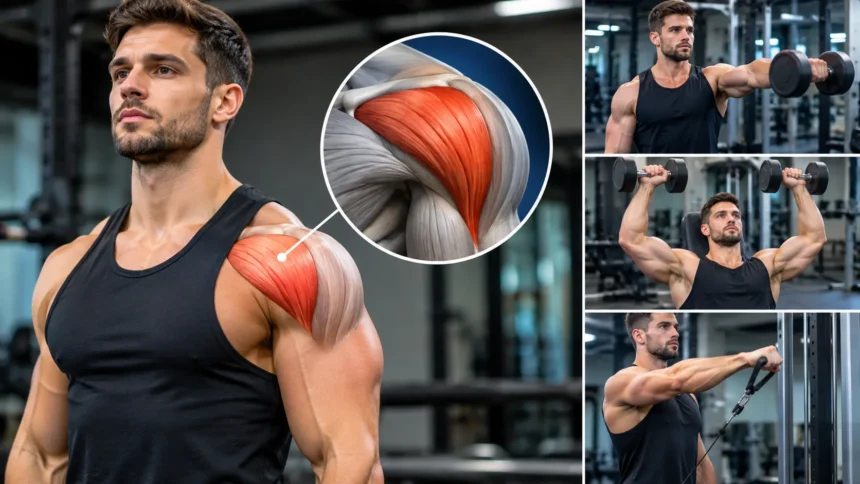
Strong shoulders play an important role in everyday movements, upper-body strength, and physical fitness. The anterior deltoid, also called the front deltoid, helps you lift your arms, push objects, and perform many common exercises. Adding anterior deltoid exercises to a balanced workout routine can improve shoulder strength, movement control, and muscular endurance. Understanding proper technique is essential because the shoulder is a complex joint that requires careful movement. This guide explains effective front shoulder exercises, their benefits, correct form, and practical training tips.
What Are Anterior Deltoid Muscles?
The anterior deltoid is the front section of the deltoid muscle that covers the shoulder joint. It begins near the outer portion of the collarbone and attaches to the upper arm bone. This muscle helps raise the arm forward and assists with several pushing movements. It works together with other shoulder muscles to support controlled upper-body motion.
The deltoid muscle has three main sections: anterior, lateral, and posterior. The anterior portion is responsible primarily for shoulder flexion, which involves lifting the arm forward. It also contributes to moving the arm across the body and rotating it inward. These actions make it important during exercises such as shoulder presses, front raises, and push-ups.
Although the anterior deltoid performs specific movements, it rarely works completely alone. The chest, triceps, rotator cuff, and shoulder blade muscles often contribute during upper-body exercises. Balanced training helps these muscle groups work together effectively. Understanding this relationship makes it easier to choose exercises that develop shoulder strength without placing unnecessary stress on the joint.
What Are the Benefits of Anterior Deltoid Exercises?
Anterior deltoid exercises can strengthen the muscles involved in lifting and pressing movements. Improved strength may make everyday activities, such as placing objects on shelves or lifting lightweight items, feel easier. These exercises also support performance in activities that involve controlled arm movements. Consistent training helps the shoulders gradually adapt to appropriate physical demands.
Another benefit is improved muscular endurance during upper-body activities. Strong front deltoids contribute to movements such as overhead pressing, pushing, and certain sports actions. However, performance depends on several muscle groups rather than one isolated muscle. Combining front shoulder exercises with balanced upper-body training encourages more complete muscular development.
Training the anterior deltoids can also contribute to overall shoulder stability when combined with appropriate strengthening exercises. The rotator cuff and shoulder blade muscles remain especially important for joint control. Using proper movement patterns can help reduce unnecessary strain during exercise. The greatest benefits come from consistent training, suitable resistance, and gradual progression rather than lifting excessively heavy weights.
Dumbbell Front Raises for Anterior Deltoid Strength
Dumbbell front raises are among the most familiar anterior deltoid exercises because they directly challenge shoulder flexion. Begin by standing upright with a light dumbbell in each hand. Keep your arms near your sides, palms facing your thighs, and knees slightly relaxed. Maintain a comfortable posture without leaning backward or excessively arching your lower back.
Slowly lift one or both dumbbells forward until your arms reach approximately shoulder height. Keep a slight bend in your elbows and avoid swinging the weights upward. Lower the dumbbells gradually while maintaining control throughout the movement. Start with light resistance because front raises can become challenging even when the weights appear relatively small.
The main benefit of dumbbell front raises is their ability to train the anterior deltoid through a focused movement. They also encourage coordination and controlled shoulder motion. However, lifting the arms higher than comfortable or using momentum can increase unnecessary strain. Choose weights that allow smooth repetitions and stop if you experience sharp pain or uncomfortable joint sensations.
Seated Dumbbell Shoulder Press for Front Delts
The seated dumbbell shoulder press is a compound exercise that strengthens the anterior deltoids while engaging other shoulder and arm muscles. Sit on a stable bench with suitable back support when available. Hold light dumbbells near shoulder level with your elbows positioned comfortably below the weights. Keep your feet supported and maintain a natural spinal position.
Press the dumbbells upward through a comfortable range of motion without forcing your elbows into a locked position. Allow your shoulder blades to move naturally as your arms rise. Slowly lower the weights toward the starting position while maintaining balance and control. Avoid excessive lower-back arching or pushing the weights behind your head.
This exercise develops pressing strength and helps train coordinated upper-body movement. The lateral deltoids, triceps, and several stabilizing muscles also contribute during the press. Beginners can start with very light dumbbells or practice the movement without weights. Proper technique matters more than lifting heavy resistance, particularly while learning overhead pressing exercises.
Standing Overhead Press for Anterior Deltoids
The standing overhead press is another effective movement for training the front shoulder muscles. It challenges the anterior deltoids while requiring support from the core, upper back, and arms. Begin with light dumbbells positioned around shoulder height. Stand with your feet comfortably apart and keep your body balanced throughout the movement.
Press the weights overhead while keeping your ribs and pelvis in a comfortable, controlled position. Allow your shoulder blades to rotate upward naturally instead of holding them rigidly in place. Lower the weights slowly without dropping your elbows too far behind your body. If overhead movement causes discomfort, choose a variation that better suits your current mobility.
Standing presses can help improve strength for activities that involve reaching and lifting overhead. Because the exercise involves several joints, it develops coordinated movement rather than isolating one muscle. Beginners should prioritize manageable resistance and smooth repetitions. Avoid excessive backward leaning, which can shift unwanted stress toward the lower back during challenging sets.
Arnold Press for Front Shoulder Development
The Arnold press is a shoulder press variation that combines pressing with controlled arm rotation. It involves the anterior deltoids along with the lateral deltoids and other supporting muscles. Start seated with light dumbbells held in front of your shoulders. Keep your palms facing toward your body and your elbows comfortably bent.
As you press upward, gradually rotate your forearms until your palms face forward or slightly inward. Continue lifting through a comfortable range without forcing the shoulders into an awkward position. Reverse the movement slowly while lowering the weights. Keep the rotation controlled instead of trying to move quickly through the entire exercise.
The Arnold press provides variety for people who can perform overhead movements comfortably. However, it is not necessary for building strong anterior deltoids, and its rotation may not suit every shoulder. A standard dumbbell press can be equally practical for many beginners. Choose the variation that feels natural and allows stable, pain-free movement throughout each repetition.
Cable Front Raises for Controlled Shoulder Training
Cable front raises provide another way to strengthen the anterior deltoid through shoulder flexion. Unlike free weights, cable machines create resistance through a pulley system. Begin with a light setting and position yourself according to the machine’s design. Hold the handle securely while keeping your posture upright and your shoulder relaxed.
Raise the handle forward with a small bend in your elbow until your arm approaches shoulder height. Avoid twisting your torso or leaning backward to move the weight. Lower the handle slowly while maintaining steady resistance. The cable angle may change how the exercise feels, so adjust your position to maintain a comfortable movement path.
Cable exercises can be useful for people who prefer controlled resistance and smaller weight adjustments. They also allow one arm to work at a time, which can help with movement awareness. However, cables are not automatically safer than dumbbells. Proper setup, suitable resistance, and controlled technique remain essential for comfortable and effective shoulder training.
Resistance Band Front Raises for Beginners
Resistance band front raises are a convenient option for people who want to exercise without heavy equipment. Bands are portable and can be used at home or in many fitness settings. Choose a light resistance band that allows smooth movement. Secure it under your feet or another suitable stable anchor, following the manufacturer’s safety instructions.
Hold the band handles or ends while standing with a balanced posture. Raise your arms forward toward shoulder height, keeping your elbows slightly bent. The resistance generally increases as the band stretches, so move slowly and avoid pulling beyond a comfortable range. Return your hands toward the starting position with the same controlled movement.
Resistance bands can help beginners practice shoulder flexion while gradually developing muscular endurance. They also work well as a lighter alternative during general strength sessions. Inspect bands for damage before use because worn material can break unexpectedly. Focus on comfortable repetitions and consistent technique rather than stretching the band as far as possible.
Landmine Press for Comfortable Shoulder Movement
The landmine press is a pressing variation that moves the arm upward and slightly forward. It can be a useful alternative for people who find fully vertical pressing uncomfortable. The exercise uses a barbell secured in a purpose-built landmine attachment. Beginners should learn proper setup and technique from a qualified instructor before using unfamiliar equipment.
Hold the free end of the barbell near shoulder height with one hand. Keep your body stable and press forward and upward along the bar’s natural movement path. Allow your shoulder blade to move while keeping your trunk controlled. Return the weight gradually without twisting or shifting your body excessively to complete the repetition.
The angled pressing movement engages the anterior deltoid, triceps, and several supporting muscles. Some people find this movement more comfortable than traditional overhead presses, although individual experiences vary. Start with manageable resistance and avoid forcing painful positions. The landmine press can complement other shoulder exercises when suitable equipment and supervision are available.
Push-Ups for Anterior Deltoid and Upper-Body Strength
Push-ups are a bodyweight exercise that strengthens the chest, triceps, and anterior deltoids. They also require coordination from the core and shoulder stabilizing muscles. Begin with your hands placed slightly wider than shoulder width on a stable surface. Keep your body aligned and your elbows at a comfortable angle rather than flaring them excessively.
Lower your chest toward the surface while maintaining a controlled movement. Stop at a depth that feels comfortable for your shoulders and wrists. Push back toward the starting position without allowing your lower back to sag. Beginners can use wall push-ups or incline push-ups to reduce the amount of body weight being supported.
Push-ups are useful because they develop several upper-body muscles through one coordinated movement. They can also be adjusted for different experience levels and available equipment. However, they should not replace all pulling and shoulder stability exercises. Balanced programming helps support the front, sides, and back of the shoulders instead of emphasizing pushing movements alone.
Incline Push-Ups for Beginner Front Delt Training
Incline push-ups are a practical starting point for learning controlled upper-body pressing. Raising the hands onto a stable elevated surface reduces the difficulty compared with standard floor push-ups. This makes the movement accessible to people developing strength and coordination. A sturdy exercise bench or other secure surface can provide an appropriate starting position.
Place your hands on the elevated surface and extend your legs backward until your body forms a comfortable straight line. Bend your elbows slowly and move your chest toward the support. Push back to the starting position while maintaining steady control. Choose a surface height that allows smooth repetitions without shoulder or wrist discomfort.
As strength improves, you may gradually use a lower surface to increase the challenge. However, there is no need to rush toward harder variations. Incline push-ups primarily train the chest and triceps while also involving the anterior deltoids. They work well in balanced beginner routines because they require little equipment and offer several progression options.
How to Perform Anterior Deltoid Exercises With Proper Form
Proper form begins with choosing an exercise that matches your current strength and shoulder mobility. Start with movements you can perform comfortably without forcing the joint. Maintain a stable posture and avoid excessive body swinging. Smooth, controlled repetitions are generally more useful than using momentum to lift resistance that is too challenging.
During pressing and raising exercises, allow your shoulders and shoulder blades to move naturally. Avoid rigidly pulling your shoulder blades downward during every overhead movement. Keep the range of motion comfortable and adjust your grip or arm position when necessary. Individual shoulder anatomy varies, so a movement that feels suitable for one person may not suit another.
Breathing and movement speed also influence exercise quality. Exhale during the more demanding lifting phase and inhale during the controlled lowering phase. Avoid holding your breath unnecessarily, particularly when learning a new movement. If you experience sharp pain, numbness, or persistent discomfort, stop the exercise and seek guidance from a qualified healthcare professional.
Common Mistakes to Avoid During Front Delt Workouts
One common mistake is lifting weights that are too heavy for controlled movement. Excessive resistance can encourage swinging, leaning backward, and other compensations. These habits reduce your ability to control the intended exercise. Select lighter weights when necessary and focus on smooth movement before gradually increasing the challenge.
Another mistake is training the anterior deltoids too frequently without considering other pressing exercises. Bench presses, push-ups, and overhead presses already involve the front shoulder muscles. Adding excessive isolation work may increase fatigue without providing a meaningful benefit. A balanced routine should also include movements for the lateral deltoids, posterior deltoids, and upper back.
Ignoring discomfort is another issue that can interfere with consistent shoulder training. Normal muscular effort should not be confused with sharp or persistent joint pain. Avoid forcing uncomfortable ranges of motion simply to complete a planned repetition. Adjust the exercise, reduce resistance, or seek professional guidance when symptoms continue despite appropriate modifications.
How Often Should You Train the Anterior Deltoids?
Anterior deltoid training frequency depends on experience, overall workout structure, and recovery needs. Beginners may start with shoulder-related strength exercises on two nonconsecutive days per week. This provides opportunities to practice movement and recover between sessions. Remember that chest and upper-body pushing exercises also train the anterior deltoids.
A simple starting approach is to choose one pressing movement and, if appropriate, one lighter front shoulder exercise. One or two manageable sets may be enough while learning technique. Training volume can increase gradually as coordination, strength, and tolerance improve. There is no universal need to perform every available anterior deltoid exercise in one workout.
Recovery is important because muscles respond to training over time rather than during a single session. Adequate sleep, regular meals, and rest between demanding workouts support normal physical development. Persistent soreness or declining exercise quality may indicate that the current workload needs adjustment. Consistency and balanced training are more valuable than maximizing workout intensity.
How to Warm Up Before Anterior Deltoid Exercises
A suitable warm-up prepares your body for shoulder movements and helps you practice exercise technique. Start with a few minutes of comfortable general activity, such as walking or easy cycling. Follow this with gentle arm movements through a pain-free range. The purpose is to become comfortable moving rather than forcing a deeper stretch.
You can then practice the movements planned for your workout without resistance or with very light resistance. For example, perform a few controlled shoulder raises before using dumbbells. Light rowing movements may also help activate muscles around the shoulder blades. Gradually increasing the challenge allows you to assess how your shoulders feel that day.
Warm-ups should match the exercises you intend to perform and your individual mobility needs. Avoid aggressive stretching or repeated movements that cause discomfort. If you have a previous shoulder injury or ongoing pain, a physical therapist can recommend suitable modifications. A thoughtful warm-up supports better preparation but cannot guarantee that injuries will never occur.
Best Tips for Building Strong and Balanced Shoulders
Balanced shoulder training involves more than focusing only on the anterior deltoids. The lateral and posterior deltoids contribute to different arm movements, while the rotator cuff helps control the shoulder joint. Exercises such as rows, lateral raises, and suitable external rotation movements can complement pressing exercises. This variety encourages more complete upper-body development.
Gradual progression is another important part of effective strength training. Begin with resistance that allows comfortable technique and increase the challenge only when the movement feels controlled. Progress can involve better coordination, additional repetitions, or slightly greater resistance. Avoid comparing your training loads with other people because strength and experience vary considerably.
Rest and regular practice are equally valuable for long-term progress. Include recovery between demanding upper-body workouts and avoid repeating painful movements. Choose exercises you enjoy and can perform with good technique. A sustainable routine that strengthens multiple muscle groups is generally more useful than concentrating on one shoulder muscle at the expense of overall balance.
Conclusion
Anterior deltoid exercises can strengthen the front shoulder muscles and support many everyday lifting and pushing movements. Dumbbell front raises, shoulder presses, resistance band raises, and push-up variations provide different ways to train this area. Each exercise offers particular benefits and challenges. Choosing movements that match your experience and comfort is important for effective training.
Proper technique should remain the main priority throughout every shoulder workout. Use manageable resistance, control each repetition, and avoid forcing uncomfortable movement patterns. Remember that the front deltoids also work during many chest and pressing exercises. Balanced training helps prevent unnecessary emphasis on one muscle group while supporting more complete upper-body strength.
Developing stronger shoulders requires patience, consistency, and appropriate recovery. Begin with simple movements and increase the difficulty gradually as your abilities improve. Include exercises for the other shoulder muscles and upper back to support balanced development. With thoughtful exercise selection and attention to form, anterior deltoid training can become a useful part of a healthy fitness routine.
Frequently Asked Questions
What is the best exercise for anterior deltoids?
Dumbbell front raises and shoulder presses are effective anterior deltoid exercises. Front raises emphasize shoulder flexion, while presses train several upper-body muscles together. The best choice depends on your experience and comfort.
Can you train anterior deltoids every day?
Daily direct training is usually unnecessary because front deltoids also work during chest presses, push-ups, and overhead movements. Allow recovery between demanding sessions and choose a balanced routine that matches your experience.
Do push-ups work the anterior deltoids?
Yes, push-ups engage the anterior deltoids along with the chest and triceps. The front shoulder muscles help control the movement, making push-ups a useful addition to a balanced upper-body strength routine.
How many anterior deltoid exercises should beginners do?
Beginners can start with one pressing exercise and optionally one lighter front raise variation. Focus on comfortable technique and a manageable number of sets before adding more exercises or resistance.
What is the difference between anterior and lateral deltoids?
The anterior deltoid primarily helps lift the arm forward and contributes to pressing movements. The lateral deltoid is particularly involved in raising the arm outward to the side. Both support shoulder movement.