Sacroiliac joint pain can make ordinary activities such as walking, standing, getting out of bed, or sitting for long periods surprisingly uncomfortable. The pain often develops around one side of the lower back or buttock, although it may also spread toward the hip, groin, or upper thigh. Because these symptoms overlap with other back and hip problems, identifying the source matters.
The sacroiliac joints, commonly called SI joints, connect the lower spine to the pelvis. When these joints become irritated, stiff, or poorly supported by surrounding muscles, movement can trigger aching, sharp pain, or a feeling of instability. Gentle mobility exercises and targeted strengthening may help improve movement while reducing unnecessary stress around the joint.
The right approach depends on what is contributing to your symptoms. Some people need more mobility, while others benefit from improving core, hip, and glute strength. The following sacroiliac joint pain exercises and relief tips can help you understand how to move more comfortably without aggressively stretching or forcing a painful joint.
What Is Sacroiliac Joint Pain?
The sacroiliac joints are located where the sacrum at the bottom of your spine meets the left and right sides of your pelvis. These joints allow only a small amount of movement, but they play an important role in transferring force between your upper body and legs. Irritation in this area can make even simple movements uncomfortable.
SI joint pain often feels like a deep ache or sharp sensation close to one side of the lower back or upper buttock. Some people notice discomfort when climbing stairs, standing from a chair, rolling over in bed, or putting weight on one leg. Pain may become more noticeable after long periods of sitting or standing.
Not every pain around the lower back comes from the sacroiliac joint. Lumbar disc problems, muscle strains, hip conditions, nerve irritation, and pelvic issues can produce similar symptoms. This is why persistent or severe pain should be evaluated rather than automatically assuming the SI joint is responsible.
Common Causes of Sacroiliac Joint Pain
SI joint irritation may develop after sudden twisting, lifting, falling, or another movement that places uneven force through the pelvis. Repetitive activities can also contribute, especially when one side of the body repeatedly handles more load than the other. Running, heavy lifting, or working in awkward positions may sometimes aggravate symptoms.
Pregnancy can also place additional stress on the sacroiliac joints because hormonal changes increase ligament flexibility while the body’s center of gravity shifts. Changes in walking mechanics or leg length can create similar uneven loading. Arthritis and age-related changes may also affect the joint and surrounding structures.
Weakness or poor coordination in the glutes, abdominal muscles, hips, and lower back may make it harder to stabilize the pelvis during movement. On the other hand, excessive muscle tension can also create discomfort. SI joint rehabilitation therefore often focuses on balanced mobility and control rather than simply stretching everything around the painful area.
Common Symptoms of SI Joint Dysfunction
The most recognizable symptom is usually pain near one side of the lower back, just above the buttock. Discomfort can spread into the buttock, outside of the hip, groin, or upper thigh, but it usually does not travel far below the knee. Symptoms may increase during movements that load the pelvis unevenly.
People with SI joint problems often report pain when standing on one leg, walking upstairs, taking long strides, turning in bed, or moving from sitting to standing. Sitting with the legs crossed may also feel uncomfortable. Some people describe the pelvis as stiff, uneven, unstable, or difficult to move after remaining in one position.
Pain around the pelvis does not always originate from the SI joint. For example, sudden pelvic or rectal cramps may have different causes and should not automatically be blamed on sacroiliac dysfunction. Paying attention to exactly where symptoms occur and which activities trigger them can help guide appropriate evaluation.
Gentle Stretches for Sacroiliac Joint Pain
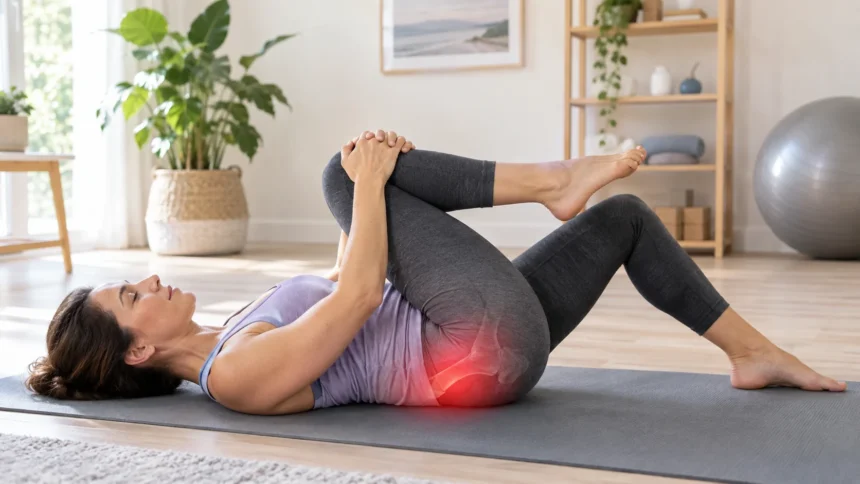
A single-knee-to-chest stretch can gently reduce stiffness around the lower back, glutes, and hips. Lie on your back with both knees bent, then slowly bring one knee toward your chest while keeping the other foot supported. Hold the position comfortably for about 20 to 30 seconds without pulling aggressively or lifting your lower back.
A figure-four stretch may help release tightness around the gluteal and piriformis muscles. Lie on your back, cross one ankle over the opposite thigh, and gently bring the supporting leg toward your body. You should feel a mild stretch through the buttock or outer hip rather than sharp pain around the sacroiliac joint.
Hip flexor stretching can also be useful when prolonged sitting makes the front of the hips feel tight. Move into a gentle half-kneeling position and shift your pelvis slightly forward while keeping your torso upright. Avoid excessive arching through the lower back, and stop if the stretch causes increased pelvic or SI joint pain.
Strengthening Exercises for SI Joint Support
Glute bridges are a simple way to strengthen muscles that help stabilize the pelvis. Lie on your back with your knees bent and feet approximately hip-width apart, then gently tighten your abdomen and raise your hips. Pause briefly before lowering slowly, keeping your pelvis level rather than allowing one side to rotate.
Clamshell exercises target the side glute muscles that help control the pelvis while walking and standing. Lie on your side with your knees bent, keep your feet together, and slowly lift the top knee without rolling your pelvis backward. Use a small range of motion and focus on control instead of trying to lift the knee as high as possible.
Side-lying leg raises can strengthen the hip abductors and improve stability around the pelvis. Keep the top leg straight and slightly behind your body, then slowly lift and lower it while maintaining a steady trunk. Begin with a small number of repetitions and increase gradually if the exercise does not worsen your symptoms.
Core Stability Exercises for SI Joint Pain
A strong, coordinated core can help control unwanted movement around the pelvis without making the lower back rigid. One gentle starting exercise is abdominal bracing. Lie comfortably, breathe normally, and lightly tighten the lower abdominal muscles as though preparing for a soft push against your stomach without holding your breath.
Bird dog exercises add controlled movement while challenging pelvic stability. Begin on your hands and knees, gently engage your abdominal muscles, then extend one leg behind you while keeping your hips level. As control improves, you can extend the opposite arm at the same time, but avoid rotating or arching your lower back.
Dead bug exercises can provide another low-impact way to train trunk control. Lie on your back with your hips and knees bent, lightly engage your core, and slowly lower one heel toward the floor before returning. Move only as far as you can while keeping your back and pelvis comfortably controlled.
How Often Should You Do SI Joint Exercises?
Frequency depends on the type of exercise and how your body responds. Gentle breathing and mobility work may be comfortable enough to perform daily, while strengthening exercises often benefit from recovery time between sessions. Starting with small amounts allows you to judge whether a particular movement helps or aggravates your symptoms.
For strengthening exercises, one or two sets of eight to twelve controlled repetitions may be enough initially. Quality matters more than reaching a high number of repetitions. Stop before fatigue causes your hips, spine, or pelvis to twist, compensate, or move differently from how the exercise is intended.
Progress gradually instead of increasing repetitions, resistance, and exercise difficulty at the same time. Improvement may be seen through easier walking, better tolerance for sitting, fewer painful transitions, or increased confidence during movement. If symptoms steadily worsen after exercise, reduce the intensity and consider getting professional guidance.
Exercises and Movements to Avoid During a Flare-Up
Activities that repeatedly twist the pelvis or load one side heavily may aggravate an irritated SI joint. Deep twisting stretches, aggressive lunges, high-impact jumping, and very heavy lifting may need to be temporarily reduced during a flare-up. That does not mean these activities are permanently harmful, but timing and technique matter.
Long periods of standing with your weight shifted onto one hip can also place uneven stress through the pelvis. Similarly, repeatedly crossing your legs or carrying heavy bags on the same side may increase discomfort for some people. Small everyday habits can matter just as much as formal exercise when symptoms are sensitive.
Avoid forcing stretches simply because an area feels tight. Pain around the SI joint sometimes reflects irritation or poor stability rather than a need for greater flexibility. If a stretch produces sharp pain, tingling, numbness, or symptoms that remain worse afterward, choose a gentler movement instead.
Everyday Relief Tips for Sacroiliac Joint Pain
Short periods of comfortable movement often work better than staying completely still. If sitting increases stiffness, stand up and walk briefly every 30 to 60 minutes when possible. Gentle movement encourages circulation and prevents surrounding muscles from becoming excessively guarded after remaining in one position for too long.
Heat may help when the muscles around the lower back and buttocks feel tense or achy. A warm shower, heating pad, or warm compress can be used for short periods at a comfortable temperature. Some people prefer cold packs after activities that make the area feel irritated, although personal response can vary.
Pay attention to how you lift and carry objects during daily activities. Keep loads close to your body, avoid twisting while carrying something heavy, and turn your whole body instead of rotating only through the spine and pelvis. Dividing heavy loads between both hands may also reduce uneven stress through the SI joints.
Sleeping, Sitting, and Posture Tips for SI Joint Relief
Sleeping on your side with a pillow between your knees can help keep the hips and pelvis more level. If one side is especially painful, some people prefer sleeping on the opposite side, while others feel better lying on their back. A pillow beneath the knees can make back sleeping more comfortable.
When sitting, keep both feet supported and avoid leaning heavily toward one side for long periods. Your chair should provide enough support that you do not constantly brace your lower back muscles. Changing positions regularly is usually more important than trying to maintain one supposedly perfect posture all day.
When getting out of bed, avoid aggressively twisting your upper body while your pelvis remains still. Roll onto your side, move your legs toward the edge of the bed, and use your arms to help push yourself upright. Moving the shoulders and pelvis together may reduce sudden rotational stress through a sensitive SI joint.
When Should You See a Healthcare Professional?
Consider professional evaluation if SI joint pain lasts for several weeks, repeatedly returns, or limits normal activities despite gentle exercise and activity modification. A physical therapist or healthcare provider can assess your hips, spine, pelvis, strength, mobility, and movement patterns. This can help determine whether the sacroiliac joint is actually the main source of symptoms.
You should also seek guidance if exercises consistently make the pain worse rather than producing gradual improvement. Individual treatment may include mobility work, strengthening, movement retraining, manual therapy, or changes to everyday activities. The most appropriate plan depends on what is driving your symptoms rather than using the same exercises for everyone.
Prompt medical attention is important for severe pain after significant trauma, new weakness, numbness around the groin, loss of bladder or bowel control, fever, unexplained weight loss, or difficulty walking. These symptoms can indicate problems that require evaluation beyond routine sacroiliac joint self-care.
Conclusion
Sacroiliac joint pain can make sitting, walking, sleeping, and everyday movement uncomfortable, but gentle exercise may help many people manage symptoms. The most useful approach usually combines controlled stretching with strengthening of the glutes, hips, and core. Exercises should improve movement without creating sharp pain or increasing instability.
Start slowly with movements such as knee-to-chest stretches, figure-four stretches, bridges, clamshells, bird dogs, and controlled core exercises. Focus on technique rather than intensity, and allow your symptoms to guide how quickly you progress. Consistency is usually more valuable than performing a large amount of exercise in one session.
If pain remains persistent or becomes more severe, getting an individualized assessment is important. SI joint symptoms can overlap with hip, lumbar spine, muscular, and pelvic conditions, so an accurate diagnosis can prevent you from treating the wrong problem. Professional guidance can also help you return to normal activities more confidently.
FAQs
What is the best exercise for sacroiliac joint pain?
There is no single best exercise for everyone. Glute bridges, clamshells, gentle hip stretches, bird dogs, and core stability exercises are commonly used to improve pelvic support and movement.
Is walking good for SI joint pain?
Gentle walking can help maintain mobility and prevent stiffness if it does not increase symptoms. Start with shorter walks and gradually increase the distance as your comfort and tolerance improve.
Should I stretch an inflamed SI joint?
Gentle stretches around the hips, glutes, and lower back may feel helpful, but aggressive stretching can worsen irritation. Stop any stretch that produces sharp pain or makes symptoms noticeably worse afterward.
How long does sacroiliac joint pain take to heal?
Recovery time varies depending on the cause, severity, daily activities, and overall health. Mild irritation may improve relatively quickly, while persistent dysfunction may require several weeks or longer of gradual rehabilitation.
Can weak glutes cause SI joint pain?
Weak or poorly coordinated glute muscles can reduce pelvic stability and may contribute to excessive stress around the SI joints. Strengthening them gradually can improve movement control and support during walking and standing.