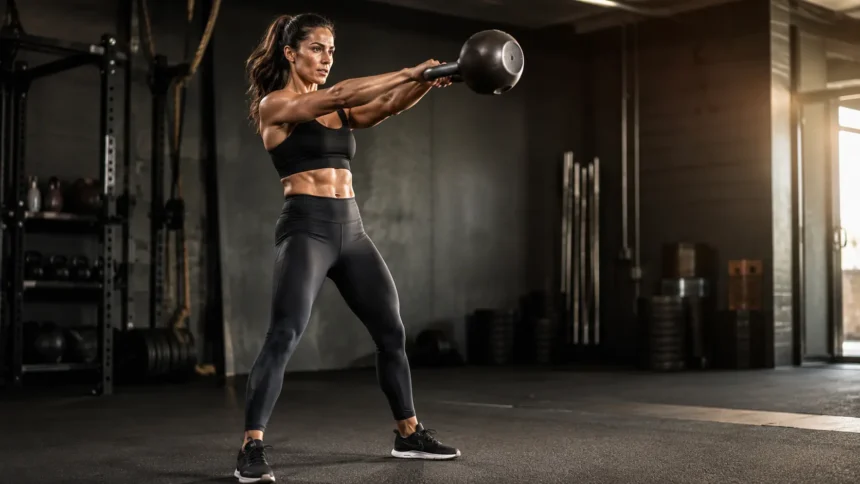
Kettlebell Swings: Build Power, Burn Fat & Get Stronger
The kettlebell swing looks simple: swing a weight between your legs and drive it forward. Done correctly, however, it is a powerful hip-hinge exercise that trains your glutes, hamstrings, core, grip, and upper back while challenging your cardiovascular system. It can fit into strength programs, conditioning workouts, home training, and athletic routines without requiring a large amount of equipment.
What makes kettlebell swings different from many traditional strength exercises is their explosive nature. Instead of slowly lifting the kettlebell with your arms, you use a rapid hip extension to propel the weight forward. This teaches your lower body to produce force quickly and can help develop power that carries over to jumping, sprinting, lifting, and other athletic movements.
Swings are also popular for calorie-burning workouts because repeated sets can raise your heart rate quickly. That does not mean kettlebell swings magically “burn belly fat” or replace nutrition. Fat loss still depends primarily on maintaining an appropriate calorie deficit over time, but swings can increase activity and make conditioning more time-efficient when combined with sensible eating habits.
This guide explains how to do kettlebell swings, which muscles they work, their main benefits, the mistakes that commonly cause poor form, and how many sets and repetitions to use. Whether you are training for strength, fitness, power, or fat loss, learning the hip hinge correctly should always come before chasing heavier weights or faster repetitions.
What Is a Kettlebell Swing?
A kettlebell swing is a dynamic exercise built around the hip-hinge movement pattern. You begin with the kettlebell slightly in front of your feet, hike it backward between your legs, and then forcefully extend your hips. The momentum produced by your glutes and hamstrings sends the kettlebell forward before gravity brings it back into the next repetition.
Unlike a squat, the swing involves relatively little vertical knee movement. Your hips travel backward while your torso leans forward, creating tension through the hamstrings before the hips rapidly drive forward. This difference is important because many beginners mistakenly turn swings into repeated squats, which changes the purpose and mechanics of the exercise.
The arms mainly guide the kettlebell rather than actively lifting it. If your shoulders and biceps are doing most of the work, you are probably missing the explosive hip drive that makes the swing effective. Think of your arms as ropes connecting your torso to the kettlebell while your lower body creates the force.
Most people begin with the two-handed Russian kettlebell swing, in which the bell generally rises to somewhere around chest height. Other versions include one-arm swings, alternating swings, hand-to-hand swings, and American-style overhead swings, but mastering the basic hip-driven variation first gives you the strongest foundation.
What Muscles Do Kettlebell Swings Work?
The gluteus maximus is one of the primary muscles responsible for driving the hips forward during a kettlebell swing. Every repetition requires powerful hip extension, making the glutes central to producing speed and force. Stronger glutes can support many everyday and athletic movements involving standing, running, jumping, and lifting.
Your hamstrings also work hard because they control the hip hinge and help extend the hips as you accelerate the kettlebell. As the bell travels between your legs, the hamstrings lengthen under tension before contributing to the powerful forward drive. This makes swings a useful posterior-chain exercise when performed with proper technique.
The core muscles stabilize your trunk and help prevent excessive rounding or arching of the spine. Your abdominal wall, obliques, and deeper stabilizing muscles must resist the forces created by the moving kettlebell. The upper back also contributes by keeping the shoulders stable as the bell repeatedly travels away from the body.
Forearms and grip muscles work continuously to control the handle, while the shoulders help guide and stabilize the kettlebell. The quadriceps contribute to some degree as well, but swings remain predominantly hip-dominant. Altogether, the exercise trains the posterior chain, core, grip, and cardiovascular system in one coordinated movement.
7 Benefits of Kettlebell Swings
The first major benefit is explosive hip power. Because swings require you to accelerate the kettlebell using forceful hip extension, they train the body to produce force quickly. This quality can support activities such as sprinting, jumping, throwing, and many sports where powerful lower-body movement matters.
Second, kettlebell swings strengthen the posterior chain, particularly the glutes and hamstrings. Third, they challenge core stability as your trunk resists movement created by the swinging weight. Fourth, they can build grip endurance because your hands and forearms repeatedly control a moving kettlebell rather than holding a completely stationary load.
Fifth, swings can provide cardiovascular conditioning when performed in repeated sets with relatively short rest periods. Sixth, the exercise is space-efficient and requires only one kettlebell, making it useful for home workouts. You can create a challenging session without racks, machines, benches, or multiple pieces of gym equipment.
Seventh, swings can increase total training activity and calorie expenditure, which may support a fat-loss program. The important distinction is that the exercise helps you burn energy; it does not selectively remove body fat from one area. Sustainable fat loss still depends on nutrition, total physical activity, recovery, and consistency over time.
How to Do Kettlebell Swings With Proper Form
Place the kettlebell on the floor slightly in front of you with your feet roughly shoulder-width apart. Push your hips backward, keep your spine comfortably neutral, and reach for the handle with both hands. Your knees should bend slightly, but your setup should look more like the beginning of a deadlift than the bottom of a squat.
Tilt the kettlebell toward you and hike it backward between your thighs as though you were passing a football behind yourself. Keep the bell relatively high between the legs rather than letting it drop toward the floor. Your forearms should pass close to your inner thighs while your hips remain pushed backward.
Drive your feet into the floor and rapidly extend your hips by squeezing your glutes. The kettlebell should move forward because of this hip power rather than because you deliberately raise it with your shoulders. Stand tall at the top with your ribs controlled, knees straight but not aggressively locked, and glutes contracted.
Allow the kettlebell to fall naturally before guiding it back between your legs. Do not begin hinging too early; wait until the bell approaches your body, then quickly push your hips backward to absorb the momentum. Continue for controlled repetitions, then guide the bell forward and place it safely on the floor when the set is complete.
The Hip Hinge Is the Secret to a Better Kettlebell Swing
The hip hinge is what separates an effective kettlebell swing from a poorly performed one. During a hinge, your hips travel backward while your knees bend only enough to allow the movement. Your torso leans forward as a unit while your spine remains stable, creating tension primarily through the hamstrings and glutes.
Imagine trying to close a car door behind you using your hips while your hands are full. That backward hip motion is similar to the position you want during the bottom of the swing. Another helpful cue is to imagine reaching your hips toward the wall behind you instead of dropping your hips straight toward the floor.
At the top, reverse that motion forcefully. Drive the hips forward until you stand tall, but avoid leaning backward or pushing your pelvis excessively beyond a neutral standing position. The top of the movement should feel like a strong vertical plank rather than a backbend.
Practicing body-weight hinges or Romanian deadlifts before attempting fast swings can help beginners understand the movement. If you cannot comfortably hinge with control at slow speed, adding a moving kettlebell usually makes technique harder rather than better. Build the movement pattern first, then add speed.
Why You Should Not Lift the Kettlebell With Your Arms
One of the most common mistakes is turning the swing into a front raise. When this happens, the lifter actively pulls the kettlebell upward with the shoulders and arms instead of allowing momentum from the hips to carry it forward. This often causes unnecessary shoulder fatigue and reduces the exercise’s power-training benefits.
During a good swing, your hands hold the handle securely, but your arms remain relatively relaxed. When the hips extend explosively, the kettlebell naturally moves forward and upward. If your hip drive is strong enough, the bell may reach chest height without requiring much deliberate arm lifting.
You can test this by focusing on your glutes rather than the height of the kettlebell. Some repetitions may rise slightly higher or lower depending on the weight and force produced. There is no need to force every swing to reach an exact height if doing so requires pulling with your shoulders.
The kettlebell’s height is a result of the hip drive rather than the goal of the exercise. A powerful, controlled swing reaching below shoulder height is better than a higher swing produced by excessive arm effort. Prioritize movement quality, rhythm, and hip extension before worrying about how impressive the bell’s path looks.
7 Common Kettlebell Swing Mistakes to Avoid
Squatting instead of hinging is one of the most frequent errors. If your knees travel excessively forward and your hips drop straight downward, the movement begins to resemble a squat. Push your hips backward and keep the lower legs relatively stable so the hamstrings and glutes can load properly.
Lifting with the arms is another mistake, followed closely by rounding the back. Your spine should remain controlled as your torso moves with the hip hinge. If your back rounds dramatically at the bottom, the kettlebell may be too heavy, your hinge may be too deep, or your movement pattern may need more practice.
Other common errors include leaning backward at the top, allowing the kettlebell to travel too low between the legs, and swinging faster than you can control. Each mistake can interfere with efficient force production. A good swing should look crisp and repetitive rather than loose, rushed, or unpredictable.
Finally, avoid starting with a weight that is too heavy or too light. Excessive weight can destroy technique, while an extremely light kettlebell may encourage arm lifting because there is not enough resistance to teach a powerful hinge. Choose a manageable load that lets you feel the hips producing the movement.
Kettlebell Swings for Fat Loss: Do They Really Burn Fat?
Kettlebell swings can raise your heart rate quickly because they involve large muscle groups and repeated explosive movements. Performing multiple sets can increase energy expenditure and improve conditioning, particularly when rest periods are controlled. This is one reason swings are frequently included in fat-loss circuits and metabolic workouts.
However, no exercise directly chooses where your body loses fat. Performing hundreds of swings will not specifically burn abdominal fat, hip fat, or thigh fat. Body-fat reduction occurs when your overall energy balance remains negative long enough for the body to use stored energy.
Nutrition therefore remains essential. A person can perform demanding kettlebell workouts and still struggle to lose body fat if calorie intake consistently matches or exceeds expenditure. Conversely, combining regular activity with an appropriate calorie deficit can support gradual weight reduction while allowing exercise to improve strength and fitness.
The best reason to use kettlebell swings for fat loss is that they provide strength and conditioning benefits while contributing to daily activity. Treat them as one part of a broader plan that includes nutritious food, adequate protein, regular movement, resistance training, sufficient sleep, and habits you can maintain.
Kettlebell Swings for Strength and Power
Traditional strength exercises often involve slower repetitions and heavier resistance, while kettlebell swings emphasize speed. This makes swings particularly useful for training power, which is the ability to produce force quickly. Power is important in sports, but it can also support everyday movements that require rapid force production.
The glutes and hamstrings generate most of this power through explosive hip extension. Over time, improving your ability to accelerate an appropriate kettlebell can make the hinge movement feel stronger and more coordinated. Swings can therefore complement deadlifts, squats, lunges, and other conventional strength exercises.
That does not mean kettlebell swings should replace all heavy resistance training. If your primary goal is maximal strength, movements such as deadlifts and squats generally allow much heavier loads and more controlled progression. Swings work well as a power or conditioning exercise alongside those heavier movements.
Think of strength and power as related but distinct qualities. Strength is about how much force you can produce, while power also considers how quickly you produce it. A balanced program can use heavy controlled lifts to develop strength and explosive swings to train the speed component.
How Many Kettlebell Swings Should You Do?
Beginners do not need hundreds of repetitions. Start with small sets that allow you to maintain excellent technique, such as 8 to 15 swings per set. Rest long enough to regain control and repeat the movement cleanly rather than continuing until fatigue causes your hip hinge to disappear.
A practical beginner session might include three to five sets. More experienced trainees may perform sets of 10 to 20 repetitions or use structured intervals, depending on the kettlebell weight and training goal. Total volume should reflect your conditioning, recovery, and the other exercises in your program.
For power development, shorter sets can be especially useful because explosive output usually decreases as fatigue increases. Ten powerful swings performed with crisp technique may provide a better power stimulus than 40 increasingly slow repetitions performed without adequate rest.
For conditioning, somewhat higher total volume can make sense, but build gradually. Your grip, hamstrings, lower back, and cardiovascular system all need time to adapt. Quality should remain the limiting factor; stop or rest when the movement becomes noticeably slower, uncontrolled, or technically inconsistent.
How Heavy Should Your Kettlebell Be?
The ideal kettlebell weight depends on your strength, training background, and experience with hip-hinge movements. A beginner should choose a bell that feels substantial enough to encourage hip drive but light enough to maintain a stable spine and controlled rhythm throughout every repetition.
People often assume that the lightest available kettlebell is automatically safest. Surprisingly, an extremely light bell can make it easy to muscle the movement with your arms instead of learning to use your hips. The right weight should provide enough feedback that you naturally feel the glutes and hamstrings generating momentum.
At the other extreme, a kettlebell is too heavy if you cannot hike it safely, your back rounds, your shoulders are pulled out of position, or you struggle to stop the bell at the end of a set. Losing control is not evidence that the workout is more effective.
Increase resistance only after your technique is consistent. You should be able to perform multiple sets with a repeatable hinge, strong lockout, stable grip, and controlled breathing. Progressive overload matters, but adding weight is useful only when the movement remains technically sound.
Russian vs. American Kettlebell Swings
The Russian kettlebell swing generally finishes with the kettlebell somewhere around chest or shoulder height. The bell reaches that position through hip-generated momentum, and the lifter then allows it to return into the next hinge. This version is often the easiest variation for emphasizing explosive hip extension.
The American kettlebell swing continues overhead until the arms finish closer to vertical. This creates a greater range of motion and requires additional shoulder mobility and control. It is commonly associated with certain functional fitness programs but is not necessary for gaining the basic benefits of kettlebell swings.
Going overhead does not automatically make the exercise superior. If reaching the top position requires excessive spinal extension, shoulder compensation, or active arm lifting, a Russian-style swing may be the more appropriate option. Exercise selection should reflect your mobility, training goals, and movement quality.
For most people learning kettlebell technique, mastering a powerful chest-height swing first is sensible. Once you can hinge, accelerate, stabilize, and control the kettlebell consistently, you can decide whether other variations provide a useful reason to expand the range of motion.
Kettlebell Swings vs. Deadlifts
Both kettlebell swings and deadlifts use a hip hinge and train many of the same posterior-chain muscles. The major difference is speed. Deadlifts are typically performed under greater resistance with controlled acceleration, while swings use a lighter load moved explosively through repeated cycles.
Deadlifts are generally better suited to developing maximal strength because you can progressively lift much heavier loads. Swings place greater emphasis on power, rhythm, and conditioning. This makes the two exercises complementary rather than competing choices.
Learning a kettlebell deadlift before swinging can also help beginners develop a stable hinge. The slow movement provides more time to understand hip position, spinal control, and foot pressure without simultaneously controlling momentum.
A well-designed program may include both. You might perform deadlifts earlier in a strength workout when you are fresh, followed by kettlebell swings as an explosive accessory or conditioning movement. The exact order depends on whether strength, power, or conditioning receives the highest priority.
Kettlebell Swings vs. Squats
Squats and swings both train the lower body, but their mechanics differ significantly. A squat involves deeper knee and hip flexion as the body moves downward, making the quadriceps major contributors alongside the glutes and other muscles.
A swing is a hip-dominant hinge. The hips travel backward rather than mostly downward, the shins remain more vertical, and the hamstrings experience greater loading. This makes the posterior chain more central to the exercise.
Because these patterns are different, doing kettlebell swings does not eliminate the need for squats. Squats provide valuable knee-dominant strength, while swings build explosive hip-extension ability. Training both can create a more balanced lower-body routine.
If your swings repeatedly look like squats, however, you may not be receiving the intended hinge stimulus. Practice Romanian deadlifts, wall hinges, or kettlebell deadlifts until you can clearly feel the difference between sitting downward and pushing the hips backward.
How to Breathe During Kettlebell Swings
Breathing should support trunk stability rather than becoming an afterthought. Many lifters use a short, forceful exhale near the top of the swing as the hips lock out. This can help coordinate breathing with the explosive phase of the movement.
As the kettlebell returns and you hinge, inhale while maintaining abdominal control. Avoid completely relaxing your torso simply because you are breathing in. Your trunk still needs enough tension to remain stable as the kettlebell changes direction.
During longer conditioning sets, breathing becomes increasingly important because holding your breath excessively can make fatigue arrive quickly. Aim for a repeatable rhythm that matches your movement instead of gasping unpredictably between repetitions.
If you become too breathless to maintain a stable hinge, end the set or take additional rest. Conditioning improves gradually, and there is little benefit in continuing simply to reach an arbitrary repetition target while your form deteriorates.
How Often Should You Do Kettlebell Swings?
For many recreational trainees, two or three kettlebell swing sessions per week can provide plenty of practice and conditioning. Beginners may need less volume while they learn the movement, particularly if their program already contains deadlifts, Romanian deadlifts, squats, and other demanding lower-body exercises.
Recovery depends on much more than the number of swing sessions. Kettlebell weight, total repetitions, set intensity, training experience, sleep, nutrition, and the rest of your workout program all determine how much stress your body receives.
You can also vary the purpose across sessions. One day might use heavier kettlebell swings in short explosive sets, while another uses a moderate bell for conditioning intervals. Changing the emphasis can prevent every workout from becoming the same repetitive high-fatigue session.
Daily swings are not automatically necessary or superior. Your glutes, hamstrings, grip, and back still need recovery after demanding training. More frequency only helps when you can maintain good technique, recover between sessions, and continue progressing without persistent soreness or declining performance.
How to Add Kettlebell Swings to Your Workout
If power is the primary goal, perform kettlebell swings relatively early in your workout after warming up. Explosive exercises are usually more productive when you are fresh enough to move quickly. Use short sets with full control and adequate rest rather than turning every power session into conditioning.
If conditioning is your goal, swings can appear later in the session after your main strength work. For example, you might perform squats and presses first, then finish with several rounds of kettlebell swings and walking or another simple conditioning exercise.
Swings can also be used in full-body circuits. Pairing them with exercises such as push-ups, rows, carries, or body-weight movements can create a compact workout. Avoid combining too many exercises that heavily fatigue the lower back or hamstrings within the same circuit.
Whatever format you choose, progression should remain measurable. You might gradually add repetitions, increase the kettlebell weight, add another set, or perform the same workload with better technique. Progress does not require making every workout longer and more exhausting.
Are Kettlebell Swings Safe for Your Back?
A correctly performed kettlebell swing is designed to produce movement primarily at the hips while the spine remains stable. The glutes and hamstrings absorb and generate force, while the core helps maintain trunk position. Good technique therefore differs significantly from repeatedly bending and extending through the lower back.
Problems often occur when lifters round their spine during the downswing or aggressively lean backward at the top. Both mistakes substitute spinal movement for hip movement. Reducing the kettlebell weight and practicing the hinge slowly can help correct these patterns.
Fatigue can also change technique. Even someone who begins a set with excellent form may start rounding or losing timing after too many repetitions. This is another reason quality sets are generally preferable to performing huge numbers of swings simply for a calorie target.
Sharp, radiating, or persistent back pain is not something to train through. If swings consistently cause pain despite reducing the weight and reviewing technique, stop the exercise and seek appropriate professional assessment, especially if symptoms include numbness, weakness, or pain traveling into the leg.
Who Should Be Careful With Kettlebell Swings?
Beginners with no experience performing hip hinges should spend time learning the movement before attempting fast, high-repetition swings. Working with a qualified coach can be particularly useful because timing errors become harder to recognize when the kettlebell begins moving quickly.
People recovering from significant back, hip, shoulder, or hamstring injuries should follow guidance from an appropriate healthcare or rehabilitation professional. Whether swings are suitable depends on the injury, stage of recovery, symptoms, and individual movement capacity rather than the exercise being universally “good” or “bad.”
Pregnancy can also change exercise considerations as the body and balance change over time. Someone who trained with kettlebells before pregnancy may receive different guidance from someone beginning an unfamiliar high-speed exercise during pregnancy. Individualized professional advice is the safer approach.
Anyone with significant cardiovascular or other medical concerns should similarly follow appropriate exercise guidance. Kettlebell conditioning can raise heart rate rapidly, so intensity should match your current health and fitness rather than what another person performs online.
The Bottom Line on Kettlebell Swings
Kettlebell swings are a powerful exercise for training explosive hip extension, the posterior chain, grip, core stability, and cardiovascular conditioning. Their combination of strength and speed makes them different from slower exercises such as deadlifts while still reinforcing an important hip-hinge movement pattern.
Good technique begins with the hips. Push them backward, keep your spine controlled, hike the kettlebell between your thighs, and drive forward using your glutes. Allow the bell to float because of momentum rather than pulling it upward with your arms.
Swings can also support a fat-loss program by increasing physical activity and energy expenditure, but they are not a shortcut around nutrition. Sustainable fat loss still depends on overall calorie balance, food quality, activity, sleep, and consistent habits.
Start with manageable sets, choose a kettlebell you can control, and increase the challenge gradually. When performed with strong technique and sensible programming, kettlebell swings can help you build power, strengthen your glutes and hamstrings, improve conditioning, and become a more capable lifter.
Frequently Asked Questions
Are kettlebell swings good for losing belly fat?
Kettlebell swings can burn calories and support a fat-loss program, but they cannot specifically target belly fat. Overall fat loss requires a sustained calorie deficit over time.
How many kettlebell swings should a beginner do?
Start with roughly 3–5 sets of 8–15 controlled repetitions. Stop the set when your hip hinge, spinal position, or rhythm begins to deteriorate.
Do kettlebell swings build muscle?
Yes, they can strengthen and develop the glutes, hamstrings, core, grip, and upper back. For maximal muscle growth, combine swings with progressive resistance exercises such as squats and deadlifts.
Should kettlebell swings feel like squats?
No. A kettlebell swing is primarily a hip hinge. Your hips should travel backward while your knees bend moderately rather than dropping deeply as they would during a squat.
Can I do kettlebell swings every day?
Some experienced trainees can tolerate frequent practice, but daily swings are unnecessary for most people. Two or three well-planned sessions per week can provide plenty of strength and conditioning work.