Cloud Kitchen vs Ghost Kitchen: What’s the Difference?
The restaurant industry is no longer built entirely around dining rooms, waitstaff, and expensive storefronts. Online ordering and food delivery have created new restaurant business models that allow entrepreneurs to prepare meals professionally without operating a traditional dine-in location. Two terms you will frequently encounter in this space are cloud kitchen and ghost kitchen, and they are often used as though they mean exactly the same thing.
In everyday conversation, cloud kitchens and ghost kitchens usually describe restaurants that primarily prepare food for delivery instead of serving customers inside a dining room. Orders typically arrive through a restaurant website, mobile ordering system, or third-party delivery platforms. Because these businesses remove many front-of-house expenses, they can provide restaurant owners with a potentially leaner way to enter new markets.
However, the terms can carry slightly different meanings depending on the restaurant operator, market, and business setup. A cloud kitchen frequently refers to the broader kitchen infrastructure where one or several food brands prepare delivery orders, while a ghost kitchen can describe an individual delivery-only restaurant brand operating from such a facility. Understanding this distinction makes comparing the two models much easier.
If you are thinking about starting a delivery-only restaurant, expanding an existing brand, or simply trying to understand how modern food businesses operate, knowing the difference matters. This guide breaks down cloud kitchen vs ghost kitchen, including how each model works, startup costs, operating structures, advantages, limitations, and which option may make more sense for different restaurant businesses.
What Is a Cloud Kitchen?
A cloud kitchen is a commercial food preparation facility designed primarily for fulfilling online food orders. Unlike a traditional restaurant, it generally does not need a dining room where customers sit and eat. Customers discover the available food brands digitally, place an order online, and receive their meals through delivery drivers or, depending on the operation, pickup services.
Cloud kitchens may contain one kitchen or several separate cooking spaces rented by different restaurant businesses. For example, one facility could accommodate a burger company, a pizza brand, a healthy meal business, and a dessert brand at the same time. Each operator can prepare its own menu while sharing certain infrastructure such as utilities, storage areas, loading zones, and delivery pickup areas.
This model is sometimes called a virtual kitchen, shared kitchen, delivery kitchen, dark kitchen, or commissary kitchen, although these terms can describe slightly different arrangements. A shared commercial kitchen, for example, may serve caterers and food manufacturers as well as delivery restaurants. A cloud kitchen is usually more directly associated with digital ordering and delivery-focused restaurant operations.
For entrepreneurs, the appeal comes largely from avoiding some of the costs associated with prime restaurant real estate and customer-facing spaces. Instead of investing heavily in furniture, dining-room décor, servers, and large storefronts, operators can concentrate resources on food quality, kitchen efficiency, digital marketing, packaging, and delivery operations.
What Is a Ghost Kitchen?
A ghost kitchen generally refers to a restaurant operation that produces food primarily or entirely for delivery without maintaining a conventional dining room. Customers may see the restaurant on delivery apps or search engines but never visit a physical restaurant location. Behind the digital storefront, meals are prepared in a licensed commercial cooking facility and handed to delivery drivers.
Some ghost kitchens operate independently from their own dedicated kitchen spaces, while others rent space inside larger shared kitchen facilities. Traditional restaurants may also launch ghost kitchen brands using their existing kitchens. For instance, an Italian restaurant could operate a separate virtual chicken-wing brand from the same equipment during slower operating hours.
The word “ghost” reflects the fact that the customer-facing restaurant exists primarily in the digital environment. Customers interact with the menu, branding, reviews, ordering system, and delivery experience rather than a traditional dining room. This makes brand identity, food photography, online visibility, customer ratings, packaging, and menu presentation especially important.
Ghost kitchens can give food entrepreneurs an opportunity to test concepts without immediately committing to a full-service restaurant. Instead of spending heavily on a storefront before knowing whether customers want the concept, operators can introduce a menu online, analyze ordering patterns, refine products, and potentially expand if demand becomes strong enough.
Cloud Kitchen vs Ghost Kitchen: The Main Difference
The biggest difference between a cloud kitchen and a ghost kitchen is often infrastructure versus restaurant concept. A cloud kitchen can describe the physical kitchen facility or operating environment where delivery-focused restaurants prepare food. A ghost kitchen more commonly describes the actual delivery-only restaurant business or virtual food brand operating from that space.
Imagine a commercial building containing ten rentable kitchen units. The overall facility could be called a cloud kitchen. Inside one of those units, an entrepreneur might operate a delivery-only fried chicken restaurant. That restaurant could be described as a ghost kitchen brand. Several different ghost or virtual restaurant concepts could therefore operate inside the same cloud kitchen facility.
In practice, however, restaurant operators, media publications, delivery platforms, and customers frequently use the two terms interchangeably. Someone saying they are launching a cloud kitchen may simply mean that they are opening a delivery-only restaurant. Similarly, another operator might call exactly the same setup a ghost kitchen without intending any technical distinction.
For that reason, the physical setup matters more than terminology when evaluating a business opportunity. Ask whether the operator owns or rents the kitchen, whether several brands share equipment, whether customers can pick up orders, how deliveries are handled, and whether multiple virtual restaurants operate from the same location. These details reveal far more than the label itself.
How Cloud Kitchens Work
Cloud kitchens typically begin with a professionally equipped commercial facility in an area where delivery demand is strong. Instead of paying premium rent for a highly visible restaurant storefront, the kitchen may be positioned in a less expensive commercial or industrial location. The facility still needs appropriate access for suppliers, employees, delivery drivers, and food storage operations.
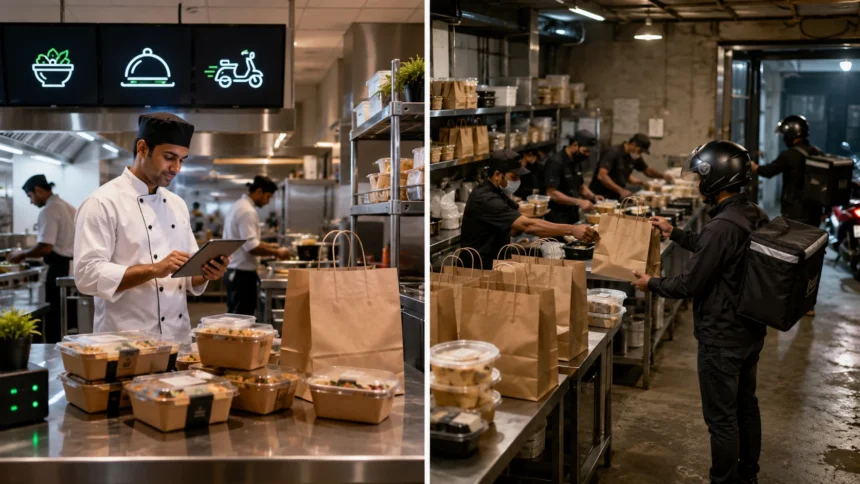
Restaurant brands operating from the location usually receive orders digitally. Customers might order directly through the restaurant’s website or through food delivery apps. Once an order enters the kitchen’s point-of-sale or order-management system, kitchen staff prepare the meal, package it appropriately, and place it in a designated collection area for pickup by a delivery driver.
Some cloud kitchen operators simply rent kitchen space to restaurant businesses, while others provide additional technology, logistics, storage, equipment, or operational support. The arrangement can resemble flexible office rental, except the tenants receive commercial cooking facilities rather than desks. Depending on the agreement, operators may pay monthly rent, usage fees, service charges, or other operating expenses.
The model can also make expansion more flexible. An established restaurant that wants to reach customers in another part of a city might rent cloud kitchen space rather than opening another complete restaurant. If the new delivery area performs strongly, the brand can maintain or expand operations; if demand is weak, exiting may be easier than closing a heavily developed traditional location.
How Ghost Kitchens Work
A ghost kitchen begins with a food concept created specifically or primarily for delivery customers. The operator develops a brand, menu, pricing strategy, packaging system, digital storefront, and production process without necessarily creating a customer-facing restaurant. The objective is to build a restaurant experience that works effectively from online discovery through final delivery.
Orders normally arrive electronically, which means digital visibility plays a central role in sales. Customers may discover the business through search results, social media, restaurant websites, or third-party delivery apps. Attractive food images, clear descriptions, good reviews, competitive pricing, and convenient delivery times can strongly influence whether someone chooses one virtual restaurant over another.
Once customers order, the kitchen follows many of the same food preparation standards as a conventional restaurant. The major operational difference is that the final meal must survive transportation. Ghost kitchen menus therefore often favor dishes that remain attractive, safe, and enjoyable after spending time inside delivery packaging rather than being consumed immediately after leaving the kitchen.
Successful operators also monitor digital performance closely. They may analyze bestselling dishes, average order value, preparation times, customer reviews, repeat purchase rates, delivery distances, food costs, and promotional performance. Because the business is largely digital, operators can sometimes adjust menus or launch new concepts faster than restaurants built around a fixed physical dining experience.
Cloud Kitchen and Ghost Kitchen Business Models
One common cloud kitchen model involves shared kitchen rentals. A company develops a commercial kitchen facility and divides it into workspaces that food businesses can rent. Restaurant operators receive access to necessary kitchen infrastructure while avoiding the substantial upfront expense of building a fully equipped commercial kitchen from an empty property.
Another model involves an established restaurant using a secondary kitchen exclusively for delivery orders. This can prevent delivery demand from overwhelming the kitchen of the main restaurant. Separating dine-in and online orders may improve preparation times while allowing the business to serve more customers without increasing dining-room capacity.
Ghost kitchen operators may also run several virtual food brands from the same cooking facility. A single kitchen, for instance, might produce burgers under one brand, chicken sandwiches under another, and loaded fries under a third. Carefully designed menus can allow these concepts to share ingredients and kitchen equipment while being marketed to different customer groups.
Traditional restaurants can participate as well by creating virtual brands within their existing locations. If a restaurant has unused kitchen capacity during certain hours, it could launch a delivery-focused concept using compatible ingredients and equipment. This approach can create an additional revenue stream, although operators must make sure the extra orders do not disrupt their primary restaurant operation.
Startup Costs: Cloud Kitchen vs Ghost Kitchen
Startup costs vary dramatically because neither cloud kitchens nor ghost kitchens follow a single standardized format. Renting an already equipped kitchen can require considerably less initial capital than constructing a full restaurant. However, entrepreneurs still need to budget for deposits, permits, licenses, kitchen equipment, technology, inventory, staff, packaging, insurance, and marketing.
Cloud kitchen rental arrangements can reduce the amount of money spent on construction and customer-facing improvements. Traditional restaurants frequently invest substantially in seating, interior design, exterior signage, restrooms, furniture, and prime real estate. Delivery kitchens can potentially eliminate or reduce many of these costs because customers usually never enter the production space.
A ghost kitchen can be inexpensive to launch when the operator already owns restaurant equipment or shares kitchen facilities. Costs can increase quickly, however, if specialized equipment, extensive staffing, expensive ingredients, multiple delivery platforms, or aggressive advertising campaigns are required. A delivery-only concept should therefore never be assumed to be automatically cheap or highly profitable.
Entrepreneurs should calculate the complete unit economics before launching. Food cost, labor, rent, utilities, packaging, delivery commissions, payment processing, discounts, refunds, advertising, and waste can collectively absorb a significant percentage of revenue. Lower startup costs provide an advantage only when the restaurant can consistently generate enough profitable orders to sustain operations.
Benefits of Cloud Kitchens
One of the strongest benefits of cloud kitchens is potentially lower occupancy costs. Because operators do not necessarily need a prominent high-traffic storefront, they may locate kitchens in less expensive areas that still provide convenient access to target delivery neighborhoods. Saving on premium restaurant real estate can free capital for kitchen operations, marketing, technology, and product development.
Cloud kitchens can also make geographical expansion more practical. Instead of opening another full restaurant every time a brand enters a new neighborhood, a business can potentially rent commercial kitchen space in the target area. This allows restaurant owners to test local demand before making a substantially larger investment in a traditional location.
The model can provide additional flexibility for menu experimentation. Operators can introduce new dishes, delivery-only menus, or even separate virtual food brands without redesigning a dining room. Digital ordering data can reveal which meals sell successfully, helping restaurant businesses refine their offerings according to actual customer purchasing patterns rather than assumptions.
Another advantage is operational focus. Without table service, dining-room management, reservations, and front-of-house responsibilities, a delivery kitchen can concentrate heavily on production speed and order accuracy. However, successful businesses must redirect some of that attention toward packaging, online customer service, delivery coordination, and digital marketing because those factors become central to the customer experience.
Benefits of Ghost Kitchens
Ghost kitchens can give entrepreneurs a relatively flexible route into the restaurant market. Launching a traditional restaurant often requires a substantial upfront commitment before the first customer arrives. A virtual restaurant concept may allow owners to begin with a narrower menu and smaller operational footprint, reducing the amount of infrastructure required to test an idea.
They can also allow restaurant companies to create brands for highly specific customer segments. One kitchen could operate separate concepts targeting healthy lunches, late-night comfort food, family meal bundles, or premium desserts. Different digital storefronts make it possible to position each menu around a particular customer need without creating several physical dining locations.
Delivery-only concepts can also adapt quickly to purchasing behavior. If a particular menu category consistently performs poorly, the operator can replace or redesign it relatively quickly. Similarly, popular dishes can be promoted more prominently through online menus, bundled offers, and direct marketing campaigns, allowing businesses to respond to sales data faster.
For existing restaurants, ghost brands may help utilize excess kitchen capacity. Equipment and staff that are underused during slower periods can potentially produce additional delivery orders. The strategy works best when the virtual menu shares ingredients and cooking processes with the primary restaurant, helping prevent unnecessary inventory complexity and operational disruption.
Challenges of Cloud Kitchens
Cloud kitchens may reduce certain restaurant expenses, but they create different challenges. One major issue is limited physical visibility. A traditional restaurant can attract people simply because they walk past the storefront, notice a busy dining room, or see signage. A delivery-only business must generate much of its customer awareness through online channels where competition can be intense.
Third-party delivery fees can also put pressure on restaurant margins. Although delivery apps can provide access to large customer audiences, platform commissions, advertising costs, discounts, and promotional programs may reduce profitability. Operators need to understand exactly how much money remains after every expense rather than focusing only on gross order revenue.
Shared facilities can introduce operational complications as well. Delivery drivers arriving simultaneously, limited storage areas, kitchen scheduling issues, equipment availability, ventilation requirements, and supplier deliveries can become difficult when several brands share a single location. Clear management systems are essential to prevent congestion from damaging food quality or delivery speed.
Customer loyalty may also be more difficult to establish when the platform controls much of the ordering relationship. If customers remember the delivery app more strongly than the restaurant brand, repeat business can become dependent on continued visibility inside that marketplace. Building direct ordering channels and recognizable brand identity can therefore become an important long-term strategy.
Challenges of Ghost Kitchens
Ghost kitchens face an especially difficult branding challenge because customers cannot physically experience the restaurant environment. There is no dining-room atmosphere, server interaction, open kitchen, décor, or storefront to communicate the brand personality. Packaging, photography, menu descriptions, social media, customer service, and food quality must perform much of that branding work instead.
The business can also become overly dependent on delivery platforms. A restaurant may initially receive substantial visibility through an app, but ranking positions and promotional opportunities can change. If customer acquisition depends heavily on paid promotions or platform discounts, the cost of generating every new order may make profitability increasingly difficult.
Food quality during transportation is another concern. A dish that tastes exceptional immediately after preparation may become soggy, cold, separated, or damaged during a long delivery journey. Ghost kitchen operators need to design menus around travel performance and test packaging under realistic delivery conditions rather than judging food only at the kitchen counter.
Running several virtual restaurants from one kitchen can also create unnecessary complexity. Multiple menus mean additional ingredients, preparation procedures, packaging materials, digital listings, promotions, and quality-control requirements. Launching more brands does not automatically generate more profit; sometimes one focused food concept with strong customer retention is more sustainable than several weak virtual brands.
Cloud Kitchen vs Ghost Kitchen vs Traditional Restaurant
A traditional restaurant is designed around both food production and an in-person customer experience. Location, interior design, seating, service quality, music, lighting, and atmosphere contribute to how guests perceive the restaurant. Cloud and ghost kitchens remove most of those customer-facing elements and concentrate primarily on production and digital ordering.
Traditional restaurants can benefit from walk-in customers and local visibility that delivery-only businesses may struggle to achieve. They can also develop emotional connections through hospitality and physical experiences. At the same time, dine-in restaurants typically carry additional costs involving front-of-house employees, furniture, larger premises, maintenance, utilities, and customer facilities.
Cloud kitchens sacrifice physical interaction in exchange for potentially greater location flexibility and reduced front-of-house overhead. Their success depends heavily on production efficiency, delivery coverage, online marketing, and operational economics. They can perform particularly well when customers already have strong habits around ordering meals digitally.
Neither approach is automatically superior. A neighborhood fine-dining concept may need a physical location because atmosphere is central to its value proposition, while a late-night burger concept may perform extremely well through delivery. Restaurant owners should choose the model that matches customer expectations, menu characteristics, available capital, and long-term brand strategy.
Is a Virtual Kitchen the Same as a Ghost Kitchen?
A virtual kitchen is another term commonly associated with ghost kitchens and cloud kitchens. It usually describes a restaurant concept built primarily around online ordering rather than a conventional dining room. Like a ghost kitchen, customers often interact with the brand digitally and receive their food through pickup or delivery instead of eating at the preparation location.
However, “virtual restaurant” can sometimes describe a brand without describing the physical kitchen itself. A virtual restaurant might operate from an existing traditional restaurant, a shared commercial facility, or its own dedicated delivery kitchen. The virtual element refers primarily to the customer-facing restaurant concept rather than necessarily specifying where food is prepared.
This distinction becomes important when researching kitchen rental opportunities. A virtual brand may need physical cloud kitchen space, while a restaurant with unused kitchen capacity may already have everything needed to launch a virtual concept. Entrepreneurs should therefore separate the question of where the food will be prepared from how the restaurant will be marketed to customers.
In practical terms, ghost kitchen, virtual kitchen, delivery-only restaurant, and cloud kitchen frequently overlap. Rather than becoming overly focused on terminology, entrepreneurs should examine kitchen ownership, licensing, order channels, delivery logistics, customer acquisition, operating costs, and profitability. Those factors determine whether the business works far more than the name assigned to the model.
How Delivery Apps Fit Into Both Models
Food delivery platforms have played an important role in making cloud kitchens and ghost kitchens practical for many businesses. They provide digital storefronts where restaurants can display menus, photos, prices, ratings, and delivery information. For a new food business without an established customer base, that visibility can provide access to potential customers relatively quickly.
The tradeoff is that marketplace access generally comes at a cost. Delivery commissions, sponsored placement, discounts, and other platform expenses can affect restaurant margins. A business generating impressive revenue through delivery platforms may still struggle financially if its food, labor, packaging, advertising, and delivery-related expenses leave too little profit per order.
Many operators therefore combine third-party marketplaces with direct ordering. Delivery apps can help customers discover the restaurant, while an owned website, email database, loyalty program, or direct ordering channel can strengthen the brand’s customer relationship. The appropriate mix depends on delivery capabilities, customer behavior, technology costs, and local market conditions.
Restaurant owners should also avoid building financial forecasts based solely on marketplace order volume. The most important measurement is contribution margin: how much each order contributes after the variable costs needed to produce and fulfill it. Understanding this number makes it easier to determine which platforms, menu items, promotions, and delivery zones actually support sustainable growth.
Can One Kitchen Operate Multiple Ghost Brands?
Yes, one commercial kitchen can operate several ghost brands, and this model is sometimes referred to as a multi-brand virtual kitchen. Instead of selling every dish under a single restaurant identity, an operator develops separate online concepts designed around different cuisine categories, price ranges, occasions, or customer preferences.
The strategy becomes more efficient when the brands share core ingredients and equipment. For example, one kitchen could use the same chicken, sauces, vegetables, fryers, and preparation stations across a chicken sandwich concept, loaded fries brand, and late-night snack menu. Ingredient overlap can help limit waste and simplify inventory management.
Problems emerge when operators launch too many unrelated menus. Producing sushi, pizza, burgers, salads, desserts, and Mexican food from the same small operation could require completely different ingredients, skills, storage systems, and equipment. Increased complexity may lead to slower preparation, inconsistent food quality, inventory waste, and frustrated kitchen employees.
A better approach is usually to treat each brand as a genuine business rather than simply uploading another delivery-app listing. The concept should have clear positioning, a focused menu, reliable production processes, attractive branding, and sufficient customer demand. Multiple brands create value only when the additional revenue outweighs the complexity they introduce.
Which Model Is Better for a New Restaurant Business?
For a first-time restaurant entrepreneur, a delivery-focused model may provide an opportunity to test demand with less commitment than a large dine-in restaurant. Renting an existing licensed commercial kitchen can reduce construction requirements, while a focused ghost restaurant allows the entrepreneur to test whether customers actually order the menu before investing in a major physical location.
However, lower barriers to entry also mean more competitors can enter the same market. A new burger, pizza, chicken, or dessert brand can easily become one of dozens of similar choices on delivery apps. Entrepreneurs therefore need a strong value proposition instead of assuming that simply listing a menu online will generate consistent orders.
The menu should also influence the decision. Foods that maintain quality during delivery are usually better suited to a ghost kitchen than dishes that rely heavily on immediate presentation or tableside service. Testing food after 20, 30, or even 40 minutes inside delivery packaging can reveal whether the concept truly works outside a restaurant dining room.
New operators should ultimately build their decision around economics rather than trends. Estimate realistic order volume, average order value, food costs, labor, kitchen rent, delivery charges, packaging, marketing, and other expenses. A simple concept with strong margins and repeat customers can outperform a fashionable delivery operation built around unrealistic sales assumptions.
How to Choose Between a Cloud Kitchen and Ghost Kitchen Setup
Start by deciding whether you primarily need kitchen infrastructure or a restaurant concept. If you already have a brand but need affordable production space in another delivery area, renting a cloud kitchen may be the main decision. If you already have a kitchen but want to create an additional delivery-only brand, launching a ghost kitchen concept may be more relevant.
Next, study where potential customers live and how far food can travel while maintaining quality. Delivery radius matters because longer trips can increase wait times and reduce product quality. A seemingly inexpensive kitchen may be poor value if it is too far from the customers most likely to order your food.
You should also examine the rental agreement carefully. Understand what equipment, utilities, refrigeration, storage, cleaning, waste disposal, security, maintenance, and technology are included. Ask how delivery drivers collect orders and whether other tenants compete for the same pickup areas during busy periods.
Finally, calculate whether the concept remains profitable after realistic costs. Do not rely entirely on optimistic order forecasts. Model conservative, expected, and strong sales scenarios to understand how changes in order volume affect profitability. The right kitchen setup is one that supports efficient operations while giving the brand enough financial room to attract and retain customers.
Cloud Kitchen vs Ghost Kitchen: Which One Should You Choose?
Choosing between a cloud kitchen and ghost kitchen is slightly misleading because the two models are not necessarily competitors. A cloud kitchen can provide the physical infrastructure where a ghost kitchen brand operates. In many cases, entrepreneurs effectively use both models at the same time: they rent cloud kitchen space and operate a delivery-only restaurant from it.
If you are an established restaurant looking to expand delivery coverage, cloud kitchen space may allow you to enter new neighborhoods without constructing another full-service location. If your goal is to experiment with an entirely new digital restaurant concept, a ghost kitchen brand can provide a flexible way to test the idea.
Restaurant owners with existing kitchens may not need a separate cloud kitchen at all. They could potentially launch a ghost brand from their current facility if licensing, capacity, workflow, and local regulations allow it. Conversely, entrepreneurs without commercial kitchen access may need a cloud kitchen before their delivery-only restaurant can begin operating.
The most important question is therefore not simply cloud kitchen vs ghost kitchen. Instead, ask what combination of kitchen space, brand positioning, delivery technology, menu design, marketing, and customer acquisition will produce sustainable profit. When those elements work together, delivery-focused restaurant models can become powerful tools for launching and expanding food businesses.
The Future of Cloud Kitchens and Ghost Kitchens
Delivery-focused restaurants are likely to remain part of the broader restaurant ecosystem because digital ordering has become an established way for customers to purchase food. However, the industry is becoming more disciplined. Simply opening multiple virtual brands is no longer enough; successful businesses need reliable food quality, differentiated concepts, efficient operations, and sustainable customer acquisition.
Direct customer relationships are also becoming increasingly valuable. Delivery marketplaces remain useful discovery channels, but restaurant brands benefit when customers remember who prepared their food rather than only remembering the app used to order it. Strong packaging, recognizable branding, loyalty incentives, and consistent product quality can help create that connection.
Technology will continue supporting these operations through integrated order management, kitchen display systems, customer data, inventory tracking, menu optimization, and delivery logistics. Nevertheless, technology cannot compensate for weak restaurant fundamentals. Customers still expect food to taste good, arrive correctly, provide reasonable value, and deliver a consistent experience.
Ultimately, cloud kitchens and ghost kitchens should be viewed as tools rather than guaranteed shortcuts to restaurant success. Their flexible structures can reduce certain barriers and help businesses test markets more efficiently, but profitability still depends on thoughtful menu engineering, disciplined cost control, smart marketing, operational excellence, and genuine customer demand.
Final Thoughts
The difference between cloud kitchens and ghost kitchens becomes much easier to understand once you separate the physical kitchen from the restaurant brand. A cloud kitchen generally describes delivery-focused cooking infrastructure, while a ghost kitchen generally describes the delivery-only restaurant concept operating from that infrastructure. In everyday restaurant conversations, however, the terms are often used interchangeably.
Both models remove many customer-facing elements associated with traditional restaurants. Instead of focusing on dining-room design and table service, operators concentrate on online ordering, cooking efficiency, packaging, delivery performance, digital visibility, and customer reviews. That shift can lower certain costs while creating completely different marketing and operational challenges.
Entrepreneurs considering either approach should resist the temptation to focus only on low startup costs. Kitchen rent, labor, ingredients, packaging, delivery commissions, promotions, refunds, utilities, technology, and customer acquisition all influence profitability. Accurate financial modeling is just as important in a delivery-only operation as it is in a conventional restaurant.
The best model ultimately depends on your menu, market, capital, operational experience, and growth strategy. Whether you call it a cloud kitchen, ghost kitchen, virtual kitchen, or delivery-only restaurant, the fundamentals remain the same: serve food customers genuinely want, deliver it consistently, control costs carefully, and build a brand people choose to order from again.
Frequently Asked Questions
Is a cloud kitchen the same as a ghost kitchen?
The terms are often used interchangeably. Technically, a cloud kitchen can refer to the delivery-focused cooking facility, while a ghost kitchen commonly refers to the delivery-only restaurant or brand operating inside it.
Do ghost kitchens have physical locations?
Yes. Ghost kitchens prepare food in real commercial kitchens, but customers usually do not dine there. The restaurant primarily exists as an online brand accessed through websites or food delivery platforms.
Are cloud kitchens cheaper than traditional restaurants?
They can have lower startup and occupancy costs because they generally do not require expensive dining rooms, furniture, or prime storefronts. However, delivery fees, marketing, packaging, labor, and kitchen rent can still make operating costs significant.
Can you run multiple restaurants from one cloud kitchen?
Yes. Many operators run several virtual restaurant brands from one facility. The model works best when brands can share equipment, staff, and ingredients without making kitchen operations unnecessarily complicated.
Are ghost kitchens profitable?
Ghost kitchens can be profitable when order volume, pricing, food costs, labor, delivery expenses, and customer acquisition are carefully managed. Being delivery-only does not guarantee profitability, so strong unit economics remain essential.